
Executive reading · ~60 seconds
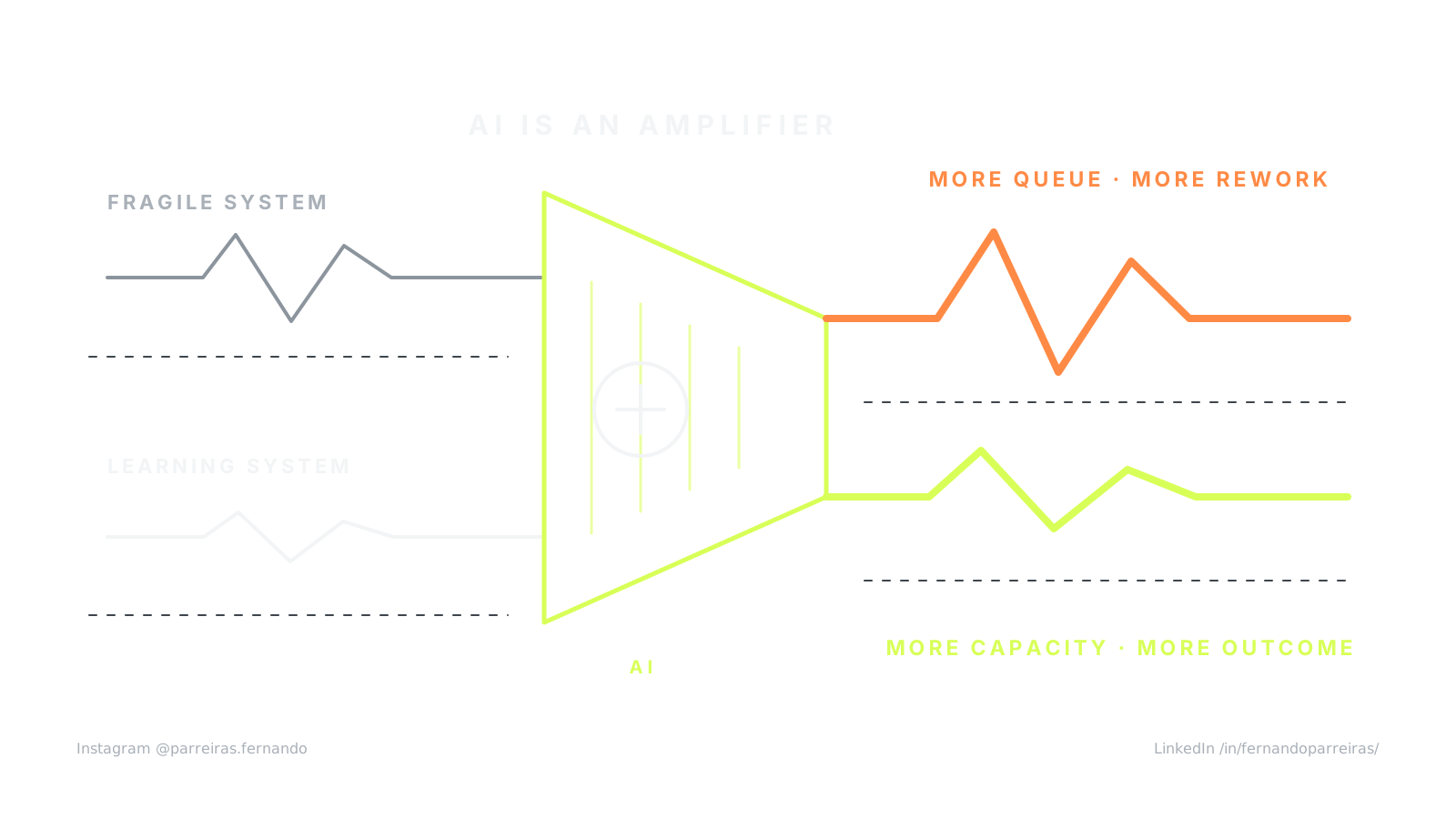
AI finds a working system and amplifies it. When intention, flow, context, verification, accountability and learning are coherent, it can increase capacity and liberate human judgment. When they are broken, it accelerates ambiguity, queues and rework. Mature adoption measures outcome, quality, end-to-end time, total cost, and risk — not just licenses, prompts, or produced artifacts.
There is an alluring promise in adopting AI: install a tool, unlock access, and watch productivity soar. Sometimes the first effect actually seems to confirm this expectation. Texts come out faster, prototypes appear in hours, and entire queues of tasks start moving.
Then comes the second question: did this movement become a result?
If priority changes every day, AI helps produce more work that will become obsolete. If quality is ambiguous, it increases the volume someone will need to review. If data does not have ownership, it combines uncertainties into a confident answer. If learning does not return to the process, each person improves their individual use while the company continues to repeat the same mistakes.
AI does not enter a neutral organization. She finds a working system and amplifies it.
Executive summary
AI capability can increase speed and range, but the value depends on the environment in which it operates. Reports from the DORA program describe AI as an amplifier: it tends to magnify existing strengths and weaknesses in the development system, and the returns depend on organizational practices, not the isolated tool. This evidence is concentrated in software and should not be generalized as a universal law across all professions. [CAREER-A18-C5]
For a company, the practical implication is simple: before measuring adoption, you need to measure whether intent, flow, context, verification, accountability and learning are improving.
A mature deployment doesn’t just ask “how many people use AI?” It asks “which outcome was better, with what quality, cost, risk and correction capacity?”.
Amplification is not automatic transformation
An amplifier increases the signal it receives. It doesn't decide if the signal is good.
In companies, this sign is made up of elements that are less visible than a software license:
- clarity of strategy;
- quality of decisions;
- workflow design;
- access to trusted context;
- authority and responsibility;
- feedback speed;
- discipline to correct the system.
When these elements are coherent, AI can reduce mechanical work and free people to discover, judge, relate and improve. When they are broken, it makes the problem faster and harder to notice.
Transformation requires redesign. The tool is a lever within him.
Six organizational amplifiers
1. Clarity of intent
A team that knows the outcome can use AI to explore paths. A team that receives ambiguous requests will produce rapid variations in ambiguity.
The first investment is not a longer prompt. It's a better definition of the problem: for whom, what change do we expect, what constraint exists, and how will we know it worked.
2. Flow quality
Automating one step does not necessarily improve the entire flow. Code can be generated faster and wait days for review. Content can grow and stall on approval. Proposals can be personalized without the service being able to deliver what was promised.
The gain must be observed from end to end: time until outcome accepted, rework, queue, cost and returned failures. Optimizing the visible part may just shift the bottleneck.
3. Trusted context
AI works with the context it receives. An outdated base, excessive permissions, or inconsistent definitions did not see truth because they were read by a capable model.
Trusted context has source, owner, version, validity and boundary. The company needs to distinguish what is a rule, decision, hypothesis, example and history. Without this, information retrieval becomes contradiction retrieval.
4. Proportional check
The larger the generation scale, the more important the ability to verify without turning everything into a manual queue becomes.
Proportional verification combines automation and judgment. Format, contract, links, security and regression can be tested. Strategic suitability, human impact and irreversible risk continue to call for responsible decisions. The goal is not to review every word; is to make explicit what can be automatically proven and where the human adds real judgment.
5. Accountability
When everyone “used AI,” accountability can become diffuse. The tool did not approve a budget, accept a risk, define a commercial promise or decide to publish.
Each flow needs to hold a person or role accountable for the outcome. AI can search, propose, execute and verify parts. The external or irreversible decision remains linked to an identified authority.
6. Closed learning
A company doesn't learn because it has accumulated conversations. Learn when a correction changes future behavior.
This could be as a test, standard, context update, new policy, training, or retirement of a bad practice. If failure only generates “try again”, the AI increases activity without increasing maturity.
Four Adoption Patterns That Look Like Progress
The race for seats
Number of licenses, active users, and prompts shows access. It doesn't show that the work has improved.
These metrics are useful as a condition for adoption, never as a final outcome. They need to be accompanied by a measure of the flow that you want to change.
The pilot's theater
The pilot is chosen where the demonstration works, not where the company has the baseline, data and ability to operate the solution. The result is impressive, but it does not account for total costs, exceptions, integration, security or maintenance.
A serious pilot states what he needs to learn and what decision will be made later.
The displaced bottleneck
A team produces twice as many artifacts, while review, approval, or deployment maintain the same capacity. “Productivity” becomes idle inventory.
If the total time does not fall and rework increases, there has been a local acceleration, not an improvement in the system.
Policy by conversation
Critical guidance lies in shared training and prompts. There is no control when the context is missing, the model changes or a person ignores the recommendation.
Important policy needs to exist in the environment, in the permit, in the contract or at the gate — not just in the memory of those who were trained.
A 30-day diagnosis
A company can start without a grand plan. Choose a relevant, delimited stream.
Week 1 — baseline
Record volume, total time, waiting, rework, cost and failures. Define the outcome that matters and what cannot get worse. Without baseline, any demo will look won.
Week 2 — borders
Map data, tools, decisions and external effects. Separate what AI can suggest, execute and verify. Name who approves and who can interrupt.
Week 3 — experiment
Perform with a small group and representative tasks, including exceptions. Capture not just time, but fixes, escalations, review cost, and accepted quality.
Week 4 — decision
Compare with the baseline. Decide to expand, adjust or discontinue. Turn learnings into contracts, testing, and shared context before scaling.
The result of the month doesn’t have to be “company-wide AI.” It could be the discovery that an organizational bottleneck needs to be resolved first. This is also value.
The panel that prevents self-deception
A balanced reading combines five dimensions:
| Dimension | Question |
|---|---|
| Outcome | Did the customer, user or team receive something better? |
| Quality | how much was accepted without material rework? |
| Flow | Has the end-to-end time dropped or has the line moved? |
| Economy | What was the total cost, including context, review and operation? |
| Risk | Have failures become detectable, reversible and assignable? |
No single dimension tells the story. Reducing time by sacrificing quality is not productivity. Increasing quality at a cost that is impossible to operate is not scale. Saving without preserving confidence can transfer costs to the future.
The role of leaders
Leadership does not need to choose all models. It needs to design conditions for the organization to learn:
- a clear thesis for each investment;
- baselines before change;
- autonomy proportional to risk and reversibility;
- secure context access;
- independent verifiers where it matters;
- mechanisms to transform failure into improvement;
- freedom to close initiatives that do not generate results.
The best sign of maturity is not permanent enthusiasm. It’s the ability to distinguish where AI helps, where it doesn’t yet, and what the system needs to change.
The role of people
When execution becomes cheaper, human contribution does not disappear. She changes places.
Understanding the problem, selecting context, noticing inconsistency, defining quality standards, negotiating trade-offs and assuming responsibility gain importance. People also need to stay in touch with execution: Delegating everything too soon can take away the tasks from which you learn.
Healthy design uses AI to amplify capability and feedback, not to create a layer of work that no one can explain.
Conclusion
AI amplifies the business you already have. This statement is not pessimistic; it's an invitation to work on the system that makes technology valuable.
A clear organization can explore more. A verifiable organization can delegate more. An organization that learns can correct faster. And a responsible organization can do all this without confusing speed with results.
Before purchasing the next capacity, look at the current flow. The biggest return may not be in asking AI for more, but in better preparing the company that will work with it.
Next reading: Engineering harness in practice, which transforms this thesis into six operational responsibilities.
Editorial and responsibility note
- Research cutoff
- Last review
- Recorded corrections
- No corrections recorded.
The cutoff above applies to the canonical claims. Additional sources and their access dates are identified in the article body.
This article combines cited sources, analysis, and the author's professional experience. Verifiable data and factual statements are linked to their respective sources. Interpretations, hypotheses, projections, recommendations, and opinions represent the author's professional point of view at the time of publication; they do not constitute proven facts, a promise of results, or legal, financial, or technical advice applicable to a specific case. Consult the original sources and qualified professionals before making decisions.
Claims and sources
CAREER-A18-C5
DORA 2025 describes AI primarily as amplifying existing strengths and weaknesses and associates the greatest returns with the organizational system, not just the tools.
Limit: The research focuses on software development; the article uses this formulation as a design principle, not as a universal labor law. This is a source-bound design input; it does not prove product adoption, operational maturity, independent attestation, search ranking, AI citation or outcome.
- Google Cloud DORA — Google Cloud DORA, CC-BY-4.0