
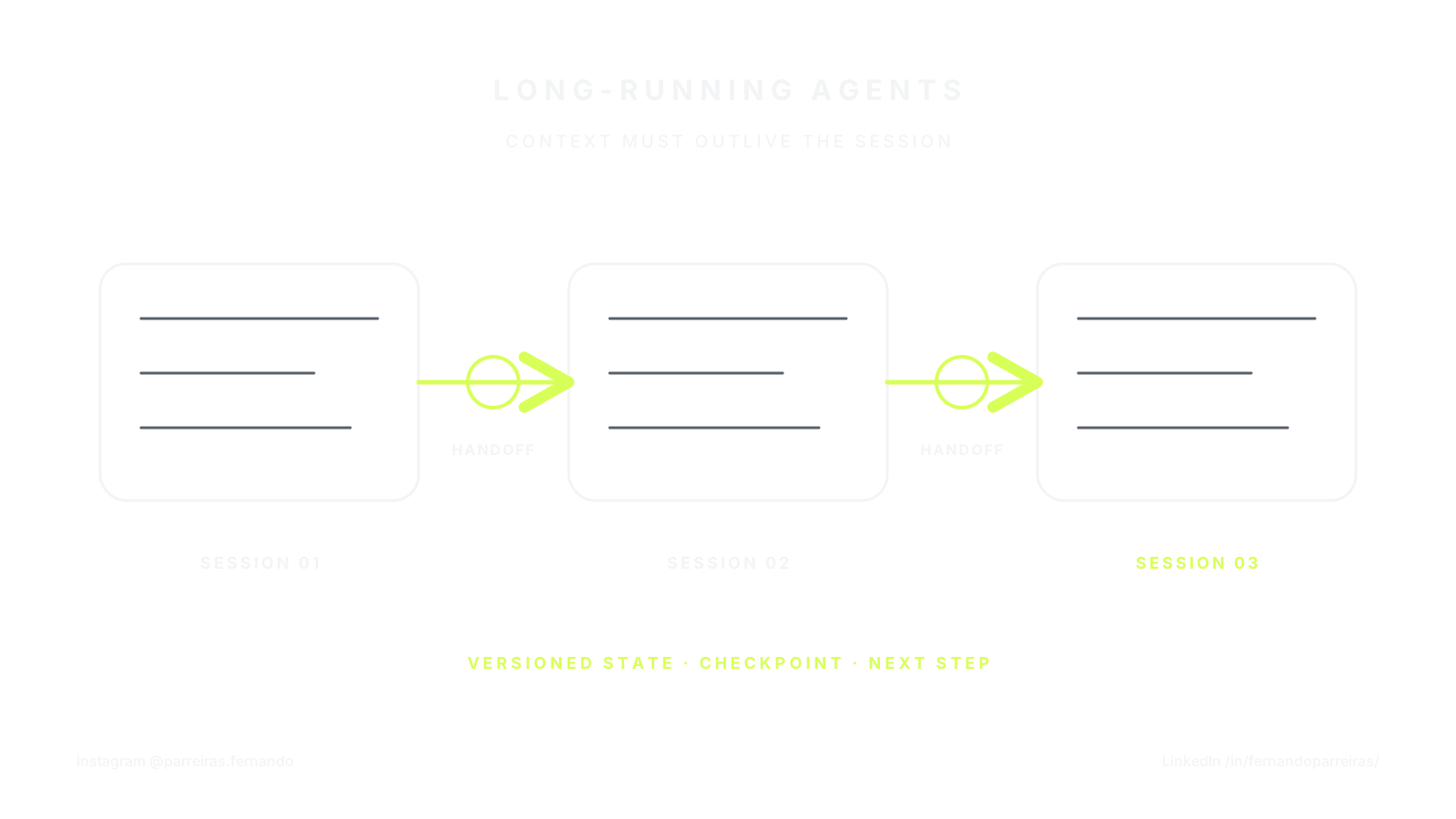
Executive reading · ~60 seconds
Conversation context helps work, but continuity depends on spec, plan, decisions, worktree, evidence and handoff outside the chat, with observable progress and authority.
Long tasks rarely fail just because the model “didn’t know how to program”. They fail because the goal drifts, state is lost, decisions don't survive the session, and the next run reconstructs the work from partial memory.
Conversational context is helpful. It is not a continuity system.
Executive summary
A long-term agent needs five states outside of chat:
| State | Question |
|---|---|
| intention | which result and limit remain valid? |
| work | which asset, branch, environment and task are active? |
| decision | what was chosen, rejected or postponed? |
| evidence | what checks and observations support the state? |
| continuity | What is the next step and how to resume it? |
The harness must maintain session history, orchestration policy, and execution isolation as explicit boundaries. Model, plugin or channel cannot cross the security boundary. [HARNESS31-C2]
The continuity problem
Window is not durable memory
A large window carries more information, but still mixes decisions, attempts, noise and current state. When the context is compressed or reset, important details may disappear.
Summary is not handoff
“I worked on the backend and there are no tests” does not allow resuming. A handoff needs to point to subject, state, evidence, lock and check command.
Repository is not flat
Git preserves changes, it doesn't explain why they exist, what hypothesis is being tested, or what work remains outside the commit.
Loop is not progress
Running continuously can repeat the same approach, increase diff and hide that no acceptance criteria were met.
Continuity artifacts
Spec versioned
Defines outcome, scope, non-scope, invariants and criteria. Material changes require a new version or decision, not silent adaptation by the executor.
Addressable plan
Decomposes work into verifiable slices. Each item has a state, dependency, owner and completion criteria. The plan is coordination; does not replace the product.
Decision log
Records context, options, choice, consequence and supersession. Prevents a new session from reopening a decision without new evidence.
Worktree and branch
Isolate competing changes and make the session recoverable. Worktree reduces file collisions; does not control network, secret, data or permission.
Evidence ledger
Preserves tests, logs, screenshots, digests and limits linked to the subject. Without binding, the next session may rely on green from another commit or environment.
Handoff
A minimal handoff responds:
objetivo | estado | mudou | não mudou | evidência | risco | próximo passo | retomadaA session contract
When starting:
- synchronize external state;
- read spec, decisions and WIP;
- confirm branch, worktree, seat and subject;
- choose a limited slice;
- declare checks before implementing.
During:
- preserve changes from the user and other agents;
- update the plan by actual status;
- record material assumptions and failures;
- limit attempts and escalation;
- do not promote maturity through proximity.
When closing:
- perform proportional verification;
- describe what is implemented, verified and operating;
- residual register and blockages;
- leave reproducible commands;
- release lock only when the handoff exists.
Context reset, compression and new session
These strategies solve different problems:
| Strategy | Advantage | Risk |
|---|---|---|
| compaction | preserves continuity with fewer tokens | summarizes error and noise together |
| context reset | offers clean reading with handoff | loses unmaterialized nuance |
| new specialized session | separates role and incentive | increases coordination |
A Anthropic long-term harness research describes incremental progress and artifacts for traversing windows. It is an empirical design of a supplier and task; not a universal standard.
Progress needs to be observable
Measure more than execution time:
- criteria satisfied by slice;
- introduced regressions;
- rework rate between sessions;
- handoffs resumed without reconstruction;
- decisions reopened without evidence;
- cost and latency per outcome;
- interventions and escalations.
An agent can run for hours and make little progress. Another may stop early because it found the right gate. Duration is neither autonomy nor value.
More agents can make things worse
Planner, generator and evaluator can improve a given task and also increase cost and latency. An experiment published by Anthropic found this trade-off in a long application; FORGE requires eval and ablation per task before making layers mandatory. [HARNESS31-C3]
Before adding paper, ask:
- which flaw does it reduce?
- What authority does it have?
- How will your contribution be evaluated?
- which state shares?
- What happens when you disagree?
- What is the marginal cost?
Contractless orchestration turns parallelism into coordinated noise.
Long-term failures
| Failure | Signal | Guardrail |
|---|---|---|
| aim drift | diff grows without criteria | spec + slice gate |
| loss of state | repeat discovery | addressable handoff |
| accumulated authority | executor changes the criteria | separate approver |
| infinite loop | same attempts | budget + escalation |
| old context | superseded font | validity + refresh |
| offset green | testing another asset | subject digest |
What this article proves — and what it doesn't prove
Public experiments show that decomposition, artifacts, and handoff can improve long tasks in specific settings. They also expose cost, latency, and model dependency. They do not prove that more agents, more context, or unsupervised execution are always superior.
FORGE describes continuity contracts. Its effectiveness needs to be verified by product and risk.
Conclusion
The challenge of a long task is not keeping a model talking. It's about maintaining coherent intent, state, authority, and evidence when models, sessions, and people change.
Chat memory helps to work. Durable artifacts allow work to survive.
Previous reading: The model is not the system. Next suggested reading: Graph, loop or hybrid?.
Editorial and responsibility note
- Research cutoff
- Last review
- Recorded corrections
- No corrections recorded.
The cutoff above applies to the canonical claims. Additional sources and their access dates are identified in the article body.
This article combines cited sources, analysis, and the author's professional experience. Verifiable data and factual statements are linked to their respective sources. Interpretations, hypotheses, projections, recommendations, and opinions represent the author's professional point of view at the time of publication; they do not constitute proven facts, a promise of results, or legal, financial, or technical advice applicable to a specific case. Consult the original sources and qualified professionals before making decisions.
Claims and sources
HARNESS31-C2
A durable harness should maintain session history, orchestration policy and execution isolation as explicit boundaries, while adapters and plugins prevent model or channel choice from becoming the security boundary.
Limit: The sources show two implementations, not a neutral interoperability standard. Actual permissions must be independently enforced and tested outside model choices. This is a source-bound design input; it does not prove product adoption, operational maturity, independent attestation, search ranking, AI citation or outcome.
- Anthropic — Anthropic, proprietary-site-terms
- YC Software —YC Software, MIT
- YC Software —YC Software, MIT
HARNESS31-C3
Anthropic reports that planner, generator and evaluator layers improved a long-running application result while materially increasing cost and latency; FORGE should require task-specific evals and ablation before making such layers mandatory.
Limit: This is a provider experiment tied to a selected model, benchmark and application task; it cannot prove universal superiority of multi-agent or evaluator layers. This is a source-bound design input; it does not prove product adoption, operational maturity, independent attestation, search ranking, AI citation or outcome.
- Anthropic — Anthropic, proprietary-site-terms