
Executive reading · ~60 seconds
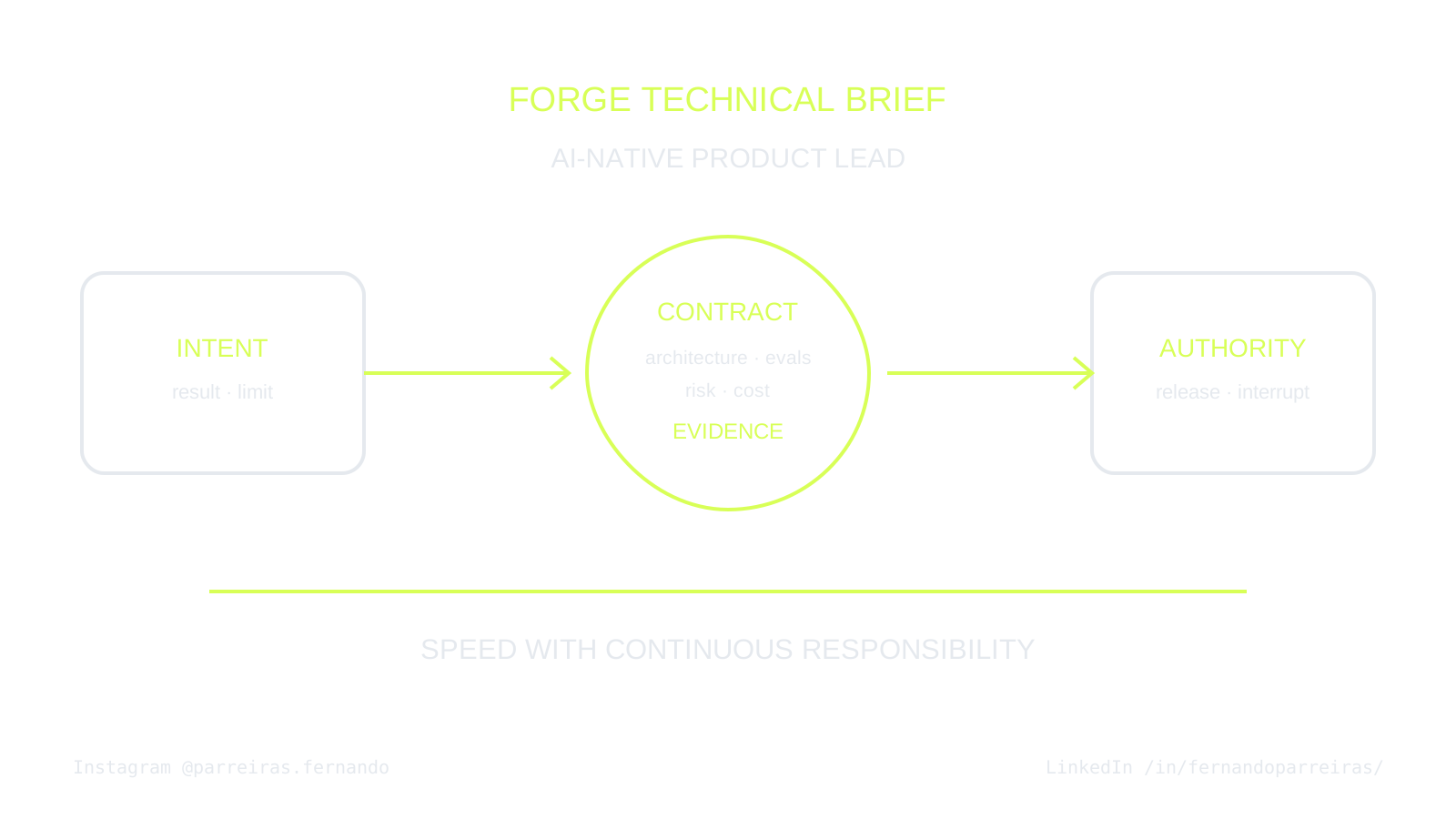
Agent-built products quickly come to functional demonstrations, but they still need someone who keeps connected result, behavior, architecture, evidence, cost and authority. This brief proposes the AI-Native Product Lead as responsible for the continuity of these decisions, without replacing engineering, data, security, operation or human release authority.
A product built with agents can quickly reach a functional demonstration. Speed does not respond to those who defined success, which limits were applied, which failures were measured, how much it costs to operate and who has the authority to release or interrupt the system.
This brief proposes a role to keep these decisions connected: Technical Product Owner, here treated as AI-Native Product Lead.
State: technical proposal approved for publication. Title is neither a regulated profession nor a universal classification. The controls and artifacts described below do not themselves represent capabilities implemented or operated by Trustyu Forge. There was no empirical validation of this proposal as an organizational design.
Paper is not a new layer of ceremony
O Scrum Guide assigns Product Owner the responsibility for maximizing the value of the product and managing its goal and backlog. It does not require the same person to be an architect, data scientist, responsible for security or system operator.
This proposal preserves this separation. The AI-Native Product Lead does not replace the specialties. He keeps a verifiable contract between:
- the result that the business expects;
- the behaviour that the product must and must not exhibit;
- the technical system performing the task;
- the evidence necessary to release a version;
- the human authority that accepts the residual risk.
In a small team, the same person can accumulate functions. The accumulation needs to be declared. A single person performing product, architecture, implementation and approval should not be described as function segregation or independent review.
The market shows convergence, not standardization
O AI Index Report 2026, from Stanford, recorded an increase of 111% in the references to AI skills in AI vacancies between 2024 and 2025 and identified the emergence of skills related to agents and orchestration. O LinkedIn Economic Graph reported an increase of more than 70% per year in the vacancies that requested AI literacy in its 2025 cut.
Public spaces also fragment the work. OpenAI describes a Product Manager, API Agents who works technically with research and engineering, user needs, security and agent infrastructure. The position of Product Manager, Safety Measurement connect product, statistics, damage measurement and leadership decisions. Anthropic lists product related functions, model behavior, code, search and safeguards in its career page.
These data do not constitute a census of the profession. Vacancies can change, reflect specific companies and carry hiring interests. The editorial inference is limited: the market begins to combine product, technique, evaluation and governance, but has not yet consolidated a single title or scope.
The unit of responsibility is the system, not the prompt
An AI-Native product includes more than model and instruction. It may include context recovery, memory, tools, permissions, queues, state, policies, verifiers, human intervention and observability.
So the backlog needs to connect to a system contract. A story such as “the agent should analyze the request” does not define:
- what data the agent can use;
- what tools you can call;
- which shares are reversible;
- what material result proves conclusion;
- how the team measures variation between attempts;
- which failure requires blocking, revision or fallback;
- which model version, prompt, tool and policy was evaluated.
The AI-Native Product Lead must ensure these questions enter the product cycle. Engineering, security, data and operations remain responsible for their specialist decisions. Evidence about harnesses and assisted-development practices supports the need to control the system around the model, but does not prove a universal team design or the operational maturity of a specific product. [R1-C1]
Six minimal artifacts
1. Product Intent Contract
The intention contract describes problem, affected population, supported decision, expected result, baseline, hypothesis and conditions of disposal.
| Field | Question |
|---|---|
| Problem | Which decision or job needs to be improved? |
| User and affected party | Who uses, who gets the effect, and who can be harmed? |
| Result | What observable change justifies the product? |
| Baseline | How does the process work today and at what cost or quality? |
| Limit | What use does not belong to the scope? |
| Discard | What evidence would cause the team to interrupt the hypothesis? |
The artifact doesn't have to be a long document. You need to have a version, a responsibility, and a bond with the evidence that supports the decision.
2. System and Authority Map
The map identifies components, data, models, tools, identities, permissions and human authorities. For each relevant action, record who can propose, execute, approve, interrupt and recover.
O NIST AI RMF organizes risk management in governing, mapping, measuring and managing throughout the life cycle. O profile for generative AI adds suggested actions related to privacy, intellectual property, validity, security and transparency. They are voluntary references; their mention does not demonstrate conformity or certification.
For agency applications, the OWASP Top 10 for Agent Applications 2026 offers an initial risk taxonomy. A list of risks does not replace threat modeling, testing, access control or legal analysis in the real context.
3. Eval Plan linked to the requirement
The evaluation needs to measure the agent and the harness in the relevant environment. The orientation of Anthropic in Demystifying evals for AI agents distinguishes task, trial, grader, trajectory, result and harness. It recommends capability and regression evals, repeated trials and verification of the final state.
This is a supplier reference, based on your experience and customers. It does not constitute independent validation. Nevertheless, it offers a useful operational principle: product requirement should be translated in case of evaluation.
The minimum plan records:
- case population and source of examples;
- common, critical, border and prohibited scenarios;
- number of attempts per case when there is variability;
- code, model and human graders, with known limitations;
- metric, baseline, threshold and uncertainty interval;
- expected material result, not only the reply declared by the agent;
- model version, prompt, tools, data and environment;
- known failures and coverage still absent.
Starting with 20 to 50 fault-derived cases and real requirements can be useful in the initial stage, according to Anthropic's practical guidance. This interval is not a universal statistical rule and may be insufficient for small effects, heterogeneous populations or high-risk uses.
4. Quality, latency and cost budget
A product decision needs to show the trade-off between quality, time and economy. “Cost per token” does not represent total cost.
Register at least:
- Cost per task initiated and per task completed with quality;
- median and tail latency;
- intervention rate and human time;
- failures, retries and wasted consumption;
- cost of observability, evaluation and storage;
- model or supplier exchange impact;
- margin or benefit associated with the flow.
O DORA State of AI-assisted Software Development 2025 describes AI as an amplifier of the existing forces and weaknesses of the organization. The report is an observational research and does not prove causal to a specific product. The implication used here is prescriptive: generation speed should be evaluated along with stability, quality and working system.
5. Release Decision Record
Each relevant release shall answer:
- which version was evaluated;
- against which criteria;
- with which results and limitations;
- what residual risk remains;
- who authorized the exhibition;
- which rollback or fallback is available;
- which will be observed after release.
Green tests don't mean observed operation. A release record also does not prove that the decision was correct; it makes the decision reconstructable.
6. Learning and Incident Ledger
After release, changes in behavior, cost, context and use need to return to the product. The ledger records incidents, interventions, false positives, regressions, model changes, new cases of evaluation and decisions to discontinue.
The goal is not to create an event file without consequence. Each relevant finding should point to a change, an explicit acceptance of risk or a decision not to act.
The proposed operational cycle
dor observada
    ↓
contrato de intenção
    ↓
mapa de sistema e autoridade
    ↓
protótipo limitado
    ↓
evals + budget + revisão especializada
    ↓
decisão humana de release
    ↓
observação, incidente e aprendizagem
    └───────────────────────────────↺
AI-Native Product Lead coordinates cycle continuity. He does not need to run all the steps alone or have automatic authority over all domains.
Matrix of responsibilities
| Decision | AI-Native Product Lead | Engineering/Architecture | Data/ML | Safety/Privacy | Operation/SRE | Release authority |
|---|---|---|---|---|---|---|
| Problem, result and priority | Responsible | Consulted | Consulted | Consultation at risk | Consulted | Informed |
| Architecture and integration | Consulted and co-responsible for product impact | Responsible | Consulted | Consulted | Consulted | Informed |
| Data, model and technical evaluation | Responsible for product criteria | Consulted | Responsible | Consulted | Consulted | Informed |
| Access and risk limits | Consultation | Consulted | Consulted | Responsible | Consulted | Informed |
| SLO, observability and recovery | Consultation | Consulted | Consulted | Consulted | Responsible | Informed |
| Release and residual risk | Prepares the decision | Issues technical evidence | Issues evidence of model/data | Issues applicable risk opinion | Issue operational readiness | Authorisation holder |
This matrix is an example. The organisation must adapt it to the legal context, risk and real structure. In solo business, columns may represent the same person; the absence of independence must remain explicit.
Definition of Done for an AI-Native product
A feature is not ready just because it generated a correct output in a demo. The Definition of Done proposal includes:
- defined results and population of use;
- data, models, tools and versions identified;
- documented quality and failure criteria;
- evaluations carried out in the applicable environment;
- preserved results, denominators and limitations;
- minimum permissions and delimited sensitive actions;
- cost, latency and intervention within the approved budget;
- enough logs and signals to investigate flaws, respecting privacy;
- fallback, interruption and exerciseable recovery;
- identified operational responsibility and release authority;
- change linked to artifact or version effectively released.
Not every item has the same weight in every product. Safety, legality and rights requirements should not be compensated for by a high quality average.
Metrics that prevent illusion of productivity
The AI-Native Product Lead needs to separate five dimensions:
| Dimension | Examples |
|---|---|
| Result | useful conversion, client cycle time, resolution, revenue or cost avoided |
| Quality | success by case, critical failure, regression, human calibration |
| Reliability | availability, tail latency, retry, recovery |
| Security and control | action blocked, intervention, privilege, incident, exposure |
| Economy | cost per useful task, cost of supervision, margin, cost of failure |
A reduction in generation time does not prove increased productivity. METR found 19% increase in completion time in an experiment with 16 experienced developers and tools from the beginning of 2025. A later collection suggested gains, but the organization declared selection bias and insufficient measurement. These results are not contradictory when treated as tool cuts, people and different tasks.
The role needs to preserve context, population, denominator and uncertainty before assigning causality to AI.
Anti-patterns
Probabilistic Backlog Owner Product
Translating orders into tickets without defining cases, metrics and limits maintains the ceremony and loses responsibility.
Vibe coding as architecture
A prototype can reduce uncertainty. It does not prove scalability, security, continuity or sustainable cost.
Evals written only by the generator
The same system can help propose tests, but that doesn't create independence. Critical criteria need review and negative cases capable of countering the solution.
Framework as certification
Using NIST, OWASP or FORGE as vocabulary does not demonstrate that controls have been implemented or are effective.
Position-hero
A description that requires product, engineering, ML, security, legal and in-depth operation creates a unique point of failure. The role shall coordinate decisions and recognise borders of authority.
How to experience the function without reorganizing the entire company
Choose a single stream Authorized AI-native and run a six-week cycle:
- register baseline and business result;
- Name one person to keep the six artifacts;
- declare experts and release authority;
- create assessments from failures and real requirements;
- release limited exposure with defined recovery;
- compare result, quality, cost, intervention and incidents;
- record what the function solved and what just shifted.
Experience does not prove that the design serves the whole organization. It can reveal whether the current problem is lack of ownership, lack of technical depth, insufficient architecture, conflicting incentives or simply a product without demand.
The contribution to FORGE
In Trustyu's reading, AI-Native Product Lead can function as the person who maintains the link between product intent, executable contracts, engineering evidence and release decision.
That's a fitting proposal. It does not mean that Forge created or certifies the profession, which already has automation for all the artifacts presented or which guarantees products without faults and without legacy.
The value of the role should be assessed by the quality of the decisions that make possible: what to build, how to prove, when not releasing and who responds afterwards.
Sources and editorial context
- Scrum Guide 2020. Official definition of Product Owner in Scrum; does not define Technical Product Owner or AI-Native Product Lead.
- Stanford HAI — AI Index Report 2026. Summary of multiple sources; data of vacancies depend on taxonomies and geographies.
- LinkedIn Economic Graph — AI Labor Market Update. Platform data, not global census.
- OpenAI — Product Manager, API Agents and Product Manager, Safety Measurement. Vacancies consulted on 01/09/2026; can be changed or removed.
- Anthropic — Careers and Demystifying evals for AI agents. Source of supplier with commercial interest; practices do not equal the independent standard.
- NIST — AI RMF Core and Generating AI Profile. Voluntary references, not certification.
- OWASP — Top 10 for Agent Applications 2026. Community guide, no proof of security.
- DORA — State of AI-assisted Software Development 2025. Observational research; does not establish causality for a specific product.
- METR — productivity of experienced developers and methodological update. Contextual evidence, with limitations of sample and selection declared.
Editorial and responsibility note
This text combines data attributed to the sources with analysis and technical design proposed by the author. “Technical Product Owner” and “AI-Native Product Lead” are editorial nomenclatures for a convergence of responsibilities; they are not regulated profession, universal academic classification or capacity certified by Trustyu. Personal and professional views should not be confused with proven facts; when there are data, the source, cutout and limitations are indicated. The content is informative and does not replace technical, legal, labor, financial or specific security assessment. Tech Human and Trustyu work commercially on related topics. Research, structure and writing received AI assistance; the publicable version received factual review, authorial review and editorial approval on 02/09/2026, without independent human review.
Search cut: 01/09/2026. Editorial status: special publication brought forward by explicit decision to 02/09/2026 at 09h24 BRT.
Editorial and responsibility note
- Research cutoff
- Last review
- Recorded corrections
- No corrections recorded.
The cutoff above applies to the canonical claims. Additional sources and their access dates are identified in the article body.
This article combines cited sources, analysis, and the author's professional experience. Verifiable data and factual statements are linked to their respective sources. Interpretations, hypotheses, projections, recommendations, and opinions represent the author's professional point of view at the time of publication; they do not constitute proven facts, a promise of results, or legal, financial, or technical advice applicable to a specific case. Consult the original sources and qualified professionals before making decisions.
Claims and sources
R1-C1
Reliable agentic delivery is a system property: the workflow, workspace lifecycle, feedback loop and organizational platform must be explicit rather than left inside a model prompt.
Limit: Public descriptions do not expose internal reliability distributions or comparable production SLOs. This is a research-synthesis design input; it does not prove product adoption, operational maturity, independent attestation or outcome.
- OpenAI — OpenAI, Apache-2.0 repository; analysis-only excerpts
- Google Cloud DORA — Google Cloud DORA, Public research page; analysis-only excelpts