
Executive reading · ~60 seconds
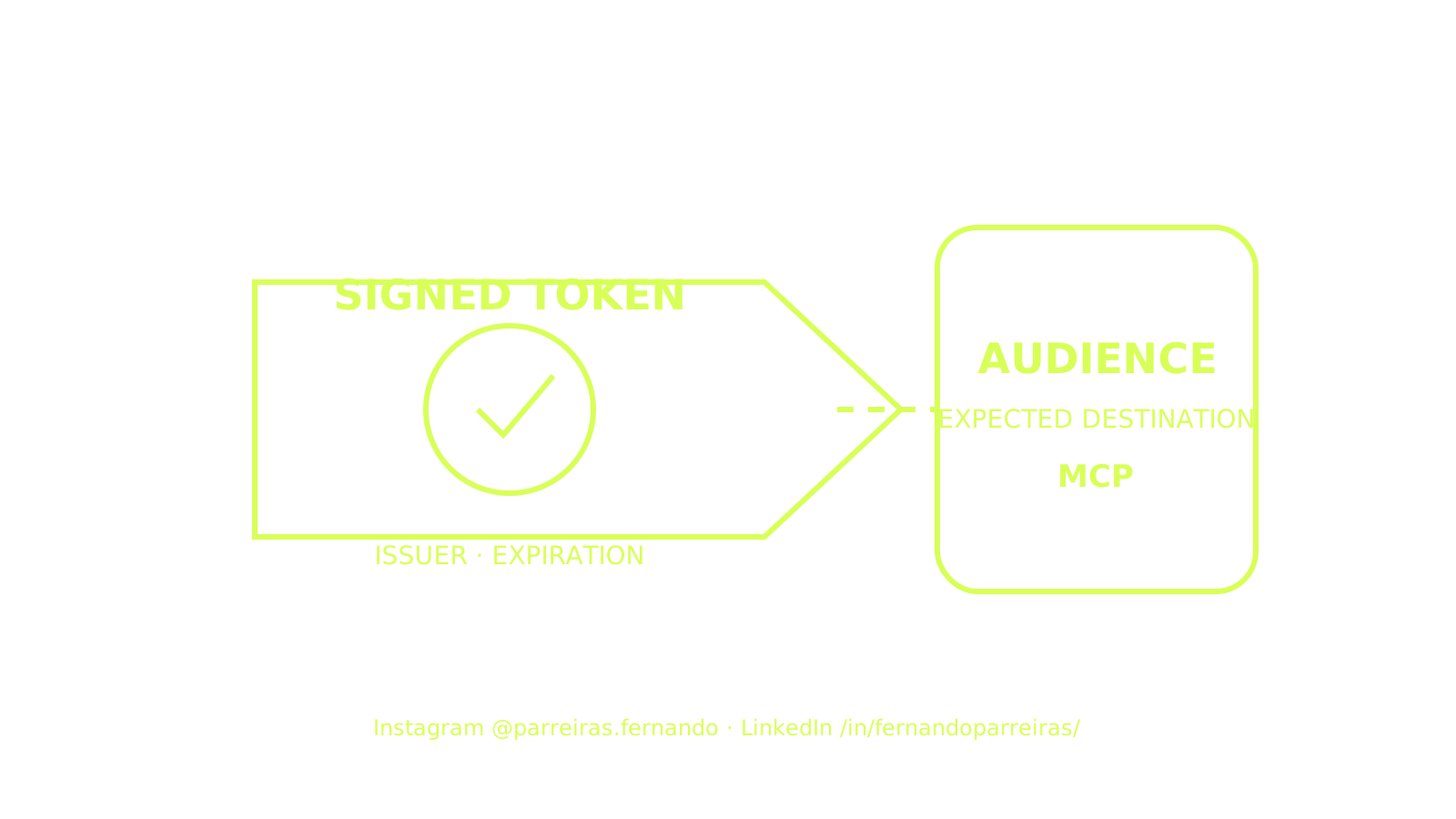
CVE-2026-115413 affected AWS API MCP Server versions from 1.3.0 up to, but not including, 1.6.0 in a specific OAuth mode. The server validated signature, issuer, and expiration, but not the token's destination application.
A token may have a valid signature, a trusted issuer, and a current lifetime—and still have been issued to another application. CVE-2026-115413, acknowledged by AWS in AWS API MCP Server, shows why audience validation is part of authentication, not an optional detail.
Status: Evidence Brief approved for publication. Editorial series: Papers we read for you. The text avoids payloads, credentials, targets, and exploitation instructions.
Affected range and required condition
The official bulletin states that versions 1.3.0 and later, but earlier than 1.6.0, were affected when the server used HTTP transport with OAuth. The implementation validated signature, issuer, and expiration but did not confirm the destination application. A token issued by the same identity provider to another client in the tenant could therefore be accepted by the server.
The potential consequence also depended on the credentials configured on the MCP host. The bulletin provides no installed-base denominator, does not state that every deployment used OAuth, and presents no evidence of active exploitation. The record therefore does not support a prevalence estimate.
Official response and fixed version
AWS released the fix in version 1.6.0 and recommended upgrading. For OAuth operators, the bulletin also calls for explicitly configuring the expected audience or the client identifier when the provider does not issue an audience claim. PyPI records version 1.6.0 on October 27, 2026.
Upgrading the package is necessary, but the operational receipt must observe the environment: loaded version, identity configuration, expected audience, host credentials, and flow regression.
What audience proves
A signature proves that the token came from an authority that holds the key. Issuer limits which authority is accepted. Expiration limits time. Audience binds the token to the service for which it was issued. Without that final link, different applications in the same tenant may share trust that was never intended.
In the Forge canon, minimum identity, explicit capability, and provenance are complementary controls. This guidance does not prove adoption, effectiveness, or certification in a specific deployment. [R2-C3]
Acceptance contract for OAuth in MCP
| Question | Minimal evidence | What it does not allow us to conclude |
|---|---|---|
| Who issued the token? | allowed issuer and validated signature | that the token is intended for the service |
| For which application was it issued? | expected audience or client ID | that scopes are minimal |
| What power reaches the host? | effective identity and denied actions | that every call will be legitimate |
| Which version is active? | observed package and process | that every environment was fixed |
| How is trust withdrawn? | rehearsed revocation, expiration, and rotation | that no earlier incidents occurred |
Proportional controls
- upgrade to 1.6.0 or a compatible later version and verify the running version;
- configure the expected audience or client ID according to the identity provider;
- reject a token without the required claim or with a mismatched recipient;
- separate clients and credentials by environment and purpose;
- reduce host credentials to the smallest necessary set of actions;
- test valid tokens intended for another client as cases that must be denied;
- record authentication decisions without persisting complete tokens;
- track the bulletin, dependencies, and forks that may not include the fix.
Limits, conflict of interest, and counterpoint
The primary source is AWS itself, maintainer of the server and provider of the services it accesses. AWS has a direct commercial and reputational interest, although the bulletin is also the primary source for the affected range and fix. NVD analysis was pending at the editorial cutoff; secondary metrics do not replace deployment context. We did not reproduce the condition or find complete independent validation of the fix.
PyPI states that AWS API MCP Server has been superseded by the official AWS MCP server. This product change does not remove the duty to inventory older versions, forks, and derivatives still in use.
Engineering rule
A valid token is not necessarily valid for you. Every OAuth integration must bind issuer, recipient, scope, effective identity, and resource before allowing an agent to reach actions in the real system.
Direct sources
- Bulletin 2026-152-AWS, AWS.
- CVE-2026-115413, NVD.
- awslabs.aws-api-mcp-server 1.6.0, PyPI.
- AWS API MCP Server, official repository.
Editorial and responsibility note
This text combines facts attributed to sources with the author's analysis and technical proposal. Personal and professional views are not proven facts; versions, conditions, and limits are stated when available. The content is informational and does not replace technical, legal, regulatory, or security assessment. AWS, MCP, NVD, PyPI, and other brands belong to their respective owners; there is no sponsorship or endorsement. No offensive procedure is reproduced. Tech Human and Trustyu operate commercially in digital-product development and governance. Research, structure, and writing received AI assistance; Fernando Parreiras authorized the topic, factual self-review, and publication on October 31, 2026, without additional independent human review.
Research cutoff: October 31, 2026. Editorial status: special Evidence Brief authorized for November 6, 2026 at 09:00 BRT.
Editorial and responsibility note
- Research cutoff
- Last review
- Recorded corrections
- No corrections recorded.
The cutoff above applies to the canonical claims. Additional sources and their access dates are identified in the article body.
This article combines cited sources, analysis, and the author's professional experience. Verifiable data and factual statements are linked to their respective sources. Interpretations, hypotheses, projections, recommendations, and opinions represent the author's professional point of view at the time of publication; they do not constitute proven facts, a promise of results, or legal, financial, or technical advice applicable to a specific case. Consult the original sources and qualified professionals before making decisions.
Claims and sources
R2-C3
Least privilege, isolated execution and supply-chain provenance are complementary controls; no substitutes for the others in an agentic system.
Limit: The exact control profile remains environment-specific and must be threat-modeled per product. This is a research-synthesis design input; it does not prove product adoption, operational maturity, independent attestation or outcome.
- OpenAI — OpenAI, Apache-2.0 repository; analysis-only excerpts
- OWASP Foundation — OWASP Foundation, CC-BY-SA-4.0 standard; analysis-only excerpts
- OpenSSF SLSA — OpenSSF SLSA, CC-BY-4.0 specification; analysis-only excerpts