
Executive reading · ~60 seconds
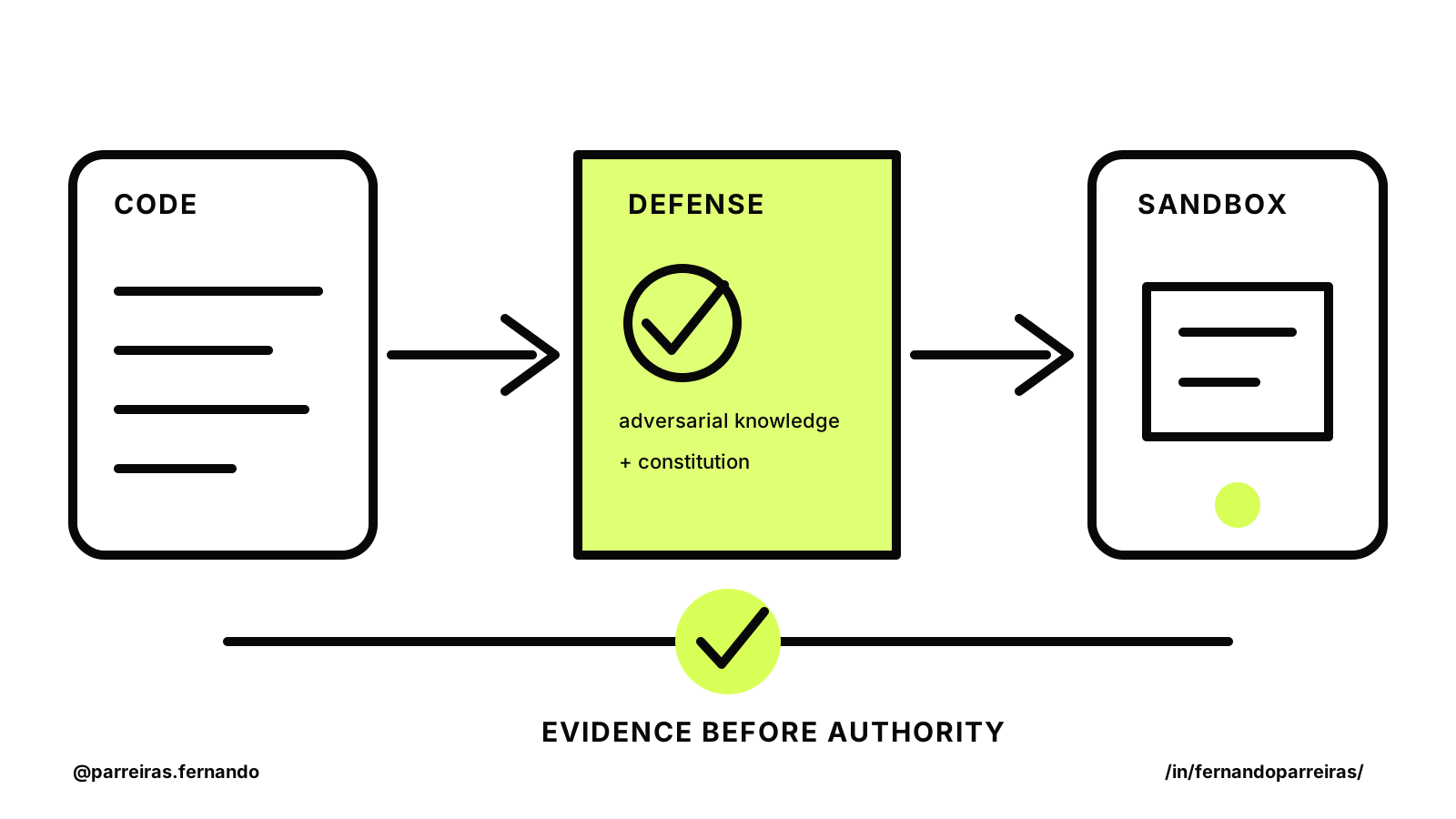
BlueCodeAgent turns examples produced by red teaming into defensive knowledge and, for vulnerable code, combines static analysis with executable tests in a sandbox. The final paper reports a 14.7% average F1 gain with GPT-4o, but the result remains limited to the benchmarks studied. The architectural decision is to separate generation, adversarial knowledge, test execution, release decisions, and human accountability.
A model can read code, recognize vulnerability patterns, and still fail in two opposite ways: let something dangerous pass or block safe code through excessive caution. BlueCodeAgent, published in the final ICML 2026 proceedings, proposes an architecture to reduce that gap.
The most important point is not to replace a human reviewer with another model. It is to turn knowledge accumulated through red teaming into defensive context and, when the property can be executed, require dynamic evidence before the decision.
Status: Evidence Brief approved for publication. This text analyzes the paper and public repository. It does not claim that Trustyu Forge reproduced the experiments, that the system is deployed in Trustyu products, or that the result transfers automatically to production.
The final result — and the discrepancy between pages
In the final ICML 2026 proceedings, the authors evaluate four tasks: biased-instruction detection, malicious-instruction detection, vulnerable-code detection, and prompt injection. With GPT-4o as the base model, the final abstract reports a 14.7% average F1 improvement over direct prompting across the four tasks. [BLUECODE-C1]
A Microsoft Research page still presents an earlier version: a 12.7% improvement, four datasets, and three tasks. This analysis uses the final proceedings record — 14.7% and four tasks — and documents the discrepancy to avoid mixing study versions.
F1 combines precision and recall. A relative improvement or gain in F1 points does not, by itself, tell us how many incidents would be prevented in production. The denominator, class distribution, baselines, and cost of false positives must accompany the number.
How BlueCodeAgent organizes the defense
O official repository describes three layers. First, the system retrieves similar examples from a knowledge base built through automated red teaming. Then, a model summarizes this material into actionable constitutions to guide classification. Finally, for the vulnerable-code task, static analysis proposes the flaw, a component generates executable tests, the sandbox runs them, and a final step combines reasoning, results, and constitution.
This design separates functions that often appear mixed into a single prompt:
- Adversarial discovery: produce difficult cases and record how the defense failed.
- Risk memory: preserve examples, provenance, category, and context.
- Decision principles: convert retrieved examples into criteria applicable to the current case.
- Artifact analysis: examine an instruction or code without producing effects in the real environment.
- Dynamic validation: generate and run tests in a restricted sandbox when this reduces ambiguity.
- Authority: decide whether the finding blocks, requests review, or allows progress.
The architecture does not eliminate judgment. It makes explicit where each kind of evidence originates and which component has authority to produce an effect.
Adversarial knowledge must be governed
A red-teaming knowledge base ages. Attacks change, libraries change, models change, and examples may carry dangerous data, restrictive licenses, or instructions that should not reach every executor. Ungoverned retrieval can improve a benchmark while expanding the exposure surface.
A minimum contract for this memory includes:
| Field | Control question |
|---|---|
source | Where did the case come from, and what use is permitted? |
risk_class | Which security property does it represent? |
affected_surface | Which language, library, tool, or model is in scope? |
observed_at | When was the failure observed? |
evidence | Which artifact allows the finding to be reconstructed? |
review_after | When must the case be revalidated? |
access_policy | Who can retrieve the content, and for what purpose? |
Retrieval must also record which examples influenced the decision. Without that, a generated constitution is a plausible explanation, not a reproducible trail.
Dynamic validation is not unrestricted code execution
The benefit of dynamic analysis comes with a condition: potentially hostile code must run inside a boundary designed to fail safely. Default-denied networking, an ephemeral file system, no useful credentials, CPU and memory limits, timeout, a pinned image, external logging, and verifiable disposal are harness requirements, not implementation details.
The repository itself uses Docker for the vulnerability task. This is evidence of a research implementation, not isolation certification. A container should not be treated as synonymous with a sufficient sandbox for every adversary. The organization must model threats, test relevant escapes, and define what happens when the verifier stalls, disagrees, or cannot execute the case.
A technical gate for AI code review
Before allowing an AI reviewer to influence a merge or release, the team can require:
- Does the finding identify the file, line, violated property, and reproducible evidence?
- Was the classifier measured on the relevant code type, language, and distribution?
- Are false positive, false negative, and inconclusive separate states?
- Do dynamic tests run outside the development environment and without useful credentials?
- Does the adversarial knowledge base have provenance, licensing, validity, access control, and versioning?
- Is the evaluated artifact bound to the commit and digest that will be promoted?
- Do protected rules prevent the agent itself from waiving checks or changing the gate?
- Does an accountable person approve residual risk in proportion to the consequence?
The useful output is not ‘safe.’ It is a package containing the finding, evidence, limitations, component versions, test results, and an authority decision.
What the paper proves — and what it does not
The paper provides experimental evidence that the proposed combination outperformed the baselines studied in the reported benchmarks. The code and part of the data are public, which improves inspectability and reproducibility. The malicious-code subsets remain under controlled access, in line with the licenses and impact described by the authors.
This is not equivalent to a complete independent replication. The study does not measure continuous operation in enterprise repositories, latency and cost at scale, developer impact, resistance to prolonged adversarial adaptation, coverage of real-world languages, or incident reduction after deployment.
Nor does it authorize turning 14.7% into a commercial promise. The metric is an average under experimental conditions with GPT-4o as the base. Another model, risk knowledge base, class balance, or decision policy may produce a different result.
Limitations, counterpoints, and conflicts
- The paper and repository were produced by the method's authors; as of the 01/10/2026 cutoff, no complete independent reproduction of the final results was located.
- The knowledge base uses material derived from red teaming; its performance depends on how closely retrieved risks match the cases being evaluated.
- Dynamic analysis appears specifically in the vulnerable-code task, not as a universal mechanism for all four tasks.
- The public repository improves auditability, but some malicious data is restricted and full reproduction requires compatible models, keys, Docker, and conditions.
- The Microsoft Research page and the final proceedings differ on tasks and average gain; this version gives precedence to the final conference record.
- The controls in this brief are a professional proposal derived from the evidence, not causal results measured by the paper.
Direct sources
- PMLR — BlueCodeAgent: A Blue Teaming Agent Powered by Automated Red Teaming for CodeGen AI. Final record in the Proceedings of the 43rd ICML, four tasks, and a 14.7% average F1 improvement with GPT-4o.
- Official BlueCodeAgent repository. Implementation, data structure, evaluation scripts, sandbox, and access limits for the malicious subsets.
- Microsoft Research — BlueCodeAgent. Institutional page that still reports 12.7% and three tasks; retained as a record of the version discrepancy.
Editorial and responsibility note
This text combines facts attributed to sources with the author's analysis and technical proposal. Personal and professional views are not proven facts; data, denominators, limits, and conflicts are stated when available. The content is informational and does not replace technical, legal, financial, or security assessment. Tech Human and Trustyu operate commercially in related areas. Research, structure, and drafting had AI assistance; factual review, authorial approval, and publication were confirmed by Fernando Parreiras on 01/10/2026, without additional independent human review.
Research cutoff: 01/10/2026. Editorial status: special Evidence Brief authorized for 02/10/2026 at 13:30 BRT.
Editorial and responsibility note
- Research cutoff
- Last review
- Recorded corrections
- No corrections recorded.
The cutoff above applies to the canonical claims. Additional sources and their access dates are identified in the article body.
This article combines cited sources, analysis, and the author's professional experience. Verifiable data and factual statements are linked to their respective sources. Interpretations, hypotheses, projections, recommendations, and opinions represent the author's professional point of view at the time of publication; they do not constitute proven facts, a promise of results, or legal, financial, or technical advice applicable to a specific case. Consult the original sources and qualified professionals before making decisions.
Claims and sources
BLUECODE-C1
In the final ICML proceedings, BlueCodeAgent with GPT-4o reports a 14.7% average F1 improvement across four benchmark tasks over direct prompting, combining retrieved red-team knowledge with constitution summarization and dynamic analysis for the vulnerable-code task.
Limit: The 14.7% figure is an average F1 improvement reported in the final ICML proceedings for GPT-4o across four benchmark tasks relative to direct prompting. It is not a production incident rate, universal model ranking, independent replication, or proof that the system prevents unsafe code in real repositories.
- BlueCodeAgent: A Blue Teaming Agent Powered by Automated Red Teaming for CodeGen AI — Proceedings of Machine Learning Research, PMLR publication terms; bibliographic and abstract-level synthesis
- Official BlueCodeAgent implementation — BlueCodeAgent authors, MIT for code; dataset-specific terms and gated subsets apply