
Executive reading · ~60 seconds
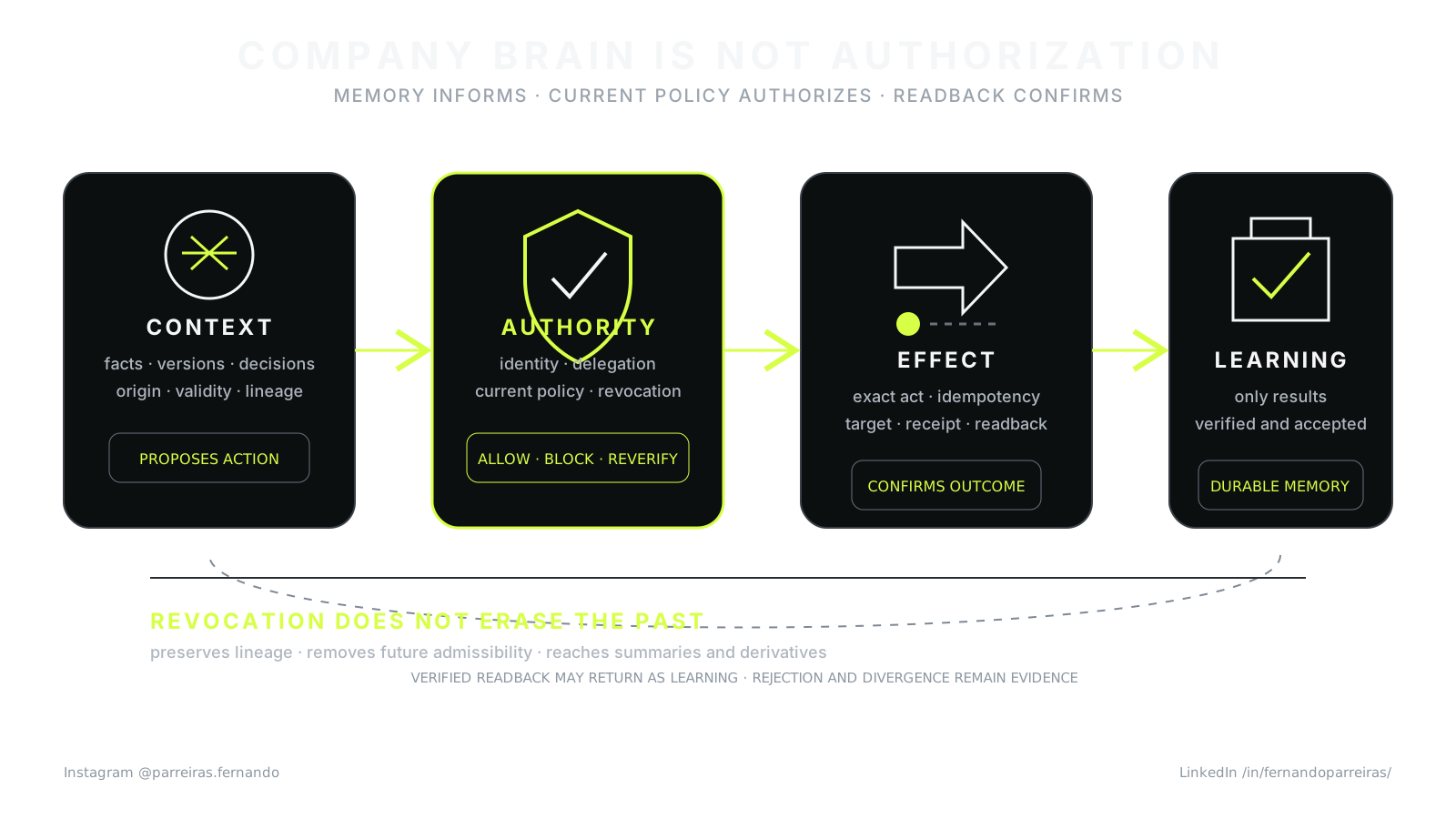
A Company Brain can retrieve facts, relationships, and decisions, but memory does not grant authority. The proposed contract separates context, current authorization, an idempotent effect, and learning after readback, while preserving provenance, temporal validity, and revocation.
A company can organize documents, conversations, decisions, roles, relationships, and learning in a context graph. This improves the chance that a person or agent will find what they need. It does not, however, turn retrieved knowledge into permission to act.
This distinction is the most important security property of a Company Brain: memory explains the past and informs a proposal; current authority decides what may happen now. An old decision may remain historically correct while being prohibited for the current role, customer, purpose, or policy.
This article proposes a four-plane contract — context, authority, effect, and learning — to prevent relevant memory from inheriting powers it never had. The proposal does not declare a ready Trustyu implementation, certify a product, or compare vendors. It is an engineering design for review.
Executive reading
A useful Company Brain must answer two different questions:
- What do we know, and why do we believe it?
- Who may perform which action, on which resource, within which limits, at this instant?
The first problem is context and provenance. The second is authorization. Mixing them creates a dangerous shortcut: “we did it this way before” comes to mean “we may still do it this way.”
The proposed architecture uses the context graph to assemble a candidate action, but requires the runtime to reassess identity, delegation, purpose, policy, and revocation immediately before the effect. It then requires readback: the target system's response confirms what actually happened. Only a verified result may return to the Company Brain as durable learning.
MEMÓRIA RECUPERADA → AÇÃO CANDIDATA → AUTORIZAÇÃO ATUAL → EFEITO → READBACK → APRENDIZAGEM
          contexto       ainda não age       permite/bloqueia    acontece   confirma     só se verificada
The thesis: a context graph is not an authorization graph
One context graph relates entities, facts, documents, events, decisions, and their origins. It helps retrieve background and reconstruct why something was understood in a particular way.
One authorization graph answers whether a principal may perform an action on a resource under a current policy. It must consider identity, delegation, scope, time, purpose, and revocation. Authorization cannot be inferred solely from semantic proximity between graph nodes.
W3C PROV-O provides a stable vocabulary for representing entities, activities, agents, and provenance relationships. This helps explain where a fact came from, but it neither grants access nor authorizes an effect. Google's Zanzibar paper addresses another responsibility: consistent access decisions as relationships and content change. The two problems are related; they are not interchangeable.
The FORGE canon already separates history, policy, and isolation as distinct responsibilities. Model selection or context retrieval does not replace controls. [HARNESS31-C2]
Four planes that must not collapse
1. Context plane — what may be considered
The context plane stores facts, versions, prior decisions, and relationships. Each record must carry, at minimum:
| Field | Question that answers |
|---|---|
source_ref and source_version | Which source and version did it come from? |
observed_at | When did the system observe this record? |
valid_from / valid_until | For what interval is the fact intended to be valid? |
owner and classification | Who is accountable for the data, and who may see it? |
derived_from | Which ancestors produced the summary or inference? |
supersedes | Which previous version was superseded? |
integrity_ref | How can content alteration or replacement be detected? |
observed_at and validity are not the same thing. A contract consulted today may have expired yesterday; an old policy may still be needed to explain a past decision without governing the next one.
Derivations also inherit restrictions. Summarizing a private source does not make the summary public. Combining revoked evidence with other sources does not erase its revocation. The MAP-Graph preprint explores this problem through recursive ancestry, permission filtering before ranking, and an action-risk-dependent gate. It is a research direction evaluated on a synthetic benchmark, not production proof or a normative standard.
2. Authority plane — what may be done now
The authority plane evaluates the proposed action against current state. A minimum decision must bind:
{
  "principal": "identidade-autenticada",
  "delegated_by": "autoridade-ou-null",
  "purpose": "finalidade-declarada",
  "action": "refund.create",
  "resource": "order:synthetic-4821",
  "parameters_sha256": "sha256:...",
  "policy_version": "refund-policy@2026-11-08",
  "evaluated_at": "instante-imediatamente-anterior-ao-efeito",
  "expires_at": "janela-curta",
  "decision": "allow|block|reverify",
  "reason_code": "regra-auditavel"
}
NIST SP 800-207 defines zero trust without implicit trust based solely on location or asset ownership. Authentication and authorization are distinct functions before resource access. For agents, the same principle prevents “it is in corporate memory” or “it came from the internal system” from being treated as authorization.
The OWASP AI Agent Security Cheat Sheet recommends authorization outside the agent's context and bound to the actor and exact call. Approval should be verified and consumed immediately before execution, failing closed and resisting replay. This guidance is stronger than a user_confirmed=true, which may be stale, out of scope, or associated with different parameters.
3. Effect plane — what actually happened
Even correct authorization does not prove that the effect occurred. An API may time out after writing, a job may be repeated, a provider may accept the request and reject it later, or the target may apply a state different from the one requested.
The effect plane needs idempotency and its own receipt:
{
  "candidate_act_id": "act:synthetic-001",
  "authorization_ref": "authz:synthetic-001",
  "idempotency_key": "stable-per-intended-effect",
  "requested_at": "2026-11-08T15:00:00Z",
  "provider_receipt": "sanitized-reference",
  "readback": "confirmed|absent|divergent|inconclusive",
  "verified_at": "2026-11-08T15:00:02Z"
}
The MCP authorization protocol covers how clients obtain tokens and scopes to access a protected server. That access is necessary, but it does not demonstrate that each business effect is allowed. The application layer must still verify the principal, resource, action, and exact parameters.
A 2026 Internet-Draft proposes keeping candidate acts non-effective until verification at the dispatch boundary. It is work in progress, not an IETF standard, but it makes one useful idea explicit: generating, selecting, or routing an action is not the same as having authority to make it effective.
4. Learning plane — what deserves to persist
The Company Brain must not learn directly from the agent's intent or an optimistic provider response. The durable record must distinguish:
proposed: the action was suggested;authorized: the current policy allowed the exact action;requested: the call was sent with an idempotency key;observed: there was a response or an observable change;verified: readback confirmed the effect and its object;accepted: a human authority or explicit rule accepted the result when required.
Only verified facts enter as new operational state. Attempts, divergences, and inconclusive results also remain auditable, but they do not become “completed successfully.” This reduces the chance that a transient failure teaches the system a reality that does not exist.
Synthetic example: the old policy is still memory, not permission
Consider a fictional company. In February, supervisors could approve refunds of up to BRL 500. A successful decision entered the Company Brain with its rationale, policy, and receipt.
In November, three things changed:
- the limit changed to BRL 150;
- the person changed roles and lost the delegation;
- the customer disputed the charge, requiring manual review.
An agent receives a new request for BRL 420. Semantic search retrieves the February case and concludes that the pattern has already been approved. If the context graph is treated as authority, the agent repeats the action.
The correct flow is different:
- recover the historical decision and its provenance;
- mark the policy used in February marked as superseded for current decisions;
- assemble the BRL 420 action as a candidate, without effect;
- evaluate November identity, delegation, purpose, dispute status, and policy;
- block or reverify because role and limit changed;
- if a current authority approves the exception, bind approval to the exact parameters;
- execute once with idempotency;
- read the target and record the actual outcome;
- learn the new exception only with its own receipt and limits.
The February history must not be deleted. It remains valid as an explanation of the past. Revocation changes its admissibility for future effects and reaches derived summaries, while preserving lineage for audit.
Minimum admissibility contract
Before using a record to support an action, the runtime can apply this gate:
1. SOURCE       a fonte é identificável, íntegra e permitida para este principal?
2. LINEAGE      todos os ancestrais necessários são admissíveis para a finalidade?
3. TEMPORAL     fato, política e delegação estão válidos agora?
4. SUPERSESSION existe versão posterior que substitui este registro?
5. ACTION       a evidência é suficiente para o risco desta ação específica?
6. AUTHORITY    a política viva permite principal + ação + recurso + parâmetros?
7. FINALITY     a autorização continua válida imediatamente antes do efeito?
8. READBACK     o destino confirmou o estado final esperado?
9. LEARNING     só o outcome verificado será promovido como memória durável?
Useful answers are not only allow and deny. reverify, redact, ask_user and inconclusive preserve useful work without turning uncertainty into permission.
Revocation must reach descendants
There are at least four revocation events:
- the principal lost access;
- the source changed classification;
- the policy was superseded;
- the evidence was corrected, withdrawn, or deemed untrustworthy.
Silently deleting the original node destroys explainability. Ignoring it preserves risk. The alternative is to preserve lineage and change admissibility:
fonte revogada
   ├── resumo derivado ............ indisponível para nova ação
   ├── decisão histórica .......... visível apenas a quem pode auditar
   └── efeito já confirmado ....... preservado como fato histórico, sem renovar permissão
Consistent authorization systems, such as the one described in the Zanzibar paper, show why relationship changes cannot be treated as an irrelevant eventual update. In a Company Brain, the same care applies to caches, embeddings, and summaries: a derived copy must not survive as a shortcut to power after its origin loses validity or access.
How to test without claiming deployment
A candidate implementation should fail in cases such as:
| Scenario | Expected result |
|---|---|
| relevant memory, but source not permitted | block or redact before retrieval |
| permitted summary with a private ancestor | inherited restriction; no leakage through derivation |
| valid approval, changed parameters | new authorization required |
| policy changes between planning and execution | reverify immediately before the effect |
| same action resent after timeout | idempotency prevents a second effect |
| provider reports success, readback diverges | outcome divergent; do not promote to learning |
| source revoked after summaries were derived | descendants lose future admissibility |
| historical decision consulted by an auditor | lineage preserved without generating new authority |
These tests demonstrate only the properties exercised. They do not prove complete security, regulatory compliance, the absence of alternate paths, or continuous operation.
Where the evidence ends
- W3C PROV-O is a recommendation for representing and exchanging provenance; it is not an authorization policy.
- NIST SP 800-207 is a zero-trust architecture; it does not prescribe this Company Brain contract.
- OWASP provides security guidance; it does not certify a specific implementation.
- Zanzibar is a primary paper about a Google authorization system; its properties and scale do not automatically transfer to another product.
- MAP-Graph and Stateful Governance for Concurrent Agentic Systems are 2026 preprints. Their results support questions and mechanisms within the evaluated scope, not production proof.
- O execution-finality Internet-Draft is work in progress and may change or expire.
- The four planes, fields, and gates in this article are an editorial engineering proposal. They do not declare Trustyu AI Works available to the market or controls operating for customers.
Glossary
- Company Brain: an organizational layer that connects knowledge, decisions, and context to support work; the term alone does not define a product, architecture, or authority.
- Context graph: a graph of facts, entities, relationships, and provenance used for retrieval and reasoning.
- Authorization graph: relationships and policies used to decide whether a principal may perform an action on a resource.
- Provenance: a record of a datum's origin, transformations, accountable parties, and dependencies.
- Temporal validity: the interval during which a fact, role, delegation, or policy can support a decision.
- Candidate action: an operation that has already been formulated but still has no power to produce a consequence.
- Readback: a subsequent read of the target system to confirm the actual effect.
- Revocation: withdrawal of access, delegation, trust, or validity without erasing the historical trail.
Primary and technical sources
- W3C — PROV-O: The PROV Ontology.
- Google Research / USENIX ATC 2019 — Zanzibar: Google’s Consistent, Global Authorization System.
- NIST SP 800-207 — Zero Trust Architecture.
- OWASP — AI Agent Security Cheat Sheet.
- OWASP AISVS — AI Security Controls Inventory.
- Model Context Protocol — Authorization.
- MAP-Graph: Provenance-Aware Shared Memory for Multi-Agent Workflows — preprint.
- Stateful Governance for Concurrent Agentic Systems — preprint.
- IETF Datatracker — Execution-Finality for Agentic AI Tool Dispatch — Internet-Draft, work in progress.
Next step
Before buying or building a Company Brain, choose one real action and map its full path: source, provenance, identity, delegation, live policy, authorization of the exact act, idempotency, readback, and learning rule. If any of these boundaries is implicit, the system may know a great deal and still act without authority.
To discuss the context, governance, and verification design of an AI Native solution, use the Trustyu institutional channel. Contact does not imply a ready product, a contracted assessment, or a guaranteed outcome.
Editorial note
The refund case, identifiers, and receipts are synthetic. No customer data, credentials, tokens, operational payloads, or commercial metrics were used. Research, structure, and writing had AI assistance. Fernando Parreiras approved this version as author and factual reviewer on 8 November 2026 and authorized the special publication for 7:00 PM Brasília time. There was no additional independent human review.
Research cutoff: November 8, 2026.
Editorial and responsibility note
- Research cutoff
- Last review
- Recorded corrections
- No corrections recorded.
The cutoff above applies to the canonical claims. Additional sources and their access dates are identified in the article body.
This article combines cited sources, analysis, and the author's professional experience. Verifiable data and factual statements are linked to their respective sources. Interpretations, hypotheses, projections, recommendations, and opinions represent the author's professional point of view at the time of publication; they do not constitute proven facts, a promise of results, or legal, financial, or technical advice applicable to a specific case. Consult the original sources and qualified professionals before making decisions.
Claims and sources
HARNESS31-C2
A durable harness should maintain session history, orchestration policy and execution isolation as explicit boundaries, while adapters and plugins prevent model or channel choice from becoming the security boundary.
Limit: The sources show two implementations, not a neutral interoperability standard. Actual permissions must be independently enforced and tested outside model choices. This is a source-bound design input; it does not prove product adoption, operational maturity, independent attestation, search ranking, AI citation or outcome.
- Anthropic — Anthropic, proprietary-site-terms
- YC Software —YC Software, MIT
- YC Software —YC Software, MIT