
Executive reading · ~60 seconds
AI does not automatically transform the job pyramid into a diamond, nor does it promote everyone to become a leader. Field studies indicate relevant gains — often greater for less experienced professionals — while the ILO measures task transformation as a more likely scenario than full replacement. The opportunity is to redesign work so that systems expand execution and people preserve context, learning, verification and accountability. Less task and more purpose is a design possibility, not an automatic effect of technology.
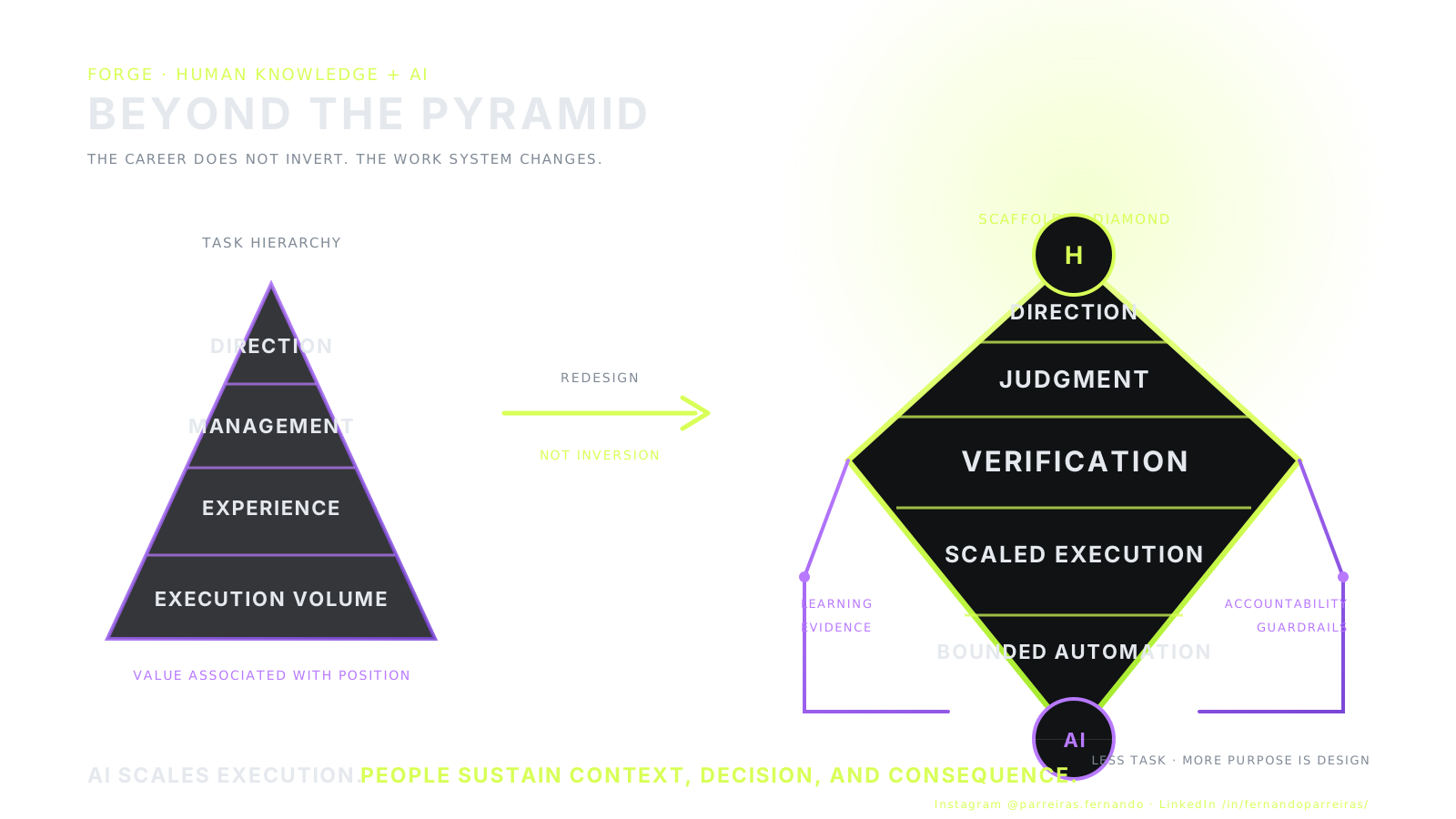
An image circulates with a seductive promise: before artificial intelligence, the career was a pyramid; after it, the pyramid turns into a diamond. AI takes over the base, people rise to decide, lead and generate results. Less chore. More purpose.
As a direction, the image is powerful. As a prediction, it is incomplete.
She is right to show that performing a task is no longer the only unit of value. It is wrong to suggest that the base simply disappears, that every professional becomes a leader or that purpose emerges automatically when a tool performs more. The real transition is less geometric and more demanding: tasks, responsibilities and learning paths are being recombined.
The most important data is not the average
One of the most cited field studies on generative AI at work followed 5.172 support agents. In final version published in the Quarterly Journal of Economics, access to an assistant increased the average number of problems resolved per hour by 15%. The effect was heterogeneous: the quintile with the lowest skill had a gain of 36%, and the gains were concentrated among less skilled and less experienced professionals. This doesn't mean that every beginner has improved by 36% — skill and experience are related but not equivalent dimensions. [CAREER-A18-C1]
In software development, three randomized experiments conducted at Microsoft, Accenture, and a Fortune 100 company brought together 4.867 professionals. A Microsoft Research reported a 26.08% increase in tasks completed across all experiments, with greater adoption and gains among less experienced developers. [CAREER-A18-C2]
These results do not prove that beginners are no longer necessary. They point out something almost opposite: in delimited contexts, AI can distribute part of the knowledge of more experienced people and reduce the initial performance gap. The effect is not uniform, nor does it automatically transfer responsibility for the outcome.
The average therefore hides the most important decision. The question is not just “how much does AI produce?”, but who learns, who checks, who responds and in which work system.
Exposure of tasks does not mean the disappearance of jobs
O refined global index from the International Labor Organization part of tasks, not job titles. The study analyzed a representative sample of 29.753 occupational tasks, collected 52.558 reviews about 2.861 tasks, and combined this material with expert validation.
The estimated result is relevant: one in four employed people is in a profession with some degree of exposure to generative AI, while 3.3% of global employment is at the highest level of exposure. The ILO itself highlights that, as most occupations combine automatable tasks with tasks that require human input, transformation is more likely than full substitution. [CAREER-A18-C3] [CAREER-A18-C4]
Exposure indicates potential technical ability. It does not determine adoption, quality, cost, regulation, demand, work reorganization or job loss. Converting exposure into destiny is exchanging a measurement for a prophecy.
The most useful shape is a scaffolded diamond
If the traditional pyramid represented a lot of execution at the base and little decision-making at the top, the new shape should not be an inverted pyramid. A more honest representation would be a diamond with learning and control scaffolding.
At the bottom, AI systems expand the ability to research, synthesize, program, test, document and operate. At the center, professionals combine domain context, quality criteria, communication, and review. At the top, risk, priority, investment, and direction decisions remain explicitly assigned to people.
Scaffolding connects everything:
- clear intention before execution;
- context and constraints that AI cannot invent;
- contracts, tests and acceptance criteria;
- review proportional to risk;
- trail of evidence and possibility of correction;
- mentoring so that speed also produces learning;
- human responsibility for the effect on customers, teams and society.
This reading is consistent with the DORA 2025: AI mainly acts as an amplifier of already existing strengths and weaknesses. The return comes not just from the tool, but from the organizational system in which it operates. [CAREER-A18-C5]
In a healthy organization, AI can amplify clarity, rapid feedback, and best practices. In a messy organization, it can amplify volume, debt, risk and rework.
The training paradox
The easiest tasks to automate are also often the tasks used to train someone: researching a simple case, writing the first draft, fixing a small bug, preparing an analysis, watching a more experienced professional review it.
If the company automates these tasks and maintains the old model of developing people, it creates a silent problem. The input work decreases, but the demand for judgment increases. At the same time, there is a lack of gradual experiments to build this judgment.
The risk is not just “there being fewer juniors”. It's interrupting the production of future senior professionals and concentrating context on a few people. A review bottleneck emerges: AI generates more artifacts, but professionals capable of evaluating consequences remain scarce.
The way forward is not to preserve mechanical work out of nostalgia. It’s about redesigning learning:
- beginners produce with AI, but explain decisions and verify the result;
- revisions teach criteria, not just return a corrected version;
- real tasks are divided by risk and difficulty, with progressive autonomy;
- safe failures become learning material;
- progress is measured by quality of judgment and time to autonomy, not by volume of prompts.
What changes at each career stage
For those starting out
The difference won't be typing faster or collecting tools. It will show that you can transform an ambiguous intention into a verifiable result.
Learn domain fundamentals, break down the problem, state what you don't know, use AI to explore alternatives, and record how you verified the answer. Your portfolio needs to show reasoning, evidence, testing, corrections, and learning — not just a polished result.
For experienced and senior professionals
Tacit knowledge now has a second function: in addition to solving problems, it needs to be transformed into patterns, examples, criteria, evals and guardrails that other people and systems can use.
The senior professional who just corrects everything at the end becomes a bottleneck. Whoever designs the quality system, teaches criteria and defines where autonomy is safe multiplies capacity.
For managers
It is not enough to buy licenses and charge for adoption. The work is to redesign the flow: where the AI can act, where it needs to ask for confirmation, who reviews it, what data can come in, what evidence accompanies the result, and how beginners continue to learn.
Reducing people before understanding this system can produce apparent savings and real dependency: less internal capacity to judge what the automation itself generates.
For executives and C-level
The question is no longer “which model are we going to use?” and becomes “what capacity do we want to build, what risk do we accept and who is responsible for the outcome?”.
Models change. Decision architecture, boundaries of autonomy, data protection, standards of evidence, and people training need to survive this exchange.
Leading does not mean becoming a boss
The phrase “humans lead” can create another confusion. Not everyone needs to lead teams. Leading, in this context, is exercising agency over work:
- formulate the correct problem;
- choose criteria and make trade-offs;
- recognize when the answer seems good but is wrong;
- communicate uncertainty and limits;
- take responsibility for a decision;
- connect execution to an outcome that matters.
An excellent engineer, analyst, designer, salesperson or researcher can lead a decision without occupying a management position. The career tends to become more like a network of responsibility than a single ladder of positions.
What to measure to know if the change is real
Counting prompts, generated lines, or active users measures activity. To evaluate work transformation, the organization needs indicators that connect speed, quality and learning:
- time until an accepted result, and not just until the first version;
- percentage of results approved without relevant rework;
- human review charge per unit delivered;
- incidents, regressions and fixes after delivery;
- time for a novice person to operate autonomously within a defined scope;
- distribution of earnings between experience levels;
- decisions that remain without a clear owner;
- impact perceived by customers and the people who carry out the work.
If production grows and the review explodes, there was no autonomy: there was a queue transfer. If time drops and incidents increase, productivity has been incompletely defined. If only the best professionals improve, the organization may be widening capacity inequality.
A 30-day experiment
Instead of reorganizing the company based on an image, choose a real, repeatable, reversible flow.
- Record the baseline of time, quality, rework and incidents.
- Separate low, medium and high consequence tasks.
- Define where the AI suggests, where it executes and where it should stop.
- Give a pair made up of a less experienced person and a more experienced person the same context and the same acceptance criteria.
- Require evidence of verification for each delivery.
- Compare accepted output, review and learning load, not just raw output.
- Record what should become standard, what requires a new guardrail and what should not be automated.
This experiment produces a local and auditable response. It is worth more to your organization than a generic prediction about the future of all jobs.
The position of FORGE
In FORGE, the principle “human knowledge + AI” does not place humans as decoration of an autonomous machine. The person defines intention, limits, criteria and responsibility. Agents operate in delimited scopes. Tests, reviews, and evidence observe the work. The result can be corrected and the decision remains assignable.
This no longer guarantees purpose. It creates conditions for people to spend less energy on repetition and more on understanding, deciding, building relationships and improving systems. The choice remains organizational and human.
Conclusion
The pyramid does not automatically become a diamond. AI does not remove the need for baseline; it changes what the base does, accelerates some learning curves and threatens others. It also does not promote all people to be leaders. It increases the value of those who can connect execution to context, verification and consequence.
Less task and more purpose is a design possibility — not an automatic effect of AI.
The future of work will be decided less by the shape of the organizational chart and more by the quality of the system we build between people, agents, learning and responsibility.
Sources and limits of this version
- Brynjolfsson, Li and Raymond — Generative AI at Work, Quarterly Journal of Economics 140(2). Final peer-reviewed version; field study in customer support that should not be directly generalized to every occupation. The 36% gain refers to the lowest skill quintile, not every beginner or less experienced professional.
- Cui et al. —The Effects of Generative AI on High-Skilled Work, Microsoft Research. Three experiments with code assistant; the aggregated result is noisy and the material is preprint.
- Gmyrek et al. — Generative AI and Jobs, ILO Working Paper 140. Measures potential task exposure; it does not measure dismissals carried out nor does it provide for a single organizational structure.
- DORA — State of AI-assisted Software Development 2025. Research focused on software development; The idea of organizational amplification is used here as a design principle, not as a universal labor market law.
The references above integrate a zero-copy cut with hashes and acquisition receipts. The factual review and approval of this version were carried out by the author himself, Fernando Parreiras, on the exact digest. This version has not had independent human review.
Editorial and responsibility note
- Research cutoff
- Last review
- Recorded corrections
- No corrections recorded.
The cutoff above applies to the canonical claims. Additional sources and their access dates are identified in the article body.
This article combines cited sources, analysis, and the author's professional experience. Verifiable data and factual statements are linked to their respective sources. Interpretations, hypotheses, projections, recommendations, and opinions represent the author's professional point of view at the time of publication; they do not constitute proven facts, a promise of results, or legal, financial, or technical advice applicable to a specific case. Consult the original sources and qualified professionals before making decisions.
Claims and sources
CAREER-A18-C1
In the field study with 5.172 customer support agents, access to the assistant increased the average number of problems resolved per hour by 15%; the lowest skill quintile had a gain of 36%, and the gains were concentrated among less skilled and less experienced professionals.
Limit: The result comes from customer support in a company and does not prove equal effect in every occupation, nor disappearance of input functions; 36% does not represent the entire group of beginners or less experienced. This is a source-bound design input; it does not prove product adoption, operational maturity, independent attestation, search ranking, AI citation or outcome.
- Oxford University Press/The Quarterly Journal of Economics —Oxford University Press / The Quarterly Journal of Economics, CC-BY-NC-4.0
CAREER-A18-C2
In three field experiments with 4.867 developers, the data set showed 26.08% more tasks completed among those who had access to the assistant, with greater adoption and gains among less experienced professionals.
Limit: Individual experiments are noisy, use a specific tool and company, and do not measure broad software quality or net employment. This is a source-bound design input; it does not prove product adoption, operational maturity, independent attestation, search ranking, AI citation or outcome.
- Microsoft Research — Microsoft Research, Microsoft website terms
CAREER-A18-C3
The ILO global index estimates that one in four employed people is in an occupation with some degree of exposure to generative AI and that 3.3% of global employment is in the highest exposure category.
Limit: Potential task exposure is not realized automation, job loss, speed of adoption, or deterministic forecasting. This is a source-bound design input; it does not prove product adoption, operational maturity, independent attestation, search ranking, AI citation or outcome.
- International Labor Organization — International Labor Organization, CC-BY-4.0
CAREER-A18-C4
As most occupations combine automatable tasks and tasks that require human input, the ILO considers job transformation more likely than full replacement.
Limit: The conclusion is a global estimate and does not exclude substitution in specific tasks, companies or occupations. This is a source-bound design input; it does not prove product adoption, operational maturity, independent attestation, search ranking, AI citation or outcome.
- International Labor Organization — International Labor Organization, CC-BY-4.0
CAREER-A18-C5
DORA 2025 describes AI primarily as amplifying existing strengths and weaknesses and associates the greatest returns with the organizational system, not just the tools.
Limit: The research focuses on software development; the article uses this formulation as a design principle, not as a universal labor law. This is a source-bound design input; it does not prove product adoption, operational maturity, independent attestation, search ranking, AI citation or outcome.
- Google Cloud DORA — Google Cloud DORA, CC-BY-4.0