
Executive reading · ~60 seconds
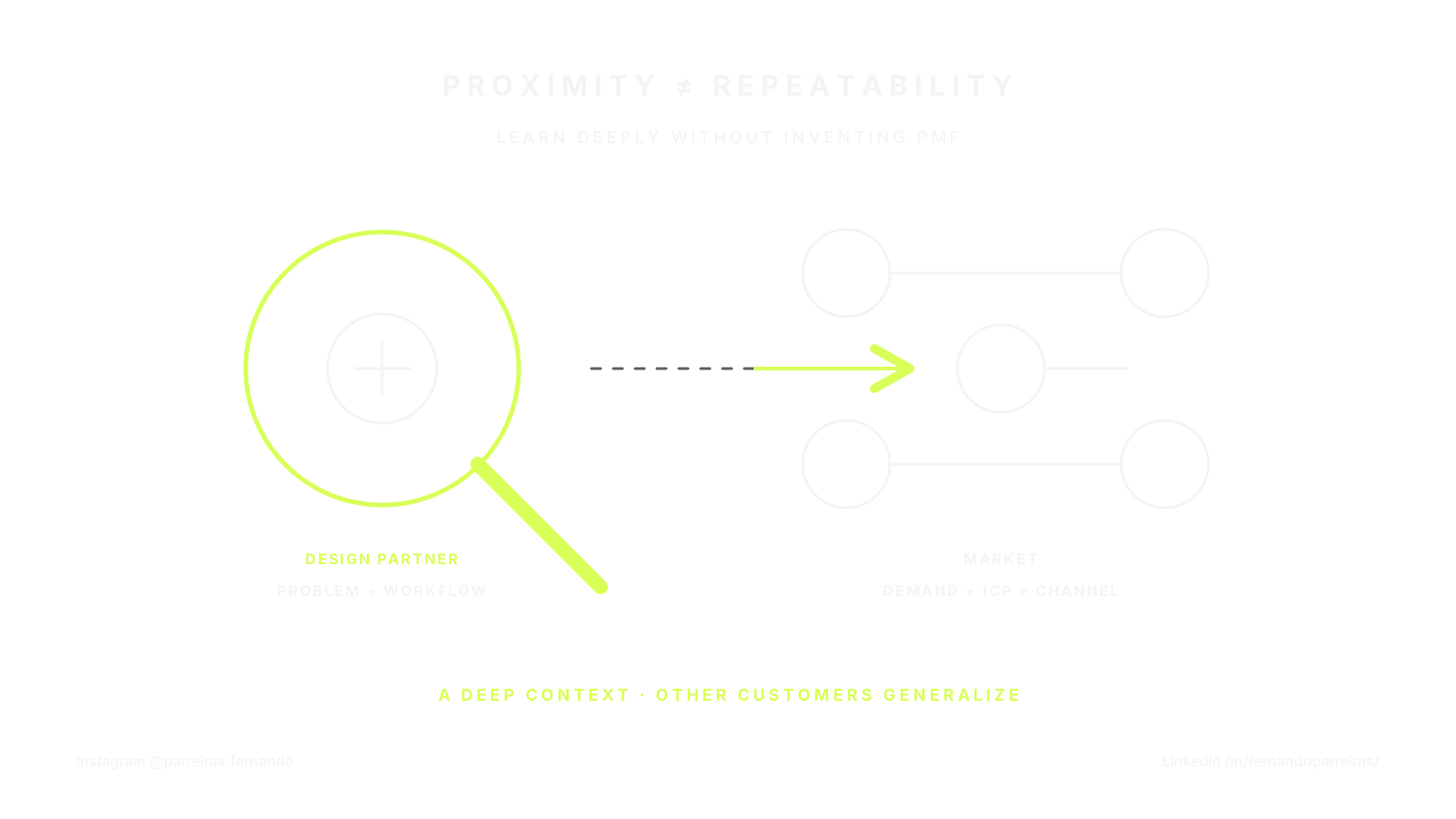
Design Partner delves into problem and operation; repeatable market requires independent evidence of demand, onboarding, ICP and channel.
A Design Partner talks every week, opens context, tests prototypes and influences the roadmap. This proximity is valuable. It can also create an illusion: interpreting an organization's intense collaboration as proof that a repeatable market exists.
Design Partner is a learning instrument. Product-market fit is a much bigger conclusion.
Executive summary
Use Design Partner to dig deeper into problem, workflow, trust and operation. Keep separately what needs to be tested on other clients.
| The Design Partner can demonstrate | Design Partner alone does not prove |
|---|---|
| problem in its context | frequency across the entire market |
| real use and friction | independent demand |
| integration and operation | repeatable onboarding |
| willingness to collaborate | broad willingness to pay |
| value in a workflow | ICP stable |
| language and objections | scalable channel |
The discipline is to learn deeply without silently generalizing.
Define the learning contract
Before the first cycle, record:
- hypothesis that will be tested;
- people and processes involved;
- permitted access and data;
- responsibilities of the parties;
- feedback frequency;
- success and stopping criteria;
- intellectual property and confidentiality;
- difference between collaboration, pilot and contracting;
- claims authorized audiences, if any.
An invitation, meeting or access does not prove adoption. A signature of intent does not equate to use. A free rider does not equate to an accepted price.
Layered evidence
Organize observations:
Problem
Recent episodes, frequency, cost and current alternative.
Use
Task completed, recurrence, abandonment and need for support.
Value
Outcome perceived by recipient and trade-off accepted.
Trust
Data, decisions or processes that the organization actually delegates.
Economy
Price, implementation effort, support, margin and sales cycle.
Repeatability
What remains the same when the client, team or context changes.
Each layer responds to a different hypothesis.
Customization or discovery?
Design Partners ask for legitimate changes. Rate each order:
| Type | Response |
|---|---|
| reveals common need | test with other cases |
| segment regulatory requirement | embed with explicit scope |
| local preference | setting, not automatic core |
| specific service | separate from product |
| broken process workaround | evaluate whether it should be automated |
| exception without repetition | don't promote early |
The danger is turning team availability into a roadmap. The partner now receives tailored consultancy and founder calls the result a product.
One voice does not represent the market
Entrepreneurship is experimentation because much relevant information only appears after investment and contact with real restrictions. Reducing the cost of experimenting changes what tests are possible, it does not remove uncertainty from the market.
Use your partner to generate hypotheses and language. Then search:
- interviews outside the relationship;
- alternatives and competitors;
- message testing;
- exceptional unsupportive behavior;
- economic commitment;
- repetition of the problem in different contexts;
- reasons not to buy.
PMF is not a maturity label
Do not declare product-market fit because:
- there is a working product;
- one partner actively participates;
- there was a sale;
- users praised;
- the pilot has many features;
- the team found a large theoretical market.
PMF involves a repeatable relationship between product and demand. The threshold varies by business model, but the conclusion needs signals in addition to a relationship built under special conditions.
The learning dashboard
For each cycle, record:
| Field | Example of content |
|---|---|
| hypothesis | what behavior is expected |
| observation | what happened, without interpretation |
| evidence | link, record or authorized data |
| alternative | how they solved it before |
| surprise | which contradicted the thesis |
| decision | maintain, change, restrict or stop |
| generalization | not yet tested / tested in N contexts |
| next test | experiment with greater strength |
A unit of outcome must be product specific. Tooling cost or internal execution does not prove customer value. [R3-C2]
Preserve real maturity
Use precise language:
- hypothesis: still needs observation;
- Design Partner: organization collaborating with learning;
- pilot: limited use to answer questions;
- customer: effective economic relationship;
- operable product: team can deliver and support;
- repeatability: signals in independent contexts;
- PMF: accumulated evidence of demand that the product meets in a sustainable way.
These states can partially coexist. Don't promote the highest out of enthusiasm.
When the Design Partner is excellent
The partnership creates high value when:
- the problem is real and frequent;
- there is access to workflow, not just opinion;
- the partner agrees to test negative cases;
- feedback arrives with context;
- commercial limits are clear;
- the founder looks for external counterpoints;
- learning becomes product decision;
- both can end without ambiguity.
Proximity is a search asset. It becomes bias when it replaces diversity of evidence.
What this article proves — and what it doesn't prove
Academic research characterizes entrepreneurship as experimentation under uncertainty. The Design Partner contract and maturity separation are operational summaries of FORGE.
The article does not provide a universal number of partners, customers, or revenue for declaring PMF. It also doesn’t diminish the value of deep collaboration; it merely limits the inference it authorizes.
Conclusion
A Design Partner can help you discover the right product sooner. It should not be used to declare that the market has already been discovered.
Learn deeply from proximity. Test repetition, acquisition, savings and demand separately. And leave each claim at the level of evidence that actually exists.
Previous reading: AI reduces the cost of experimenting. Next suggested reading: Sandbox, capability and identity.
Editorial and responsibility note
- Research cutoff
- Last review
- Recorded corrections
- No corrections recorded.
The cutoff above applies to the canonical claims. Additional sources and their access dates are identified in the article body.
This article combines cited sources, analysis, and the author's professional experience. Verifiable data and factual statements are linked to their respective sources. Interpretations, hypotheses, projections, recommendations, and opinions represent the author's professional point of view at the time of publication; they do not constitute proven facts, a promise of results, or legal, financial, or technical advice applicable to a specific case. Consult the original sources and qualified professionals before making decisions.
Claims and sources
R3-C2
Useful AI observability must connect technical telemetry to a unit of value and its cost, instead of optimizing aggregate spend without an outcome denominator.
Limit: A unit must be product-specific; this framework-only run measures intake cost but not customer outcome. This is a research-synthesis design input; it does not prove product adoption, operational maturity, independent attestation or outcome.
- OpenTelemetry — OpenTelemetry, CC-BY-4.0 documentation; analysis-only excerpts
- FinOps Foundation — FinOps Foundation, CC-BY-4.0 framework; analysis-only excerpts