
Executive reading · ~60 seconds
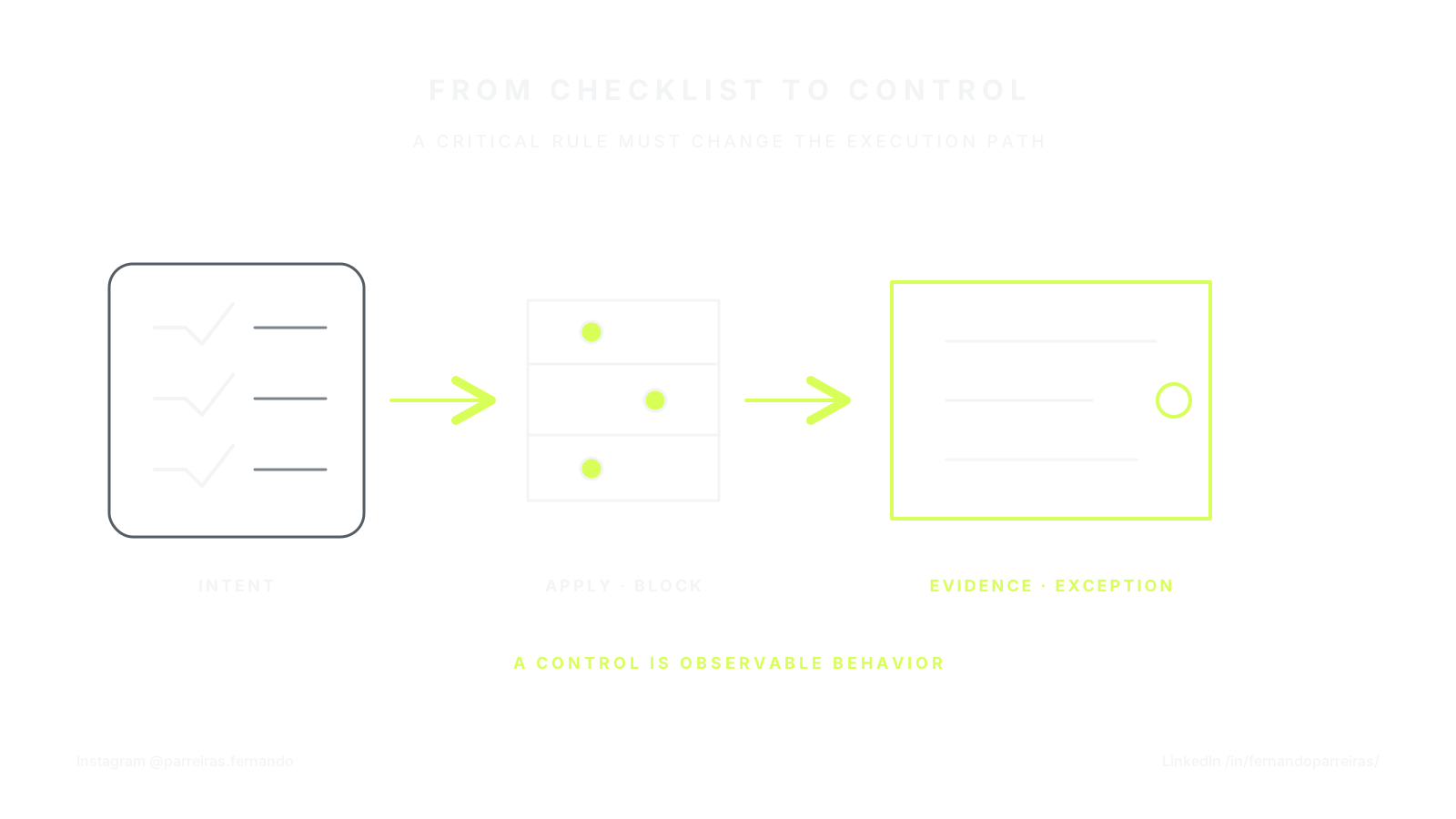
Checklist remembers intention. Executable control defines property, scope, mechanism, evidence, authority and validity, governs the effect of failure and treats exception as an object that expires.
“Review safety,” “validate quality,” and “obtain human approval” appear in many AI policies. The sentences seem prudent. They remain fragile when the system does not know when the rule applies, who responds, what mechanism can block it and what evidence demonstrates execution.
A checklist remembers an intention. An executable control changes the behavior of the system.
Executive summary
A critical rule needs six fields:
| Field | Question |
|---|---|
| Property | what must remain true? |
| Applicability | in which assets, risks and environments? |
| Mechanism | what measures, limits or blocks? |
| Evidence | Which record demonstrates result and subject? |
| Authority | Who can accept, except or revoke? |
| Validity | when rule, exception and proof expire? |
Executable governance does not mean automating every decision. It means making explicit the point at which a person decides and preventing silence, timeout or convenience from being interpreted as approval.
Why checklists fail
Propertyless language
“Secure system” does not inform threat, border, version or criteria. A control needs something falsifiable, like “no exit calls occur outside the allowlist in this task class”.
Implicit applicability
The rule exists, but no one knows whether it applies to prototype, production, real data, external supplier or low-risk change. The team decides during execution and produces inconsistent treatments.
Non-blocking verification
The scanner finds a fault, the report is attached, and the flow continues. The organization has observability, but not enforcement.
Approval without subject
A person approves “the deploy” without commit, image, configuration, environment or digest. The checked asset may not be the released asset.
Eternal exception
An urgency creates temporary bypass; without owner, expiration and compensation, it becomes architecture.
The minimum control contract
Consider a rule of thumb: High-impact changes require human review.
An executable version states:
- trigger: risk classification equal to or greater than the threshold;
- subject: commit, artifact digest, configuration and environment;
- checker: applicable tests and evidence must be green and valid;
- authority: eligible human identity, separate from the executor;
- effect: without approval, the promotion fails closed;
- receipt: decision, date, subject, residual risk and exceptions;
- expiration: changing the subject invalidates the acceptance.
Control may contain a human step. It remains executable because its input, authority, effect and evidence are verifiable.
Policy, checker, gate and evidence are not synonymous
| Element | Function | Fails when |
|---|---|---|
| Policy | states the rule and reason | is vague or contradictory |
| Checker | measures a property | observe the wrong subject |
| Gate | prevents an effect | Treats error as warning |
| Evidence | preserves the result | does not connect identity, data and asset |
| Approval | accepts residual risk | has no authority or expiration |
A policy page is no substitute for testing. A green test does not replace gate. A gate does not prove that the rule is adequate. Assurance requires connected elements.
Regulatory sources and public tools cover different parts of assurance; they reinforce the need for reproducible tests linked to explicit requirements, without transforming policy prose into certification. [R2-C1]
How to transform a written rule
1. Extract the property
Replace the generic verb with an observable statement. “Securing data” can break down into minimum collection, authorized access, encryption, retention, deletion and auditability.
2. Model applicability
Use signals such as environment, data type, external effect, reversibility, origin of change and risk class. Applicability should be testable, not a footnote.
3. Choose the most deterministic engine available
Schema, type system, policy engine, allowlist, property test and diff reduce interpretation. Evals by model come in where the property requires judgment and must expose rubric, baseline and limit.
4. Define the glitch effect
warn may be suitable in shadow. In enforcement, a material failure needs to block. Maturity status should never be promoted just because the checker was installed.
5. Preserve addressable evidence
Record subject, control version, result, environment, executor, verifier and validity. A log without binding is context; is not sufficient evidence for a subsequent decision.
6. Treat exception as object
Exception has reason, owner, compensation, scope and expiration. On the final date, the system revokes or demands a new decision.
Maturity matrix
| State | What exists | What cannot yet be stated |
|---|---|---|
| specified | rule and contract | actual execution |
| shadow | checker observes without blocking | enforcement |
| enforced | gate blocks on the declared scope | universal effectiveness |
| verified | independent testing supports ownership | lack of risk |
| attested | third party or attestation chain signs the claim | full semantic correction |
The clarity of these states avoids adjectives that are greater than the evidence.
What this article proves — and what it doesn't prove
NIST, OWASP, and other frameworks help organize requirements and tests, but they cover different scopes. FORGE translates this separation into ownership, applicability, mechanism, evidence and authority. This is a governance design, not a certification of the framework or products.
No control eliminates judgment. It reduces ambiguity, makes deviations visible, and defines where judgment needs to take place.
Conclusion
Checklist asks if anyone remembered. Executable control demonstrates what happened and governs what can happen next.
The goal is not to replace people with rules. It's reserving human attention for decisions that really require context and preventing predictable tasks from relying on memory, good will or interpretation.
Previous reading: Evidence before adjective. Next suggested reading: When AI fails, does the system learn or merely retry?.
Editorial and responsibility note
- Research cutoff
- Last review
- Recorded corrections
- No corrections recorded.
The cutoff above applies to the canonical claims. Additional sources and their access dates are identified in the article body.
This article combines cited sources, analysis, and the author's professional experience. Verifiable data and factual statements are linked to their respective sources. Interpretations, hypotheses, projections, recommendations, and opinions represent the author's professional point of view at the time of publication; they do not constitute proven facts, a promise of results, or legal, financial, or technical advice applicable to a specific case. Consult the original sources and qualified professionals before making decisions.
Claims and sources
R2-C1
AI assurance needs reproducible tests and measurable evidence mapped to explicit verification requirements; policy prose alone is insufficient.
Limit: Dioptra and AISVS cover different scopes; neither is a turnkey certification of a FORGE deployment. This is a research-synthesis design input; it does not prove product adoption, operational maturity, independent attestation or outcome.
- NIST — NIST, NIST public-domain repository; analysis-only excerpts
- OWASP Foundation — OWASP Foundation, CC-BY-SA-4.0 standard; analysis-only excerpts