
Executive reading · ~60 seconds
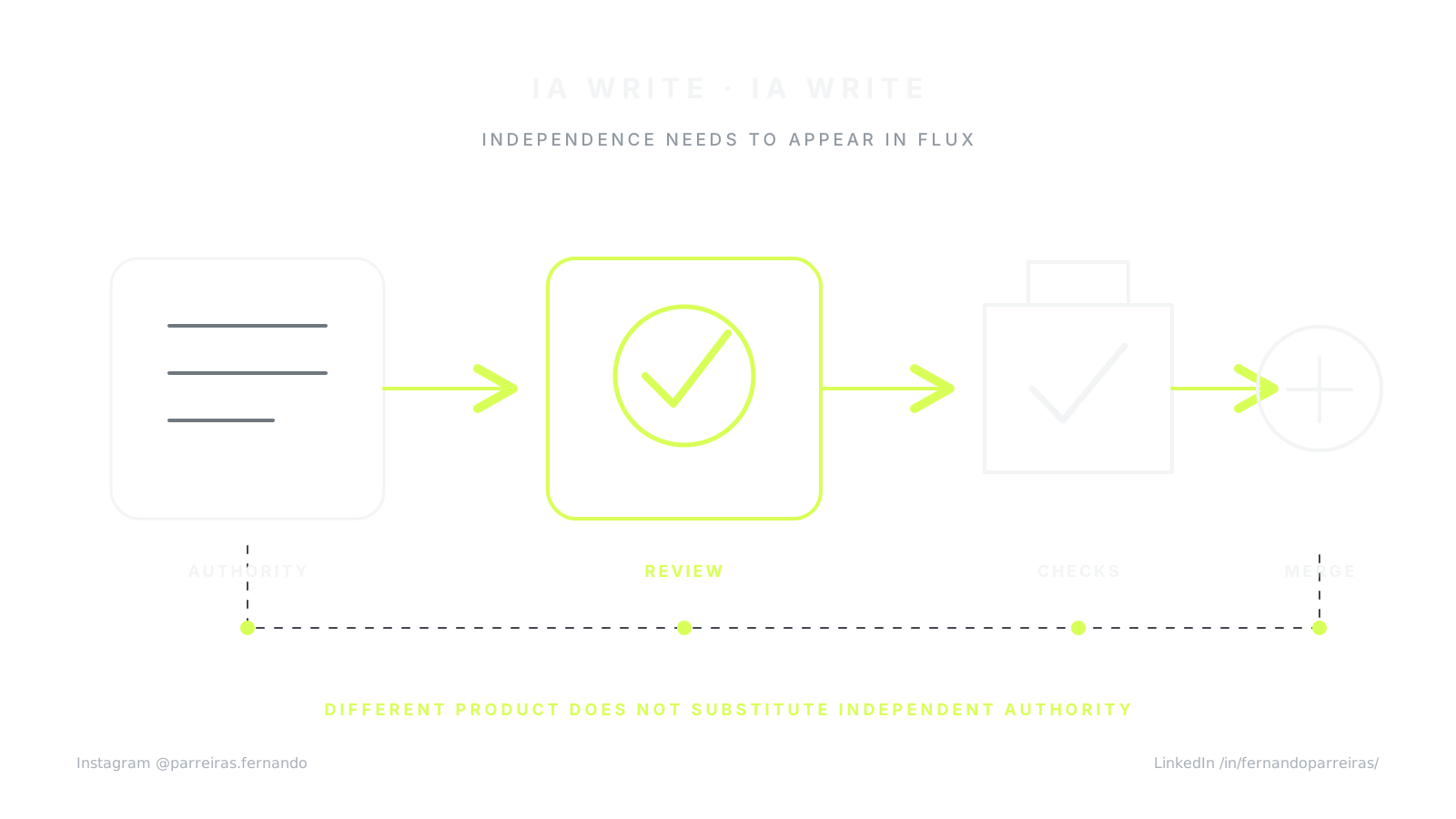
Agents already show up on both sides of the pull request. Independence does not come from the product brand: it needs to exist in separate authorities, protected checks, accounting approval and provenance.
Agents already occupy both sides of the pull request. One produces change; another comments, classifies or recommends. The flow can reduce latency and expand coverage. It can also manufacture a review appearance when authorship, criticism, verification and authority remain attached to the same circuit.
This Evidence Brief part of the paper AI-to-AI Code Reviews of GitHub Pull Requests to define a technical contract for segregation of authority. It does not state that revision IA-for-IA is bad, nor that different product proves independence.
What was observed
The authors used public events of GitHub between 01/01/2024 and 15/04/2026 and signatures attributable to agents. Among 2,830.284 PRs identified as agent-authored, 248,641 received at least one review attributed to AI — 8.8% of the attributable population.
- 45,269 received cross-product review;
- 208,145 received a similar-product review;
- 4,773 appeared in both categories;
- cross-product represented approximately 1.6% of the 2.83 million PRs attributed to agents.
O replication package publishes scripts, filtered cohorts, registration of signatures, tables and figures. This improves reproducibility, but remains a material of the same authors, not an independent replication.
Closed-loop is not no-human-loop
In paper, closed-loop only means that AI appears on both sides of the PR. The dataset does not allow determining whether a person has also reviewed, tested or approved. The absence of human event in the clipping does not prove absence of human judgment.
Counts are also lower limits: missing or removed signatures cause sub-allocation. Private repositories, GitHub Enterprise, other unrecognized platforms and agents stay out.
Four things the study did not measure
- quality or correction of the code;
- quality, severity or groundedness of comments;
- causal effect of same-product versus cross-product;
- presence or absence of human review.
Differences in volume and latency may reflect PR size, language, repository, integration, configuration and composition of reviewers. More comments are activity; they are not automatic evidence of defects found or reduced risk.
Different product is not independent authority
Independence requires separating at least five plans:
| Plan | Question | Failed to collapse |
|---|---|---|
| author | who proposed the diff and with what context? | origin becomes invisible |
| revision | who sought trouble and under what criteria? | comment repeats generation |
| verification | Which mechanism tested the property? | plausible text turns proof |
| approval | Who can take a risk and merge? | bot becomes implicit authority |
| promotion | What artifact was built and deployed? | revised code differs from release |
Changing the brand of the reviewer can diversify context, but different products can share model, dependencies, incentives or permissions. The same product can also call really different verifiers. The unit of independence is the authority and the mechanismNot the logo.
Different papers help create a counterpoint as long as the system preserves those who perform, those who check and those who accept. [R1-C3]
Pull request gate for agent streams
1. Diff identity and provenance
Record the agent/product when attributable, human executor, spec, base commit, changed files, dependencies, tools and limitations. Incomplete provenance must remain unknown, never become “human” by exclusion.
2. Review as a sign, not authority
The agent's comment enters as ending with explicit rule of severity, deduplication, resolution and false positive. Merge approval remains linked to an authorized authority.
3. Ownership by risk
Use CODEOWNERS or equivalent mechanism for identity, authorization, payments, migrations, infrastructure and data. An owner needs to review the property under his responsibility, not just confirm that the bot commented.
4. Safe checks
Require lint checks, types, tests, security, dependencies, negative tests, contract, migration, rollback and evals at risk. An agent can trigger and interpret checks; he should not be able to silently rewrite the policy that decides the merge.
Small and isolated changes increase revisitability, but separate workspace is neither sandbox nor security guarantee. [R1-C2]
5. Last push under new approval
A GitHub branch protection can invalidate approval after a new commit or require another person to approve the latest push. Without this, a later change can be merged based on a review of an old diff.
6. Explicit merge and bypass
Restrict who can push, merge, dispense review or change checks. Exception needs motive, authority, validity, and trail — especially when those who have generated change also control bypass.
7. Source and build linked to release
SLSA 1.2 defines provenance as verifiable information about where an artifact came from and where, when and how it was produced. Preserve the commit, inputs, builder, digest and promotion receipt to prove that what was reviewed is what operates.
Permissions and gates need to exist outside the model and be tested on the delivery system. [HARNESS31-C2]
Risk proportional authority matrix
| Change | IA author | IA reviewer | Secure Check | Human approval |
|---|---|---|---|---|
| reversible copy | allowed | recommended | build + accessibility | content owner |
| business rule | allowed | recommended | contract tests + regression | domain owner |
| identity/authorisation | permitted with scope | Mandatory as additional signal | safety + negative tests | authorised specialist |
| data migration | allowed with sandbox | Mandatory as additional signal | dry-run + integrity + rollback | responsible engineering |
| infrastructure/release | allowed with minimal grants | Mandatory as additional signal | policy + provenance + deploy gate | production authority |
The table is the author's professional analysis, not the paper's result. The goal is to calibrate authority, not impose a universal topology.
Evidence Packet of the merge
A governmentable merge must allow for reconstruction:
- which decision and spec started the change;
- who or what agent produced and reviewed;
- which exact diff was evaluated;
- which endings were accepted, corrected or dismissed;
- which checks have been run, in which commit and with which result;
- who approved the residual risk;
- which artifact by digest was promoted;
- which smoke test, monitoring and rollback sustain the operation.
If the answer exists only in the agent's summary, the organization has a narrative — not evidence.
What this brief proves — and what does not prove
The study proves that events attributed to agents on both sides of the PR are already numerous in public projects and that combinations exhibit distinct patterns. It does not prove that same-product is complacent, that cross-product is independent, that bots have replaced humans or that the resulting code has more or less quality.
The controls of this brief derive from the paper, official documentation and professional experience of the author. They are a proposal for technical governance, not a causal finding of researchers.
Direct sources
- Paper — AI-to-AI Code Reviews of GitHub Pull Requests
- Replication package
- CodAGE — dataset-base
- GitHub — pull request reviews
- GitHub — protected branches
- GitHub — CODEOWNERS
- NIST SP 800-218 — Secure Software Development Framework
- SLSA 1.2 — provenance
Conclusion
AI can write and review in the same stream. What she cannot do alone is create legitimacy for her own approval.
Independence needs to appear in separate authorities, verified properties, protected checks, provenance and a person accountable by merge and operation.
Editorial and responsibility note
- Research cutoff
- Last review
- Recorded corrections
- No corrections recorded.
The cutoff above applies to the canonical claims. Additional sources and their access dates are identified in the article body.
This article combines cited sources, analysis, and the author's professional experience. Verifiable data and factual statements are linked to their respective sources. Interpretations, hypotheses, projections, recommendations, and opinions represent the author's professional point of view at the time of publication; they do not constitute proven facts, a promise of results, or legal, financial, or technical advice applicable to a specific case. Consult the original sources and qualified professionals before making decisions.
Claims and sources
R1-C3
Multi-agent teams and evolving architecture require explicit orchestration roles plus durable decision records with status, consequences and supersession.
Limit: The sources do not prescribe one universal team topology or ADR template. This is a research-synthesis design input; it does not prove product adoption, operational maturity, independent attestation or outcome.
- Microsoft — Microsoft, MIT/CC-BY-4.0 repository; analysis-only excerpts
- Amazon Web Services — Amazon Web Services, Public official guidance; analysis-only excerpts
- Microsoft Azure — Microsoft Azure, Public official guidance; analysis-only excerpts
R1-C2
Autonomy should be bound by isolation and small reviewable changes; a worktree allone is not a security bondary and a large change weakens review quality.
Limit: Change-size guidance is human-review guidance; it does not by itself define an agent sandbox policy. This is a research-synthesis design input; it does not prove product adoption, operational maturity, independent attestation or outcome.
HARNESS31-C2
A durable harness should maintain session history, orchestration policy and execution isolation as explicit boundaries, while adapters and plugins prevent model or channel choice from becoming the security boundary.
Limit: The sources show two implementations, not a neutral interoperability standard. Actual permissions must be independently enforced and tested outside model choices. This is a source-bound design input; it does not prove product adoption, operational maturity, independent attestation, search ranking, AI citation or outcome.
- Anthropic — Anthropic, proprietary-site-terms
- YC Software —YC Software, MIT
- YC Software —YC Software, MIT