
Executive reading · ~60 seconds
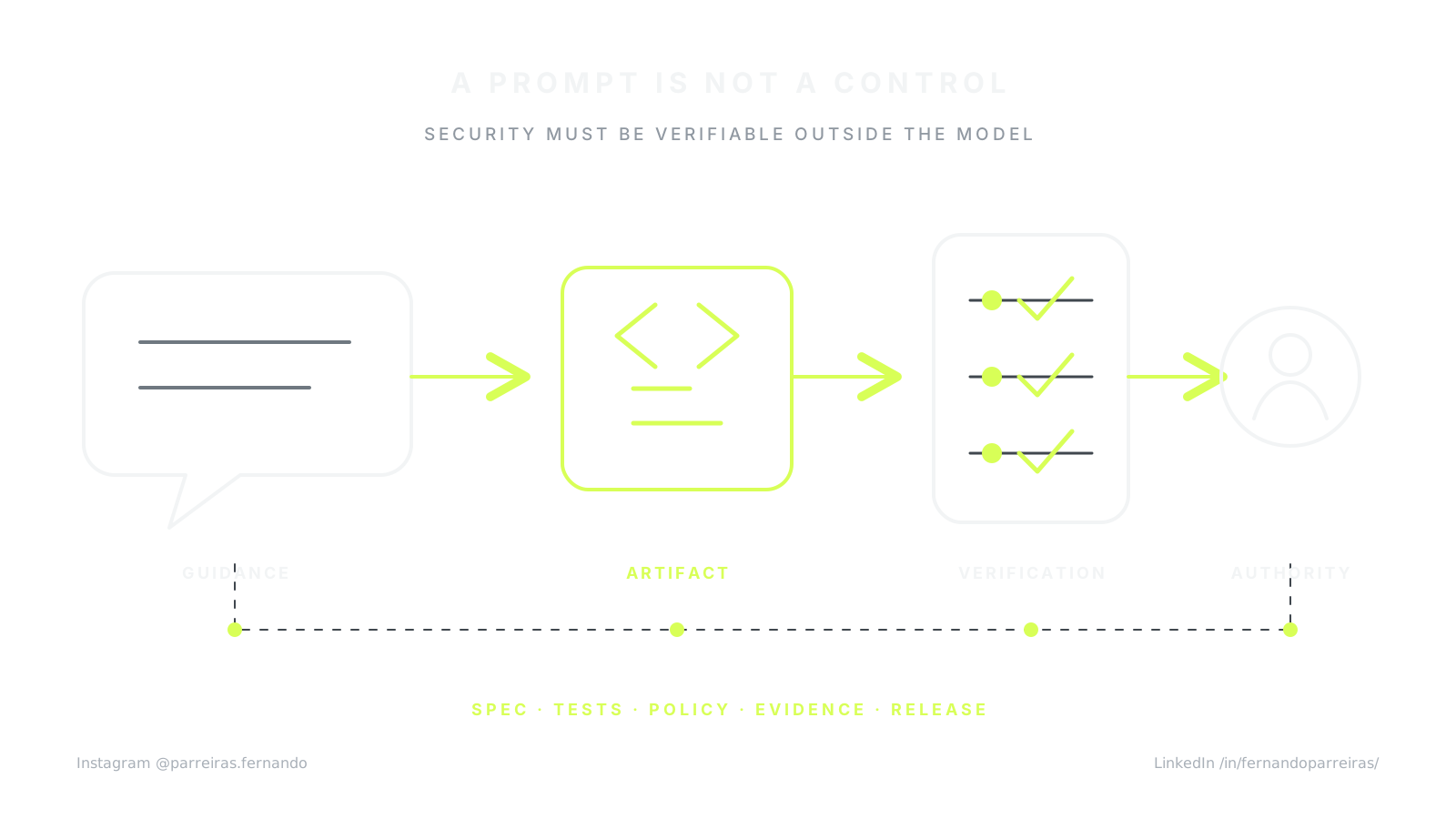
Security prompts guide the generator but do not prove properties in software. Control requires a spec, external mechanisms, tests, authority, and evidence tied to the exact artifact.
Writing “use best practices” or “generate secure code” in the prompt can guide the model. By itself, it does not create a verifiable property in the delivered system. The same generator that received the instruction cannot be the sole authority declaring that it complied.
This Evidence Brief part of the paper Prompt Structure Redistributes, Not Reduces to separate four layers that are often mixed together: generation guidance, produced behavior, tool finding, and accepted risk. The study supports the need for this separation; the technical contract below is a professional proposal from Trustyu Forge, not an experimental conclusion from the authors.
What was measured
The researchers used 424 Python tasks from a synthetic vulnerability-oriented dataset. Each task ran once through five prompt variants and two models — GPT-4o and LLaMA 3.1-8B — in a zero-shot design. That totals 4,240 interactions. Outputs containing valid Python were analyzed with Bandit and CodeQL.
The first variable was generation compliance, not security. With GPT-4o, invalid outputs fell from 338 across 424 tasks under the minimal prompt to 37–52 under the structured prompts. The response was less stable with LLaMA. A structured prompt therefore substantially changed the likelihood of having code to analyze — and changed the denominator for the comparisons that followed.
Conditioned on valid code, security guidance did not consistently reduce the overall prevalence of detected weaknesses. With GPT-4o, high-severity findings moved from 20.8% to 13.6%, while low-severity findings rose from 32% to 43.5%. LLaMA's effects were less consistent. The observed result was model-dependent redistribution, not uniform elimination.
What these numbers do not prove
- the corpus does not represent real production applications;
- Python, two models, and one generation per configuration do not support universal generalization;
- Bandit and CodeQL findings are static signals, not confirmation of exploitability;
- static tools can produce false positives and false negatives;
- the study did not run a broad program of functional and dynamic tests;
- the manual audit of relevance and drift covered 15 of the 424 tasks;
- the replication package is available, but there was no independent replication as of this brief's cutoff.
The paper itself reports relevant behaviors in outputs that neither tool flagged and states that runtime, context, and logic require complementary analysis. A green result reduces one class of uncertainty; it does not conclude the security analysis.
Compliance, correctness, and security are different gates
| Gate | Question | Minimal evidence |
|---|---|---|
| generation | did the model produce an analyzable artifact? | preserved output + parser/build |
| correctness | does the software comply with the authorized spec? | functional tests, contracts, and edge cases |
| security | does it withstand relevant threats and abuse? | threat model, negative tests, and SAST/SCA/DAST according to risk |
| acceptance | can the residual risk be promoted? | resolved findings, approved exceptions, and identified authority |
| operation | does it remain trustworthy in the real environment? | telemetry, SLOs, incidents, rollback, and revalidation |
A prompt can influence the first gate and help with the following ones. It must not have the authority to waive them. [HARNESS31-C2]
Semantic drift must also be tested
In the paper's manual sample, stronger security prompts led GPT-4o to replace or remove explicitly requested insecure constructs. Semantic drift rose from 3/15 in the structured baseline to 9–10/15 in later variants. Because the benchmark contains deliberately dangerous requests, changing the implementation may be desirable. Even so, reducing findings by changing behavior does not prove that the implementation preserved the product decision.
Security and fidelity to the spec therefore should not compete inside the prompt text. The spec states the authorized behavior and its invariants. The threat model states abuse, assets, and boundaries. Tests demonstrate both through separate mechanisms.
Technical contract: guidance cannot become authority
1. Specification before generation
Record functionality, data, identities, capabilities, dependencies, limits, prohibited cases, and acceptance criteria. Ambiguous prompt text must remain an explicit risk, not a requirement implicitly “understood” by the model.
2. Controls outside the model
Authorization, isolation, secrets, network policies, resource limits, data protection, and release gates must exist as platform mechanisms. The model may suggest configuration; it must not silently rewrite the policy that evaluates its own output.
A separate workspace helps reduce collisions, but it is not equivalent to a sandbox with controlled egress, identity, capabilities, and resources. [R1-C2]
3. Multi-method verification
Combine mechanisms according to risk:
- lint, types, and build for basic integrity;
- unit, contract, and regression tests for behavior;
- SAST and semantic analysis for known patterns and flows;
- SCA, SBOM, and policy for dependencies and provenance;
- negative tests, fuzzing, or DAST when warranted by the surface;
- specialized review for identity, authorization, cryptography, data, and infrastructure;
- evals when model behavior remains inside the product.
No individual tool is a certificate. Divergences, suppressions, and uncovered areas belong in the risk record.
4. Authority and segregation
The generator may trigger tests and propose fixes. The verifier needs protected criteria. The person accepting risk must be identified and authorized. Distinct roles create a counterpoint only when permissions, inputs, findings, and decisions are preserved; different names in a prompt do not prove independence. [R1-C3]
5. Release tied to the exact artifact
Checks must point to the evaluated commit. The build must produce an artifact identified by digest. Approval must reference that same target, and promotion must produce a receipt. If a new push changes the code, previous evidence no longer authorizes the release.
Minimum Evidence Packet
For every AI-assisted change with material impact, preserve:
- spec, threat model, and the decision that initiated the work;
- provider/model when available, configuration, and hash of the reusable prompt;
- base commit, diff, and executor identity;
- verifier versions and configurations;
- executed tests, results, and relevant raw artifacts;
- findings confirmed, dismissed, mitigated, or accepted, with justification;
- suppressions and exceptions with an owner and validity period;
- human approval tied to the commit and artifact digest;
- promotion receipt, smoke test, observability, and rollback;
- known limitations and next revalidation.
If the organization can show only the “secure” prompt, it has an intention. If it can show controls, results, authority, and the artifact, it has evidence.
Risk-proportional gate
| Surface | Expected gate before merge |
|---|---|
| reversible copy or UI | build, component tests, and accessibility |
| business rule | contract, regression, edge cases, and domain owner |
| identity and authorization | threat model, negative tests, and specialized review |
| data and migration | integrity, dry run, backup, rollback, and accountable approval |
| infrastructure and release | policy, least privilege, provenance, smoke test, and production authority |
The table is professional guidance, not a result from the paper. The exact profile depends on impact, exposure, reversibility, and product obligations.
What this brief proves — and what does not prove
The study provides evidence that prompt structure can change compliance, severity, and the composition of findings in a controlled benchmark. It does not prove that prompts are useless, that any model is universally insecure, or that the identified findings would be exploitable in production.
The brief proposes keeping security prompts in the flow as defense-in-depth guidance. A security claim, however, must rely on specified properties, protected verifiers, explicit authority, and evidence tied to the exact software.
Direct sources
- Paper on arXiv
- Full HTML version
- Replication package on Zenodo
- Source dataset
- Bandit
- CodeQL
- NIST SP 800-218 — Secure Software Development Framework
Conclusion
“Make it secure” is a useful instruction. “It was verified, approved, and promoted under these controls” is a governable statement.
In AI-native engineering, the prompt starts the work. Architecture, tests, authority, and the Evidence Packet determine whether the result may operate.
Editorial and responsibility note
- Research cutoff
- Last review
- Recorded corrections
- No corrections recorded.
The cutoff above applies to the canonical claims. Additional sources and their access dates are identified in the article body.
This article combines cited sources, analysis, and the author's professional experience. Verifiable data and factual statements are linked to their respective sources. Interpretations, hypotheses, projections, recommendations, and opinions represent the author's professional point of view at the time of publication; they do not constitute proven facts, a promise of results, or legal, financial, or technical advice applicable to a specific case. Consult the original sources and qualified professionals before making decisions.
Claims and sources
HARNESS31-C2
A durable harness should maintain session history, orchestration policy and execution isolation as explicit boundaries, while adapters and plugins prevent model or channel choice from becoming the security boundary.
Limit: The sources show two implementations, not a neutral interoperability standard. Actual permissions must be independently enforced and tested outside model choices. This is a source-bound design input; it does not prove product adoption, operational maturity, independent attestation, search ranking, AI citation or outcome.
- Anthropic — Anthropic, proprietary-site-terms
- YC Software —YC Software, MIT
- YC Software —YC Software, MIT
R1-C2
Autonomy should be bound by isolation and small reviewable changes; a worktree allone is not a security bondary and a large change weakens review quality.
Limit: Change-size guidance is human-review guidance; it does not by itself define an agent sandbox policy. This is a research-synthesis design input; it does not prove product adoption, operational maturity, independent attestation or outcome.
R1-C3
Multi-agent teams and evolving architecture require explicit orchestration roles plus durable decision records with status, consequences and supersession.
Limit: The sources do not prescribe one universal team topology or ADR template. This is a research-synthesis design input; it does not prove product adoption, operational maturity, independent attestation or outcome.
- Microsoft — Microsoft, MIT/CC-BY-4.0 repository; analysis-only excerpts
- Amazon Web Services — Amazon Web Services, Public official guidance; analysis-only excerpts
- Microsoft Azure — Microsoft Azure, Public official guidance; analysis-only excerpts