
Executive reading · ~60 seconds
An AI squad expands execution when founder explains roles, criteria, limits and counterpoint and remains accountable.
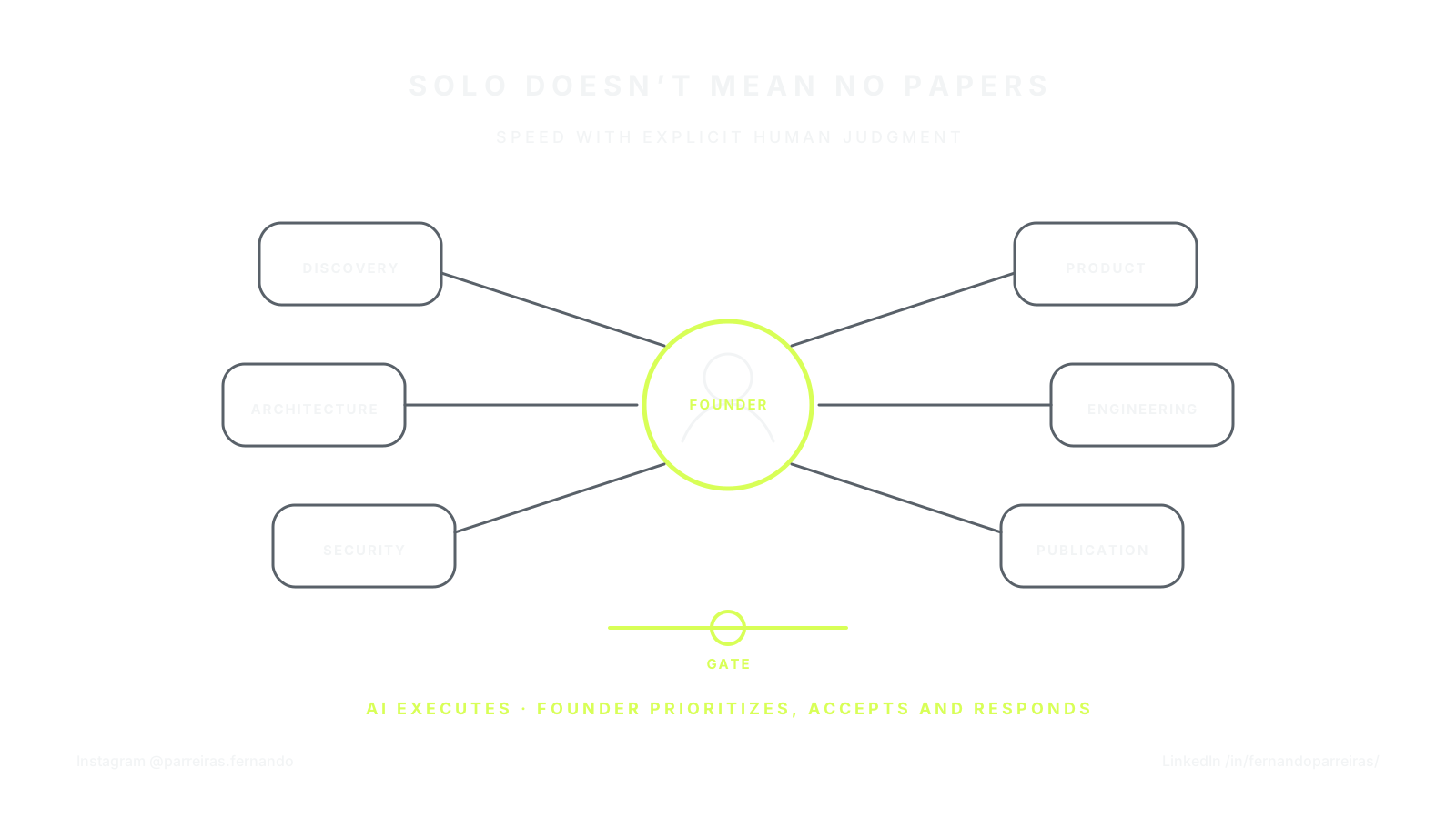
A founder alone can research, design, program, test, document and publish with the help of agents. The new capability is extraordinary. She also concentrates product, architecture, security, quality and business in the same person.
The problem is not working alone. It's letting speed hide the absence of roles, criteria and counterpoint.
Executive summary
An AI squad extends execution when the founder operates as accountable orchestrator, not as a spectator of autonomous agents.
| Paper | Can be assisted by AI | Continues demanding decision from founder |
|---|---|---|
| discovery | research, synthesis, script | real contact and interpretation |
| product | alternatives, specs, prototypes | priority and promise |
| architecture | options, diagrams, analysis | accepted risk and boundaries |
| engineering | implementation and testing | definition of ready |
| security | scans and threat prompts | authority and exception |
| publication | build, SEO, distribution | claim audience and reputation |
founder doesn't need to do everything manually. You need to know who is doing what, under what contract and how the result will be accepted.
Roles matter even without different people
Architect, backend, QA and security don't have to mean four fixed models or four subscriptions. They are different perspectives and authorities.
In the same initiative, a person can occupy several roles at different times. The important thing is not to collapse them into the same statement:
explorar -> propor -> implementar -> verificar -> aceitarIf the same agent is given context to do everything and founder just reads the final summary, failures and incentives remain in the same circuit.
Public multi-agent architectures show that roles can be composed, while architectural decision practices record choices and consequences. They do not prescribe a universal topology. [R1-C3]
The founder as control plane
founder defines:
- which problem deserves energy;
- which hypothesis is at risk;
- which agent or tool receives the task;
- what data and capabilities are allowed;
- what evidence concludes the work;
- who or what checks;
- when to stop, escalate or publish.
This role is not micromanagement. It is governance of the execution system.
A minimum workflow for each increment
1. Specify the decision
Don’t start with “build a screen.” Start with the change the screen should allow and the hypothesis it tests.
2. Separate exploration from commitment
Agents can research alternatives in parallel. No alternative becomes architecture, expense or public claim without an explicit gate.
3. Reduce the slice
Ask for the smallest increment that produces learning or observable result. Cheap production can create a backlog that is expensive to review.
4. Set the checker
Test, checker, browser, expert or real user. The checker needs to evaluate the property that matters, not just repeat the spec text.
5. Preserve evidence
Save decision, diff, test, screenshot, feedback and limit. The next agent should not reconstruct the story from the previous chat.
6. Make human acceptance proportional to the risk
Reversible copy does not require the same data migration gate. The person remains accountable for both, but calibrates depth.
Parallelism only helps when there is decomposition
Creating five agents for an ambiguous task multiplies interpretations. Before parallelizing, explain:
- file or domain boundaries;
- dependencies between subtasks;
- exit contract;
- source of truth;
- order of integration;
- owner of the acceptance.
Sessions and workspaces help separate execution, but actual permissions need to be enforced and tested outside of model choice. [HARNESS31-C2]
The antidote to automatic agreement
A solo founder risks receiving sophisticated confirmation for the thesis itself. Create counterpoint functions:
- red team: look for how the idea fails;
- evidence checker: asks what was actually observed;
- scope guardian: remove what is not useful for the current test;
- security reviewer: tests abuse and irreversible effect;
- customer voice: uses real interviews and behavior, not synthetic personas;
- decision reviewer: compares with the initial objective.
A second agent is not automatically independent. Change context, instruction, tool and, when necessary, involve another person.
founder AI-first's agenda
A practical division of time:
| Block | Main job |
|---|---|
| direction | problem, priority, promise and limit |
| acquisition of evidence | interviews, use, sale, operation |
| orchestration | decomposition, grants, handoffs and integration |
| revision | quality, risk, claims and trade-offs |
| learning | transform failure into durable mechanism |
If all the time remains in direct production, AI has just become a faster keyboard. If all the time goes into managing agents without contact with the market, the company becomes a laboratory without recipients.
When to bring someone else
AI reduces the cost of access to knowledge and execution. It does not eliminate asymmetry of experience, legal responsibility or the need for adversarial proceedings.
Seek human review when:
- the consequence is difficult to reverse;
- lack of mastery to evaluate the output;
- there is regulatory or fiduciary duty;
- the decision affects third party data, people or money;
- the same hypothesis guides all agents;
- the founder has a strong incentive to believe.
Being solo does not mean being isolated.
What this article proves — and what it doesn't prove
Public sources support role composition, separate environments and the need for external authorization to the model. They do not demonstrate that a founder with agents replaces a team in any company or stage.
This article describes an operational model to enhance execution while preserving judgment. It doesn't promise speed, revenue, quality or product-market fit.
Conclusion
An AI squad does not transform a person into a universal expert. It offers the ability to explore and execute on multiple fronts. Value appears when founder separates roles, limits authority, demands evidence, and seeks real contact with the problem.
Speed comes from agents. Direction, judgment and responsibility remain human.
Previous reading: AI reduces the cost of experimenting. Next suggested reading: Sandbox, capability and identity.
Editorial and responsibility note
- Research cutoff
- Last review
- Recorded corrections
- No corrections recorded.
The cutoff above applies to the canonical claims. Additional sources and their access dates are identified in the article body.
This article combines cited sources, analysis, and the author's professional experience. Verifiable data and factual statements are linked to their respective sources. Interpretations, hypotheses, projections, recommendations, and opinions represent the author's professional point of view at the time of publication; they do not constitute proven facts, a promise of results, or legal, financial, or technical advice applicable to a specific case. Consult the original sources and qualified professionals before making decisions.
Claims and sources
R1-C3
Multi-agent teams and evolving architecture require explicit orchestration roles plus durable decision records with status, consequences and supersession.
Limit: The sources do not prescribe one universal team topology or ADR template. This is a research-synthesis design input; it does not prove product adoption, operational maturity, independent attestation or outcome.
- Microsoft — Microsoft, MIT/CC-BY-4.0 repository; analysis-only excerpts
- Amazon Web Services — Amazon Web Services, Public official guidance; analysis-only excerpts
- Microsoft Azure — Microsoft Azure, Public official guidance; analysis-only excerpts
HARNESS31-C2
A durable harness should maintain session history, orchestration policy and execution isolation as explicit boundaries, while adapters and plugins prevent model or channel choice from becoming the security boundary.
Limit: The sources show two implementations, not a neutral interoperability standard. Actual permissions must be independently enforced and tested outside model choices. This is a source-bound design input; it does not prove product adoption, operational maturity, independent attestation, search ranking, AI citation or outcome.
- Anthropic — Anthropic, proprietary-site-terms
- YC Software —YC Software, MIT
- YC Software —YC Software, MIT