
Executive reading · ~60 seconds
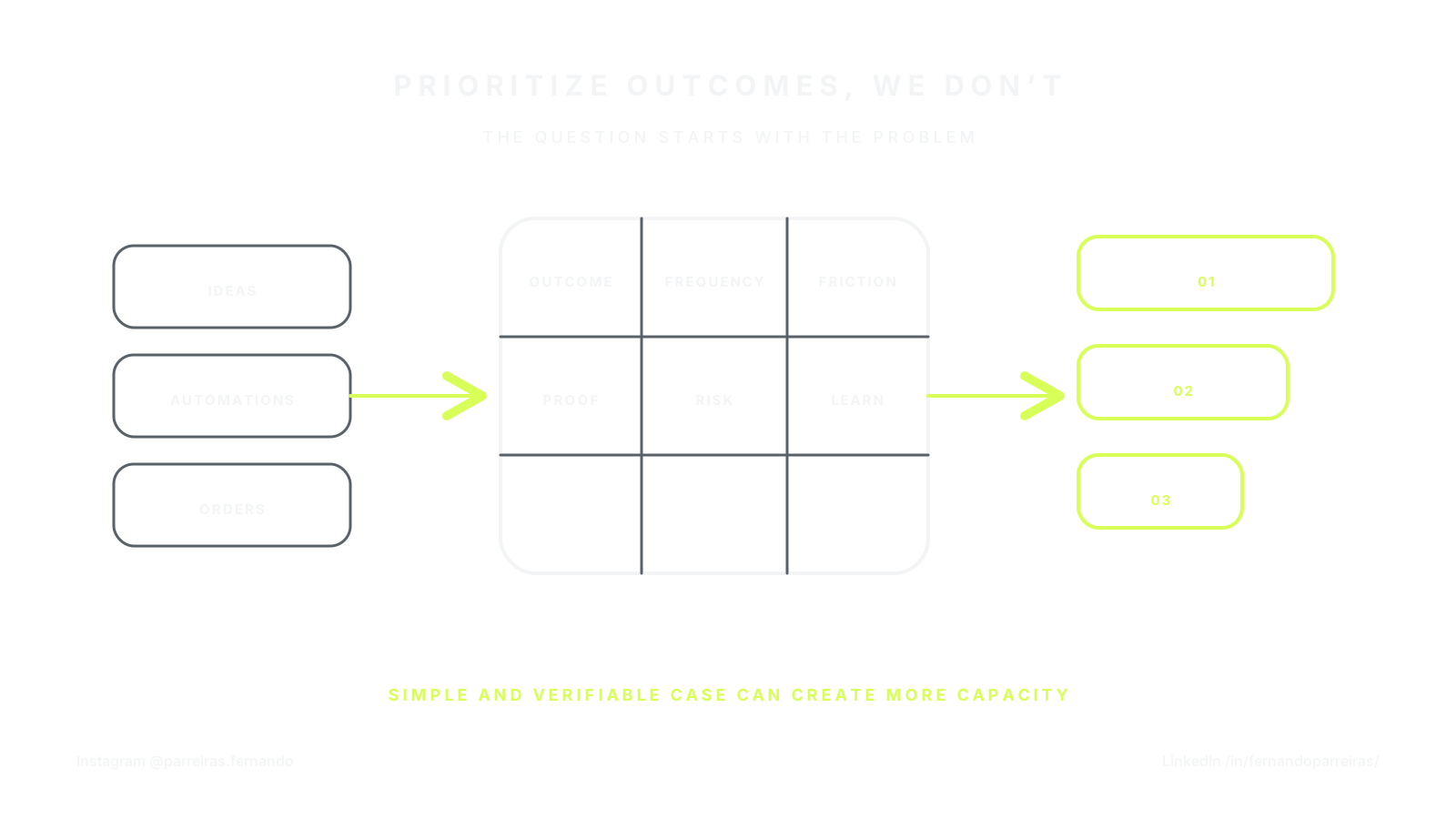
The AI queue must start with the decision or outcome to improve and consider frequency, friction, proof, risk and learning.
An organization opens the AI backlog and finds dozens of ideas: summarizing meetings, responding to emails, generating presentations, classifying leads, reviewing contracts, writing code. Almost all are technically possible. This does not mean they deserve the same priority.
The right backlog doesn’t first ask “what can AI do?” Question which decision, flow or outcome needs to improve and what risk the change introduces.
Executive summary
Prioritize opportunities across six dimensions:
| Dimension | Question |
|---|---|
| outcome | who gets anything better? |
| frequency | How often does the problem occur? |
| friction | what cost, queue or error exists today? |
| verifiability | Do we know if it was good? |
| risk | What is the effect of a failure? |
| learning | the pilot reduces which uncertainty? |
Showy automation with weak outcome is demo. Simple, frequent, and verifiable case can create greater organizational capacity.
Start with the real flow
Map:
- work trigger;
- input information;
- human decision;
- execution;
- revision;
- recipient;
- rework and exceptions;
- current metric.
AI can act on one point, but outcome depends on the entire flow. Speeding up writing does not reduce lead time if approval remains in the queue; generating more leads does not create revenue if qualification and service are the bottleneck.
Unit of value, not unit of consumption
Tokens, calls and documents measure activity. The decision unit should be closer to the result:
- case accepted without material rework;
- time until qualified decision;
- incident prevented;
- task completed in user context;
- proposal understood;
- error detected before effect.
Observability and FinOps frameworks help measure consumption and cost, but the unit needs to be product specific; a framework run does not prove client outcome. [R3-C2]
A priority matrix
Rate each opportunity from 1 to 5:
| Criterion | Suggested weight |
|---|---|
| impact on outcome | 3 |
| frequency and volume | 2 |
| ability to check | 3 |
| reversibility | 2 |
| quality of available context | 2 |
| total operating effort | -2 |
| risk of data or effect | -3 |
The score does not decide alone. It makes premises comparable. A high-risk case can be valuable and still start in the shadows, with synthetic data or a recommendation without execution.
Four types of opportunity
To attend
AI prepares, summarizes or suggests; person decides. Good for learning with low external effect.
Check
AI or rules look for inconsistencies, risks and gaps. Value appears when the alert is actionable and calibrated.
To execute
System performs a delimited action with criteria, idempotence and rollback.
Orchestrate
Agent chooses tools and paths within policy and budget. Requires greater maturity of context, eval, identity and observability.
Don't jump from assistance to orchestration just because the model seems capable.
The ideal starting case
Look for a problem that is:
- frequent enough to generate data;
- delimited enough to test;
- important enough for someone to care;
- reversible enough to learn;
- verifiable by state or clear criteria;
- close to a real owner;
- small enough not to require an entire transformation before the first signal.
The best first case is not necessarily the one with the highest theoretical ROI. This is what you teach with controlled risk and cost.
Compare with human baseline
Before the pilot, record:
- end-to-end time;
- acceptance rate;
- rework;
- operating cost;
- incidents or exceptions;
- recipient satisfaction;
- variation between people and cases.
Without baseline, every quick demo seems like a win. With baseline, the team may find that the AI saved minutes on the local step and added enough review to make the flow worse.
AI amplifies the existing queue
DORA describes AI as amplifying the strengths and weaknesses of the software development system, not as a universal cause of improvement. [CAREER-A18-C5]
This principle guides the backlog:
- clear process + fast feedback -> amplification candidate;
- ownership ambiguous -> first correct decision;
- inconsistent data -> treat origin and governance;
- quality without criteria -> define accepted;
- political queue -> automation may just produce more waiting.
The kill criterion is part of the pilot
Before you start, define when to stop:
- outcome does not improve after minimal sampling;
- total cost exceeds alternative;
- risk requires disproportionate control;
- quality depends on comprehensive review;
- user does not adopt in the real context;
- problem was less frequent than it seemed;
- bottleneck was at another stage.
Closing a pilot who answered the question is a learning success.
A balanced portfolio
Avoid going all-in on one big automation. Keep:
- cases of limited efficiency;
- quality and prevention cases;
- customer experience cases;
- foundations of data, context and control;
- a clearly marked exploration bet.
The portfolio needs to show how each case contributes to reusable capacity, not just a list of tools.
What this article proves — and what it doesn't prove
Development and observability sources support measuring the system and defining specific unit of the product. There is no universal score that calculates AI ROI before the actual operation.
This article offers a prioritization method. Weights, baseline and risk must be adjusted to the business.
Conclusion
A good AI queue starts with problems that someone recognizes, outcomes that can be measured, and risks that can be controlled.
Don't prioritize the most impressive automation. Prioritize the next uncertainty that the system can reduce with evidence.
Previous reading: From pilot to value. Next suggested reading: Seniority in the age of agents.
Editorial and responsibility note
- Research cutoff
- Last review
- Recorded corrections
- No corrections recorded.
The cutoff above applies to the canonical claims. Additional sources and their access dates are identified in the article body.
This article combines cited sources, analysis, and the author's professional experience. Verifiable data and factual statements are linked to their respective sources. Interpretations, hypotheses, projections, recommendations, and opinions represent the author's professional point of view at the time of publication; they do not constitute proven facts, a promise of results, or legal, financial, or technical advice applicable to a specific case. Consult the original sources and qualified professionals before making decisions.
Claims and sources
R3-C2
Useful AI observability must connect technical telemetry to a unit of value and its cost, instead of optimizing aggregate spend without an outcome denominator.
Limit: A unit must be product-specific; this framework-only run measures intake cost but not customer outcome. This is a research-synthesis design input; it does not prove product adoption, operational maturity, independent attestation or outcome.
- OpenTelemetry — OpenTelemetry, CC-BY-4.0 documentation; analysis-only excerpts
- FinOps Foundation — FinOps Foundation, CC-BY-4.0 framework; analysis-only excerpts
CAREER-A18-C5
DORA 2025 describes AI primarily as amplifying existing strengths and weaknesses and associates the greatest returns with the organizational system, not just the tools.
Limit: The research focuses on software development; the article uses this formulation as a design principle, not as a universal labor law. This is a source-bound design input; it does not prove product adoption, operational maturity, independent attestation, search ranking, AI citation or outcome.
- Google Cloud DORA — Google Cloud DORA, CC-BY-4.0