
Executive reading · ~60 seconds
Agents make execution more accessible; seniority remains visible in problem, trade-off, proof, responsibility and multiplication.
For a long time, seniority was confused with speed in remembering answers, mastering shortcuts and performing difficult tasks alone. Agents have made some of this capability more accessible. Seniority has not disappeared; it became more visible in the way a person frames, decides, checks and develops other people.
Executive summary
Seniority is not amount of code, prompts or meetings. It is the ability to produce outcomes under uncertainty while preserving quality, risk and learning.
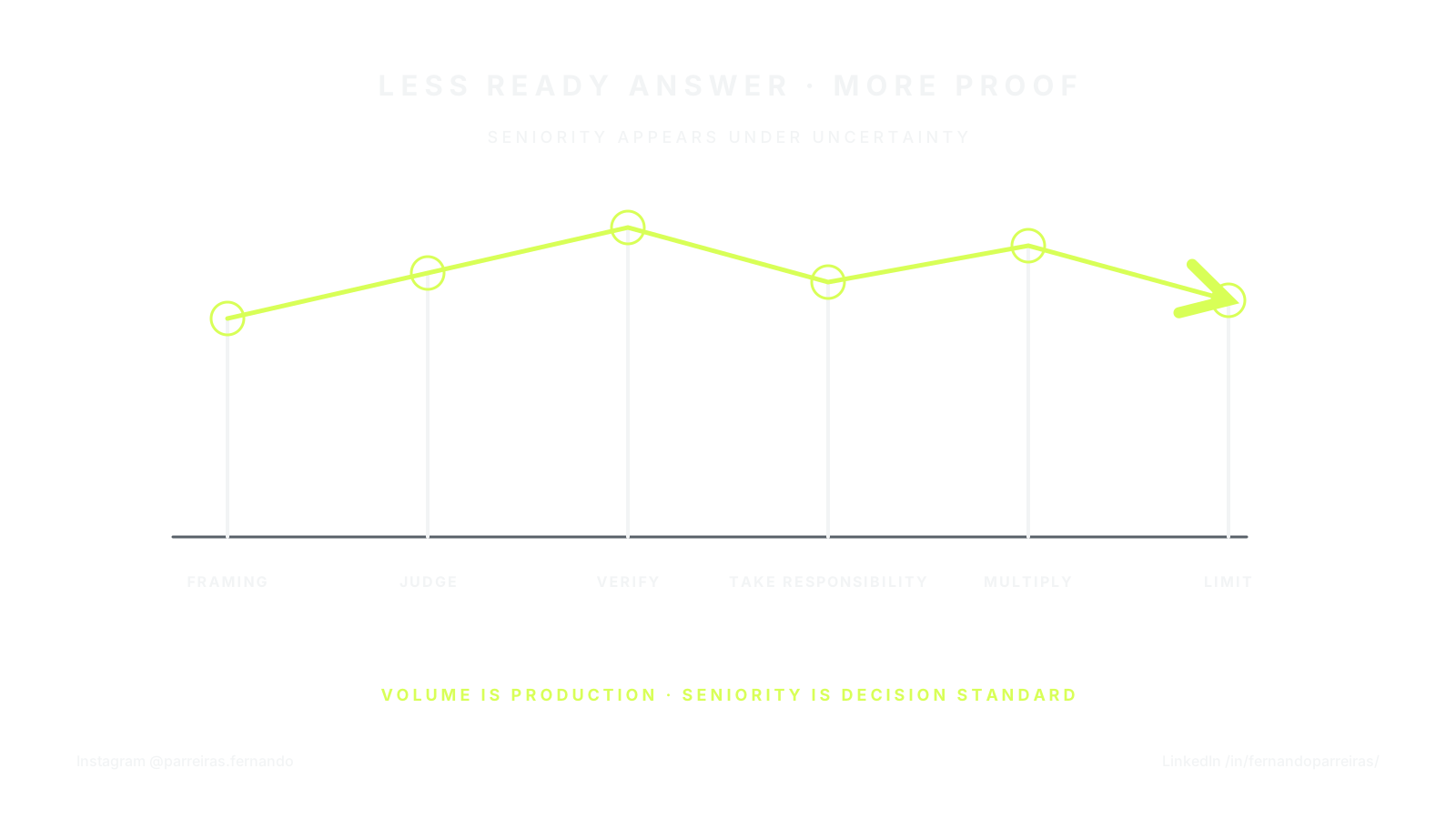
| Signal | Observable Question |
|---|---|
| framing | Did you choose the correct problem and slice? |
| judgment | Did you compare alternatives and consequences? |
| verification | required proof appropriate to the risk? |
| ownership | assumed results and correction? |
| multiplication | left the system and people better? |
| limit | Have you distinguished what you know, infer and need to validate? |
AI can speed up every step. It does not automatically produce the standard that decides whether the step was done well.
Ready response became cheap
Documentation, examples and explanations can be retrieved in seconds. This changes the value of memorizing isolated syntax and patterns, but it does not eliminate fundamentals.
A senior person recognizes:
- when the common solution does not apply;
- what information is missing;
- that abstraction creates dangerous dependency;
- where a green test does not cover the risk;
- when operational cost outweighs elegance;
- which decision needs another specialty.
These choices depend on repertoire and contact with consequences, not just access to answers.
Seniority begins before execution
Senior work reduces ambiguity before it becomes inventory:
- translates demand into problem;
- identifies recipient and outcome;
- separates need from preference;
- maps risk and reversibility;
- defines the smallest useful evidence;
- chooses who or what should execute;
- explains the acceptance criteria.
With fast agents, this framework gains importance. A misdirection can generate much more material in less time.
Reviewing AI is domain work
Don’t just ask if the answer “looks good.” Senior Review looks for:
- consistency with the system;
- impact beyond the changed file;
- negative cases;
- security and privacy;
- observability and rollback;
- claim greater than evidence;
- future maintenance;
- experience of those who receive the result.
Field experiments with developers observed productivity effects linked to specific tools, companies and tasks; results do not measure all SDLC or net employment. [CAREER-A18-C2]
This prevents transforming “the agent writes faster” into “engineering just got better”.
The specialist remains essential
Models generalize over a lot of content. Experts carry local context, causality, failure patterns, and professional responsibility.
The specialist does not need to compete in producing the first draft. It raises:
- the quality of the question;
- the design of the eval;
- font selection;
- the limit of autonomy;
- the judgment of exceptions;
- the acceptance decision;
- the training of those who are starting out.
The more plausible the output, the more valuable it is to know where it can mislead.
Seniority is also teaching
A senior person doesn't just fix the result. Makes the pattern understandable and reusable:
- explains why an option was rejected;
- creates examples and counterexamples;
- converts incident into test;
- gives feedback on the process, not just answers;
- allows someone else to take on the next case;
- records the decision in the right place.
If all quality depends on silent review by a single person, the system remains fragile.
The risk for those just starting out
Studies in a support context have observed greater gains for less experienced workers, but this does not represent every entry role nor guarantee development of expertise. [CAREER-A18-C1]
AI can offer explanations, examples and immediate feedback. You can also remove tasks that previously created a repertoire. A development program needs to ensure that juniors:
- make predictions before consulting;
- explain choices;
- read traces and errors;
- assume real slices with protection;
- receive feedback from experts;
- see the consequence of the work;
- practice without outsourcing understanding.
A growth rubric
Evaluate a professional on four levels:
Execute with guidance
Uses AI and tools within a clear contract; checks the basics and reports blockages.
Decide on the domain
Decomposes, compares alternatives, handles negative cases and assumes bounded outcomes.
Design the system
Defines standards, controls, observability and interfaces between people and agents.
Multiplies capacity
Improves platform, method, learning and development of others.
Levels are not universal roles. They are a map to evidence of growth.
How to prove seniority
In a case, show:
- context and constraint;
- difficult decision;
- rejected alternative;
- how AI was used;
- chosen check;
- fault found;
- result and limit;
- what changed in the system afterwards.
Occupational exposure varies by task and does not determine an individual trajectory. [CAREER-A18-C3] Your portfolio needs to show how you work within this range.
What this article proves — and what it doesn't prove
Research shows heterogeneous effects by task, experience and context, in addition to the potential transformation of occupations. They do not define a new universal career ladder, nor do they prove that every senior role will gain value.
The rubric is an authorial proposal. Organizations need to calibrate it to domain, risk and responsibilities.
Conclusion
Seniority in the age of agents appears less in having all the answers and more in building conditions for answers to become reliable decisions.
The senior person chooses the problem, sets the standard of proof, accepts responsibility, and leaves the organization more capable after delivery.
Previous reading: Taste, responsibility and clarity. Next suggested reading: Evals before release.
Editorial and responsibility note
- Research cutoff
- Last review
- Recorded corrections
- No corrections recorded.
The cutoff above applies to the canonical claims. Additional sources and their access dates are identified in the article body.
This article combines cited sources, analysis, and the author's professional experience. Verifiable data and factual statements are linked to their respective sources. Interpretations, hypotheses, projections, recommendations, and opinions represent the author's professional point of view at the time of publication; they do not constitute proven facts, a promise of results, or legal, financial, or technical advice applicable to a specific case. Consult the original sources and qualified professionals before making decisions.
Claims and sources
CAREER-A18-C2
In three field experiments with 4.867 developers, the data set showed 26.08% more tasks completed among those who had access to the assistant, with greater adoption and gains among less experienced professionals.
Limit: Individual experiments are noisy, use a specific tool and company, and do not measure broad software quality or net employment. This is a source-bound design input; it does not prove product adoption, operational maturity, independent attestation, search ranking, AI citation or outcome.
- Microsoft Research — Microsoft Research, Microsoft website terms
CAREER-A18-C1
In the field study with 5.172 customer support agents, access to the assistant increased the average number of problems resolved per hour by 15%; the lowest skill quintile had a gain of 36%, and the gains were concentrated among less skilled and less experienced professionals.
Limit: The result comes from customer support in a company and does not prove equal effect in every occupation, nor disappearance of input functions; 36% does not represent the entire group of beginners or less experienced. This is a source-bound design input; it does not prove product adoption, operational maturity, independent attestation, search ranking, AI citation or outcome.
- Oxford University Press/The Quarterly Journal of Economics —Oxford University Press / The Quarterly Journal of Economics, CC-BY-NC-4.0
CAREER-A18-C3
The ILO global index estimates that one in four employed people is in an occupation with some degree of exposure to generative AI and that 3.3% of global employment is in the highest exposure category.
Limit: Potential task exposure is not realized automation, job loss, speed of adoption, or deterministic forecasting. This is a source-bound design input; it does not prove product adoption, operational maturity, independent attestation, search ranking, AI citation or outcome.
- International Labor Organization — International Labor Organization, CC-BY-4.0