
Executive reading · ~60 seconds
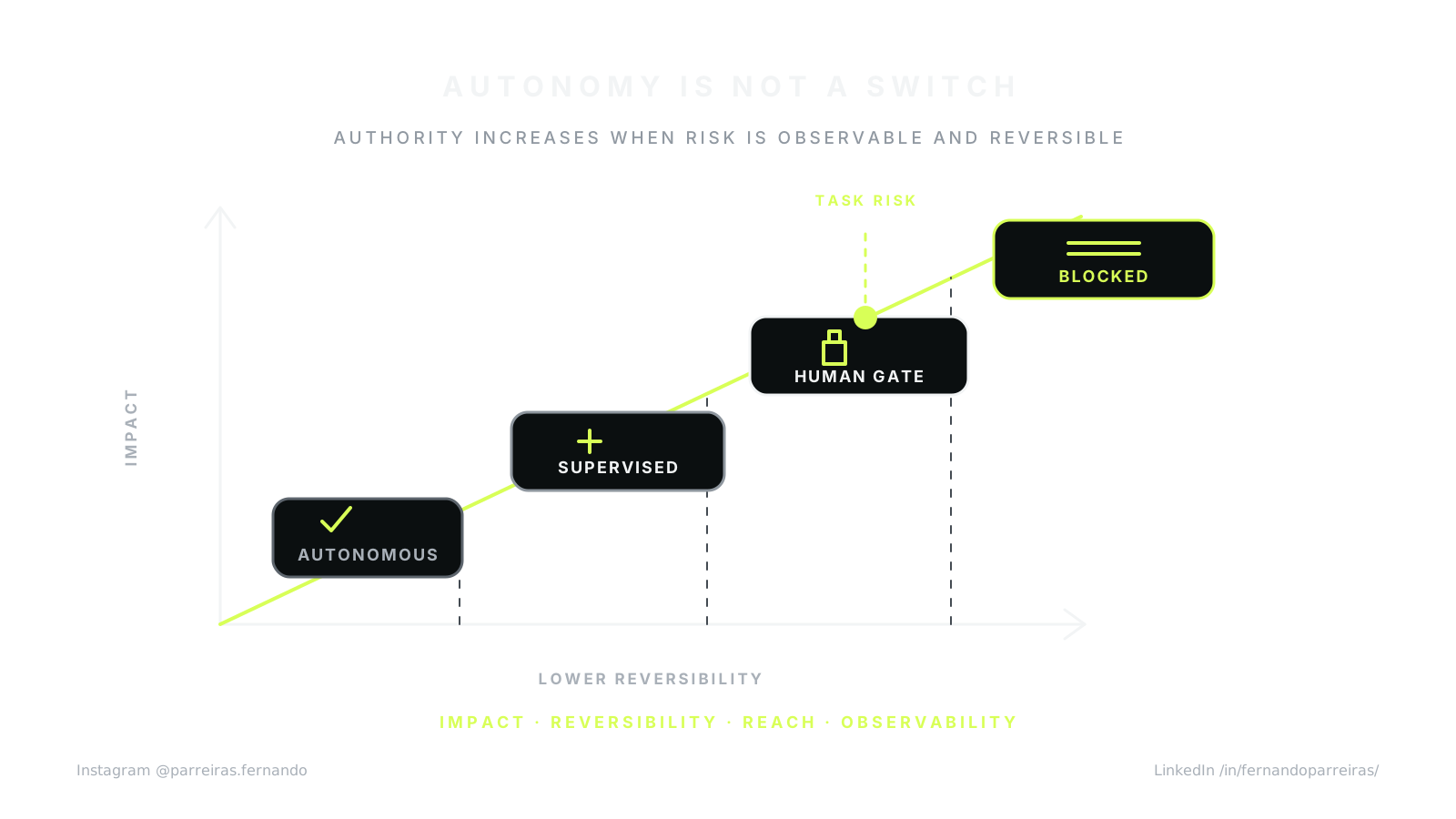
Autonomy is the authority to act, not intelligence. The contract must vary according to effect, reversibility, sensitivity and uncertainty; the greater the risk, the more explicit policy, verification, evidence, revocation and human acceptance need to be.
“How much autonomy should we give AI?” It looks like a question about trust in the model. In practice, it is a question about the system: what action can occur, on what data, in what environment, with what effect, reversibility, supervision and evidence.
The same model can be given broad autonomy to organize personal notes and no authority to approve credit, publish a commercial promise or remove data. Capacity does not determine grant. Declared trust does not replace control.
This article presents a practical way to scale autonomy without falling to the extremes of blocking all use or handing over irreversible decisions to a probabilistic executor.
Executive summary
The NIST AI RMF organizes risk management as an ongoing activity throughout the lifecycle, with governance spanning mapping, measuring and managing. He also recommends differentiating roles and responsibilities in human–AI settings. THE OWASP AISVS, on the other hand, offers testable security requirements for AI-enabled systems. Neither provides universal authorization for a specific agent; the exact profile remains environment and threat model dependent. [R2-C1] [R2-C3]
The FORGE proposal is to link autonomy to four axes: effect, reversibility, sensitivity and uncertainty. The larger any axis, the more explicit policy, verification, evidence and human gate need to be. The human doesn't need to click on everything; needs to retain authority where error is difficult to detect, attribute or reverse.
Autonomy is not intelligence
Intelligence describes the ability to produce or select actions. Autonomy describes authority to execute them without new approval. Mixing the two creates the dangerous argument: “the model has improved, so it can do more”.
Responsible promotion asks:
- Does the system know the task limit?
- Is the executing identity verifiable?
- tools and data use allowlist?
- Is there a budget for action, time and cost?
- Is the effect observable and reversible?
- Are critical failures detected before leaving the border?
- Who accepts the residual risk?
The model participates in the execution. The organization continues to own the authority.
The four axes of action risk
Effect
A private suggestion and a message sent to the customer do not have the same effect. Read, write, publish, transact, and destroy as different classes, even when they belong to the same stream.
Reversibility
Reverting a draft is simple. Recovering an exposed secret, a financial transfer or a regulatory decision may be impossible. The smaller the reversal window, the sooner the gate should appear.
Sensitivity
Public, internal, personal, financial, legal and credential data require distinct boundaries. Access to data does not imply permission to transform or send it.
Uncertainty
Tasks with objective criteria and a stable environment support more automation. Ambiguity, exceptions, context change, and subjective evaluation increase the need for human containment and sampling.
A five-level operating scale
| Level | AI Authority | Example | Minimum gate |
|---|---|---|---|
| 0 | observe | read permitted data and explain | logging and minimization |
| 1 | propose | create draft or plan | review before effect |
| 2 | perform reversible | change branch or sandbox | checker + rollback |
| 3 | run limited | act externally on allowlist | policy, limit and human sampling |
| 4 | execute critical | sensitive or irreversible effect | nominal human approval and strong evidence |
Level 4 does not mean “forbidden forever”. It means that unattended execution is not the default. To reduce gate, the system needs to demonstrate controls, history, and the ability to detect failures in the exact scope — not just present a newer model.
The autonomy contract
Before handing over a tool to the agent, record:
| Field | Question |
|---|---|
| Subject | which agent, version, tenant and session? |
| Objective | what delimited result can you pursue? |
| Capabilities | what tools, operations and destinations? |
| Data | which classes can be read, written or sent? |
| budget | how many actions, time, cost and depth? |
| Stop conditions | When should you stop, ask for help or fail closed? |
| Verification | What needs to turn green before it takes effect? |
| Evidence | which trace, diff, receipt and decision will be preserved? |
| Revocation | How to remove authority during execution? |
The contract must be business-readable and technology-enforceable. “Use common sense” is not policy.
Human gates that really help
A poorly designed human gate transfers noise: dozens of approvals, insufficient context, and pressure to click. The goal is not to maximize clicks; is to place judgment at the point where he changes the decision.
A good approval request shows:
- proposed action and recipient;
- motive and evidence used;
- data that will leave the border;
- alternatives considered;
- expected effects and rollback;
- checks already carried out;
- residual risk that the person is accepting.
If the person needs to reconstruct the entire work, the agent has not prepared a decision; just forwarded a task.
Shadow before authority
For risk-relevant flows, execute first with no external effect. Compare the proposed action with the real process, record divergences and test stop conditions. Shadow produces evidence without implicitly promoting authority.
A mature sequence might be:
- replay in synthetic fixture;
- shadow with data allowed and no effect;
- reversible execution with narrow scope;
- canary with allowlist and supervision;
- expansion conditioned on metrics and incidents;
- Automatic rollback when the boundary fails.
Elapsed time does not promote the system. Reviewed evidence can promote.
The delegation matrix
| Action | Effect | Reversible | Given | Uncertainty | Decision |
|---|---|---|---|---|---|
| summarize public document | internal | yes | public | low | execute |
| prepare commercial proposal | draft | yes | internal | average | propose |
| send proposal to customer | external | partial | commercial | average | human approval |
| change pricing policy | systemic | partial | financial | high | nominal human authority |
| revoke leaked credential | security | yes, urgent | secret | low | pre-authorized automation + evidence |
The last example shows why “high effect = always human” is also simplistic. In incident response, a critical, delimited and pre-authorized action may need to be automatic. The contract is more precise than intuition.
Metrics that justify expanding authority
Don't just use average success rate. Please note:
- critical failure by action class;
- detection before versus after the effect;
- rollback time and rate;
- divergence between proposal and human decision;
- exceptions outside the contract;
- concentration of failures by population or data;
- cost of supervision;
- near-incidents and triggered stop conditions.
A correct stop is a sign of control, not necessarily a product failure.
What this article proves — and what it doesn't prove
NIST and OWASP support ongoing risk management, explicit responsibilities, and verifiable requirements. The FORGE canonical sources also outline which controls need to be adjusted to the environment. [R2-C1] [R2-C3]
The five-level scale and four axes are an operational synthesis of FORGE. They do not replace legal, regulatory, security, or domain impact assessment. They also do not guarantee absence of damage. They serve to prevent an authority decision from being made solely based on the model name or a successful demonstration.
Conclusion
Safe autonomy is not the absence of humans. It is explicit distribution of authority.
AI can perform more and more, but the organization needs to decide where the effect starts, who accepts the risk, how the action is verified and what evidence allows it to extend or revoke the grant. The goal is not to keep people on every click; is to maintain responsibility for irreversible points.
Previous reading: Spec-driven without self-deception. Next reading: *Evidence before adjective*, on 08/20 at Trustyu Forge.
Editorial and responsibility note
- Research cutoff
- Last review
- Recorded corrections
- No corrections recorded.
The cutoff above applies to the canonical claims. Additional sources and their access dates are identified in the article body.
This article combines cited sources, analysis, and the author's professional experience. Verifiable data and factual statements are linked to their respective sources. Interpretations, hypotheses, projections, recommendations, and opinions represent the author's professional point of view at the time of publication; they do not constitute proven facts, a promise of results, or legal, financial, or technical advice applicable to a specific case. Consult the original sources and qualified professionals before making decisions.
Claims and sources
R2-C1
AI assurance needs reproducible tests and measurable evidence mapped to explicit verification requirements; policy prose alone is insufficient.
Limit: Dioptra and AISVS cover different scopes; neither is a turnkey certification of a FORGE deployment. This is a research-synthesis design input; it does not prove product adoption, operational maturity, independent attestation or outcome.
- NIST — NIST, NIST public-domain repository; analysis-only excerpts
- OWASP Foundation — OWASP Foundation, CC-BY-SA-4.0 standard; analysis-only excerpts
R2-C3
Least privilege, isolated execution and supply-chain provenance are complementary controls; no substitutes for the others in an agentic system.
Limit: The exact control profile remains environment-specific and must be threat-modeled per product. This is a research-synthesis design input; it does not prove product adoption, operational maturity, independent attestation or outcome.
- OpenAI — OpenAI, Apache-2.0 repository; analysis-only excerpts
- OWASP Foundation — OWASP Foundation, CC-BY-SA-4.0 standard; analysis-only excerpts
- OpenSSF SLSA — OpenSSF SLSA, CC-BY-4.0 specification; analysis-only excerpts