
Executive reading · ~60 seconds
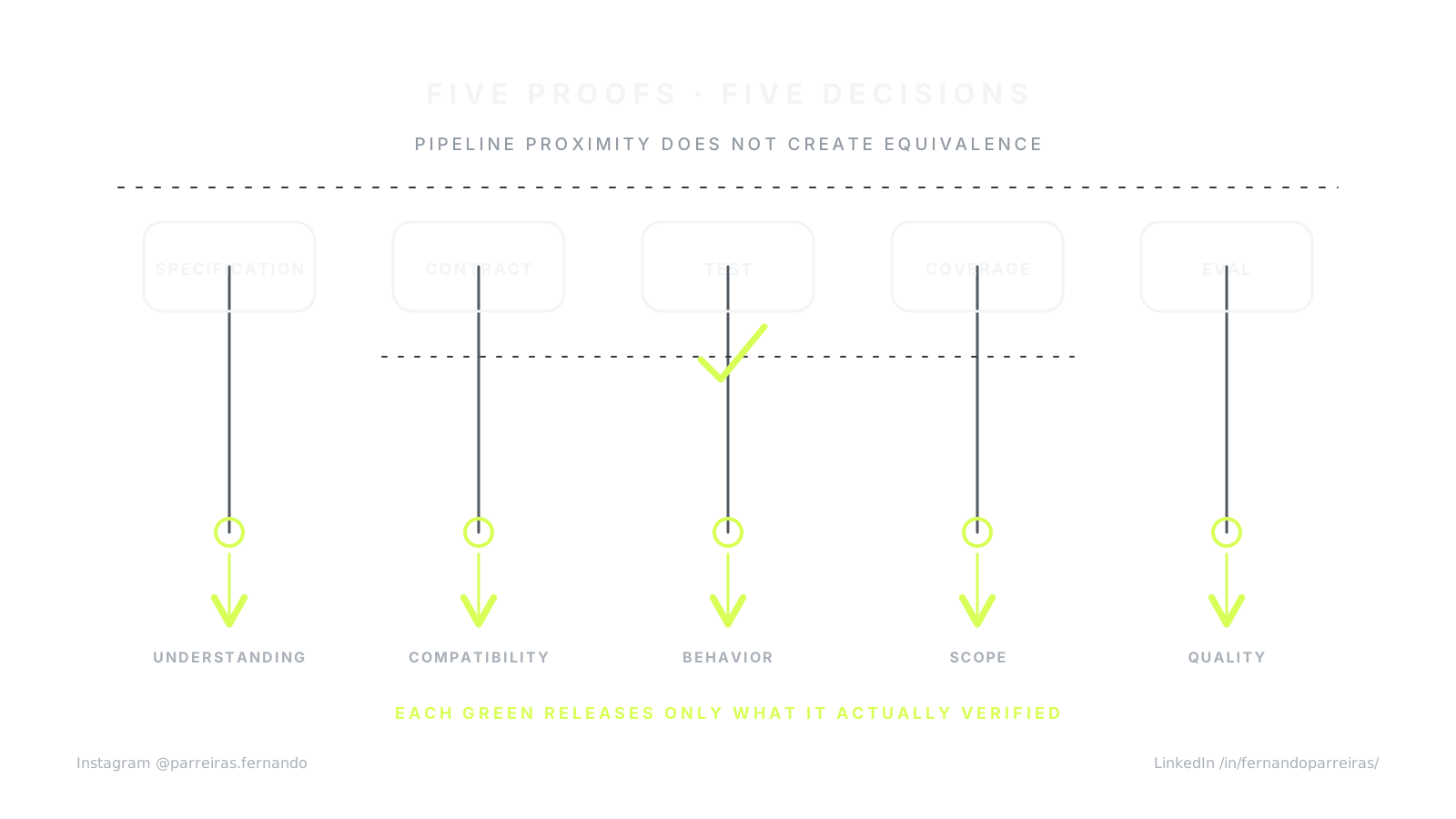
Specification, API contract, test, coverage and eval answer different questions. A verifiable pipeline links each property to the subject, mechanism, evidence and decision that the result can release; Proximity between checks does not create semantic equivalence.
Teams that adopt AI quickly learn to ask for evidence before accepting a change. The problem begins when disparate evidence is compressed into a single word: “green.” The suite has passed, coverage has gone up, the contract exists, the schema is valid and eval has improved. Therefore, it is concluded that the system is correct.
This conclusion does not follow the premises. Each mechanism answers a different question. When we treat proximity in the pipeline as semantic equivalence, we build a beautiful dashboard for a certainty that was never produced.
Spec-driven does not mean writing a specification and relying on it. It means maintaining a traceable chain between intent, properties, verification mechanisms, evidence and acceptance decision.
Executive summary
A description OpenAPI tells how consumers and tools can understand an HTTP interface; a compatibility diff looks for structural changes; a test run observes behavior; a coverage metric tells you what was exercised; and an eval measures a behavioral property under a set of tasks and graders. They are complementary layers, not substitutes. [API31-C1]
Even within a single layer there are limits. oasdiff documents OpenAPI 3.1 comparison and breaking change rules, but a green diff does not certify business compatibility. Coverage percentage, in turn, does not prove relevance of tests, correction or risk coverage. [API31-C2] [API31-C4]
Responsible design starts with a simple question: Which property does this green really authorize to assert? The answer must be explicit before the pipeline runs.
Five mechanisms, five questions
| Mechanism | Question that answers | Does not authorize completion |
|---|---|---|
| Spec | Has the desired behavior been stated? | that the implementation complies |
| API Agreement | Is the interface versioned and understandable? | that the business rule is correct |
| Test | Did this example run produce the expected result? | that all risks have been covered |
| Coverage | Which parts were exercised? | that the tests are relevant or sufficient |
| Eval | How did the system behave in this bank, grader and environment? | that behavior generalizes universally |
The table does not create a fixed hierarchy. In a pure library, contract and unit testing may be the center. In an agent that changes data, policy, sandbox, eval and observability may be more important. The composition depends on the risk.
Start with the property, not the tool
“Add eval” is not a verifiable requirement. “In one hundred representative scenarios, the agent never sends a message without valid consent and every blocked attempt generates attributable evidence” is a candidate property.
For each property, record:
- subject — which version of the system is being examined;
- stimulus — task, input and environment;
- oracle — who or what decides the outcome;
- limit — which condition needs to be satisfied;
- evidence — where the immutable result can be inspected;
- authority — which decision the green can release.
Without subject, a report may belong to the wrong commit. Without an oracle, the output becomes opinion. Without limit, any number can be called an improvement. Without authority, green exists but no one knows what it unlocks.
OpenAPI is description; compatibility is a bigger decision
The OpenAPI specification defines a language-independent interface description for people and computers to understand a service's capabilities. This reduces ambiguity in the integration, but does not carry all the business semantics.
Consider a field limite_aprovado which remains numeric and mandatory. The API can remain structurally compatible while a unit, policy, or rounding change breaks the operation. The structural diff deserves to be green; the business invariant test deserves to fail. They are coherent results because they examine different properties.
The error is not in the tool. It’s about presenting “no breaking change” as “no impact”.
Coverage is a map, not a verdict
Coverage shows areas visited during the run. It helps locate silence: branches never exercised, forgotten modules, untested deltas. But an executed line may be poorly checked; a test may reproduce the implementation rather than the requirement; a critical case may represent a small fraction of the code.
In FORGE, useful reading separates at least line, branch, scope, delta and threshold. Still, these fields are signs of testing, not resolved risk. [API31-C4]
To not turn percentage into theater:
- link critical scenarios to the properties they protect;
- use coverage to discover gaps, not to declare correctness;
- treat new code and high risk differently than historically;
- require evidence of the test that fails when property is violated.
Eval is a versioned experiment
An eval needs a task bank, environment, system configuration, grader, aggregation rule and baseline. Changing any of these elements changes the experiment.
An aggregate number can hide classes of failure. An agent can improve the average and worsen irreversible cases. A model grader may prefer style and miss facts. A benchmark may contain broken tasks. Therefore, eval is not a medal; it is a decision infrastructure.
The minimal panel records:
| Field | Example |
|---|---|
| Bank | 120 versioned tasks per domain and risk |
| Environment | tools, synthetic data and policies available |
| System | model, prompt, harness and commit |
| Graders | deterministic, model and sample human review |
| Metrics | success by class, critical failure, cost and latency |
| Decision | promote, shadow, correct or block |
The most important test: violating property
A gate only demonstrates strength when the prohibited condition causes it to fail. Before trusting the pipeline, perform a deliberate negative case:
- remove a required field and confirm contract failure;
- introduce an incompatible change and commit the diff;
- delete the test from a critical branch and observe coverage;
- make the agent try to overcome an authority and confirm the block;
- change the subject of the evidence and confirm that the binding fails.
The negative case distinguishes executable mechanism from aspirational documentation.
An evidence matrix for PR
| Property | Mechanism | Evidence | Limit | Decision |
|---|---|---|---|---|
| interface does not lose mandatory field | contract diff | report linked to spec digest | zero rupture classified as blocking | merge blocked |
| rule calculates correct value | example and property tests | suite linked to commit | all critical invariants pass | merge released |
| agent behavior preserves policy | eval + adversarial cases | results by task and trace | zero external action without grant | promotion blocked |
| regression doesn't come back | negative test | case reproduces the previous failure | red before, green after | terminable incident |
The matrix does not need to cover each product line. It needs to cover the properties that support the decision being made.
What this article proves — and what it doesn't prove
FORGE sources and contracts support the separation of description, diff, execution, coverage, and eval. They do not define a universal recipe for tools, thresholds or number of tests. A regulated product and an internal prototype need different profiles.
There is also no automatic independence because a second model evaluated the first. If both share context, incentive, error, or authority, there is separation of calls, not necessarily separation of control.
Conclusion
Spec-driven is a traceability discipline, not a label.
A specification declares intent. A contract structures an interface. A test looks at examples. Coverage reveals exercised areas. An eval measures behavior in an experiment. When each green maintains its question, its subject and its limit, the group can support a defensible decision.
When everyone just saw “CI passed”, the system loses exactly the precision that engineering was supposed to create.
Previous reading: Engineering harness in practice. Next reading: *Autonomy proportional to risk*, on 08/18 at Trustyu Forge.
Editorial and responsibility note
- Research cutoff
- Last review
- Recorded corrections
- No corrections recorded.
The cutoff above applies to the canonical claims. Additional sources and their access dates are identified in the article body.
This article combines cited sources, analysis, and the author's professional experience. Verifiable data and factual statements are linked to their respective sources. Interpretations, hypotheses, projections, recommendations, and opinions represent the author's professional point of view at the time of publication; they do not constitute proven facts, a promise of results, or legal, financial, or technical advice applicable to a specific case. Consult the original sources and qualified professionals before making decisions.
Claims and sources
API31-C1
A versioned API description, a compatibility diff and an executed request specification are separate evidence layers; FORGE should keep them distinct and bind each result to the same contract version.
Limit: The selected positive intake covers official AsyncAPI 3.1.0 repository and schema artifacts, not the normative spec/asyncapi.md source of truth. OpenAPI 3.1.2 also remains a candidate not admitted by the v1 fetch policy, so this claim asserts neither AsyncAPI nor OpenAPI conformance. This is a source-bound design input; it does not prove product adoption, operational maturity, independent attestation, search ranking, AI citation or outcome.
- AsyncAPI Initiative — AsyncAPI Initiative, Apache-2.0
- AsyncAPI Initiative — AsyncAPI Initiative, Apache-2.0
- oasdiff — oasdiff, Apache-2.0
- rswag —rswag, MIT
API31-C2
oasdiff v1.27.0 documents OpenAPI 3.1 comparison and breaking-change rules; this is a useful CI control, not proof of semantic or business compatibility.
Limit: This claim describes asdiff only. Rule coverage can lag a specification or miss domain invariants, and a green diff cannot certify business compatibility. This is a source-bound design input; it does not prove product adoption, operational maturity, independent attestation, search ranking, AI citation or outcome.
API31-C4
FORGE coverage evidence should be tool-neutral and normalize at least line, branch, scope, delta and threshold fields; SimpleCov and coverage.py remain language adapters, while an interchange report is not a quality verdict.
Limit: The exact normalized FORGE schema remains a framework decision. Coverage percentage cannot prove test relevance, correctness, risk coverage or absence of defects. This is a source-bound design input; it does not prove product adoption, operational maturity, independent attestation, search ranking, AI citation or outcome.
- Ruby — Ruby, Ruby-License-or-BSD-2-Clause
- SimpleCov —SimpleCov, MIT
- coverage.py — coverage.py, Apache-2.0
- GitHub — GitHub, CC-BY-4.0
- Coverage — Penthouse, GPL-2.0