
Executive reading · ~60 seconds
CVE-2026-110732 shows that administrative consent does not replace authorization applied before an MCP client is registered. The directory reported 90,000 plugin installations, not 90,000 vulnerable installations.
A consent screen can show an administrator what a client intends to do. It does not replace authorization applied before that client is registered, nor does it protect the approval interface by itself. This is the technical point of CVE-2026-110732, disclosed for the AI Engine plugin for WordPress.
Status: Evidence Brief approved for publication. Editorial series: Papers we read for you. The text does not reproduce a vulnerable route, payload, target URL, or exploitation procedure.
What the sources support
The public advisory rates the issue High with a CVSS 3.1 score of 7.5. It states that versions through 3.8.6 were affected and that the condition involved the MCP module's OAuth flow: a client could be registered without the expected authorization and then depend on an administrator's approval on the consent screen. Human interaction was required; lack of prior privilege alone did not mean automatic compromise.
The official WordPress directory reported more than 90,000 active plugin installations at the research cutoff. That number describes the plugin's total population. It does not show how many installations used an affected version, had MCP enabled, were reachable, or were exploitable. Converting it into ‘90,000 vulnerable sites’ would be an unwarranted inference.
The vendor response
The official changeset associates the fix with version 3.8.7. At the editorial cutoff, the directory already displayed later versions. The minimum action is to upgrade to a compatible fixed version and verify the artifact actually installed; a changelog page does not prove that every environment was updated.
The architecture mistake that extends beyond this case
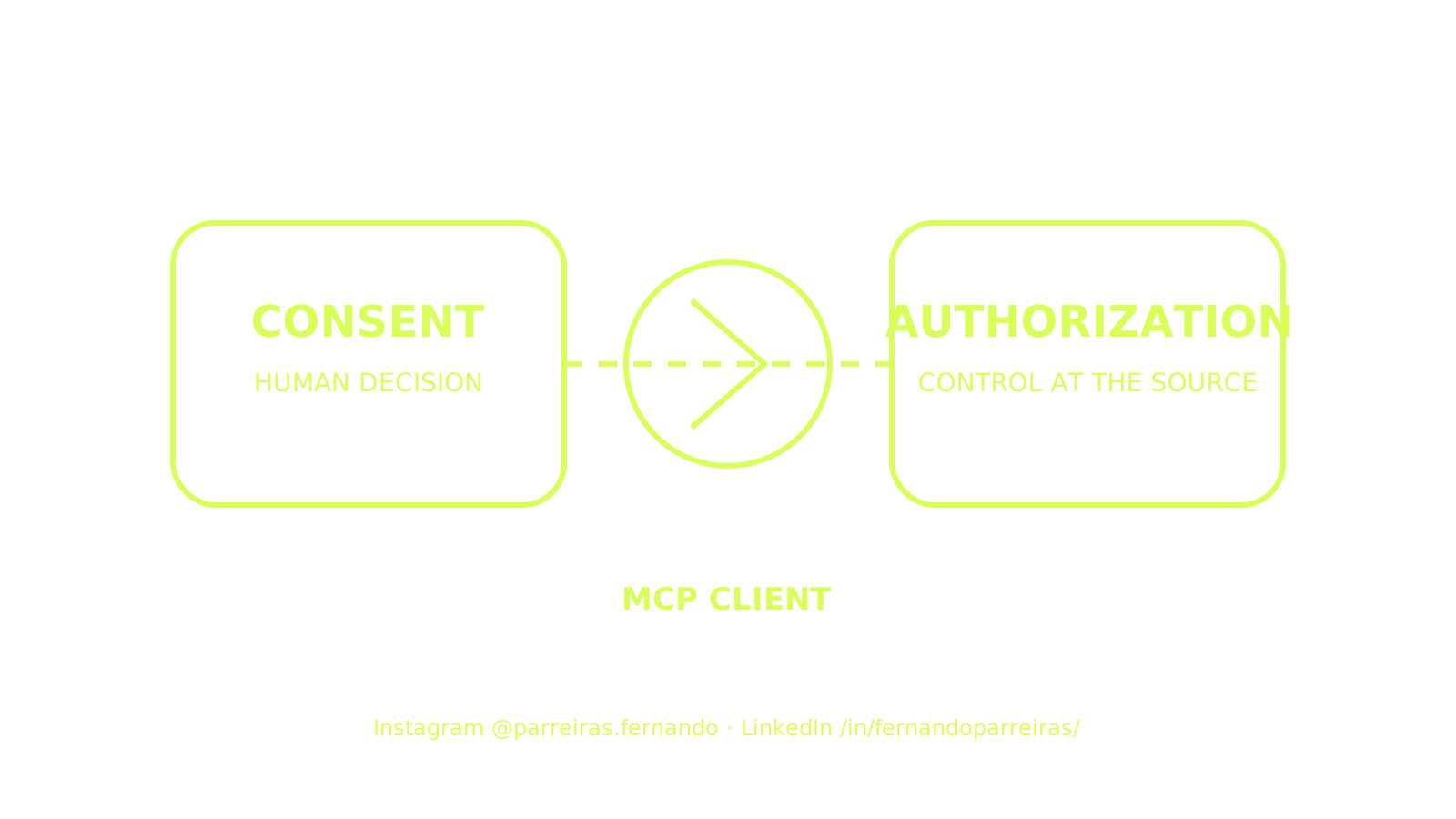
Consent and authorization answer different questions. Consent records a human decision about a request. Authorization determines whether the identity may perform the operation in that state, on that resource, and within that limit. If the system creates trust before this check, the final screen becomes the last obstacle in a chain that has already granted too much power.
In the Forge canon, minimum identity, explicit capability, and isolation are complementary controls; none replaces the others. This is architecture guidance, not evidence that a specific product has adopted or proven these controls. [R2-C3]
Verification contract
| Question | Minimal evidence | What it does not allow us to conclude |
|---|---|---|
| Who may register a client? | identity, authorization rule, and negative test | that the entire OAuth flow is secure |
| Does approval resist improper framing? | headers and behavior observed in the browser | absence of other forms of inducement |
| Which version is active? | package and version observed in the environment | that every node was updated |
| Does the token have the minimum necessary power? | scopes, expiration, and denied actions | that the operator cannot make a mistake |
| Did remediation preserve operations? | functional regression, minimal logs, and rehearsed rollback | universal security of the new version |
Proportional controls
- upgrade to a fixed version and validate the version actually running;
- disable the MCP module where it is not part of the product;
- require authorization before registering, approving, or activating clients;
- protect the consent interface against embedding and unexpected navigation;
- limit tools and actions to the strictly necessary set;
- record approvals, revocations, and failures without storing secrets or sensitive content;
- test denied cases in an authorized environment without reproducing exploitation against third parties;
- track advisories and reopen the assessment when version, configuration, or identity changes.
Limits, conflicts, and counterpoints
The advisory derives from NVD, the GitHub database, and research published by Wordfence, a company that sells WordPress security products. The context establishes a commercial interest. The plugin code and changeset corroborate the fix, but we did not reproduce the condition or test real installations. At the editorial cutoff, we found no denominator for installed versions, confirmation of widespread exploitation, or detailed public vendor response beyond the published changes.
CVSS supports prioritization; it does not establish identical impact in every environment. A site without the MCP module enabled, an isolated environment, and an exposed installation have different surfaces. Verification must begin with the operator's own inventory.
Engineering rule
Human confirmation does not fix a trust decision made too early. In MCP integrations, the system must prove who is asking, what they may do, which resource they can reach, and how that permission is revoked—before and after consent.
Direct sources
- GHSA-22w7-p44p-2gq7, GitHub Advisory Database.
- CVE-2026-110732, NVD.
- AI Engine in the official directory, WordPress.org.
- Version 3.8.7 changeset, WordPress Plugins Trac.
- Wordfence record, commercial discovery source.
Editorial and responsibility note
This text combines facts attributed to sources with the author's analysis and technical proposal. Personal and professional views are not proven facts; numbers, versions, conditions, and limits are stated when available. The content is informational and does not replace technical, legal, regulatory, or security assessment. WordPress, AI Engine, Wordfence, GitHub, and other brands belong to their respective owners; there is no sponsorship or endorsement. No offensive procedure is reproduced. Tech Human and Trustyu operate commercially in digital-product development and governance. Research, structure, and writing received AI assistance; Fernando Parreiras authorized the topic, factual self-review, and publication on October 31, 2026, without additional independent human review.
Research cutoff: October 31, 2026. Editorial status: special Evidence Brief authorized for November 4, 2026 at 09:00 BRT.
Editorial and responsibility note
- Research cutoff
- Last review
- Recorded corrections
- No corrections recorded.
The cutoff above applies to the canonical claims. Additional sources and their access dates are identified in the article body.
This article combines cited sources, analysis, and the author's professional experience. Verifiable data and factual statements are linked to their respective sources. Interpretations, hypotheses, projections, recommendations, and opinions represent the author's professional point of view at the time of publication; they do not constitute proven facts, a promise of results, or legal, financial, or technical advice applicable to a specific case. Consult the original sources and qualified professionals before making decisions.
Claims and sources
R2-C3
Least privilege, isolated execution and supply-chain provenance are complementary controls; no substitutes for the others in an agentic system.
Limit: The exact control profile remains environment-specific and must be threat-modeled per product. This is a research-synthesis design input; it does not prove product adoption, operational maturity, independent attestation or outcome.
- OpenAI — OpenAI, Apache-2.0 repository; analysis-only excerpts
- OWASP Foundation — OWASP Foundation, CC-BY-SA-4.0 standard; analysis-only excerpts
- OpenSSF SLSA — OpenSSF SLSA, CC-BY-4.0 specification; analysis-only excerpts