
Executive reading · ~60 seconds
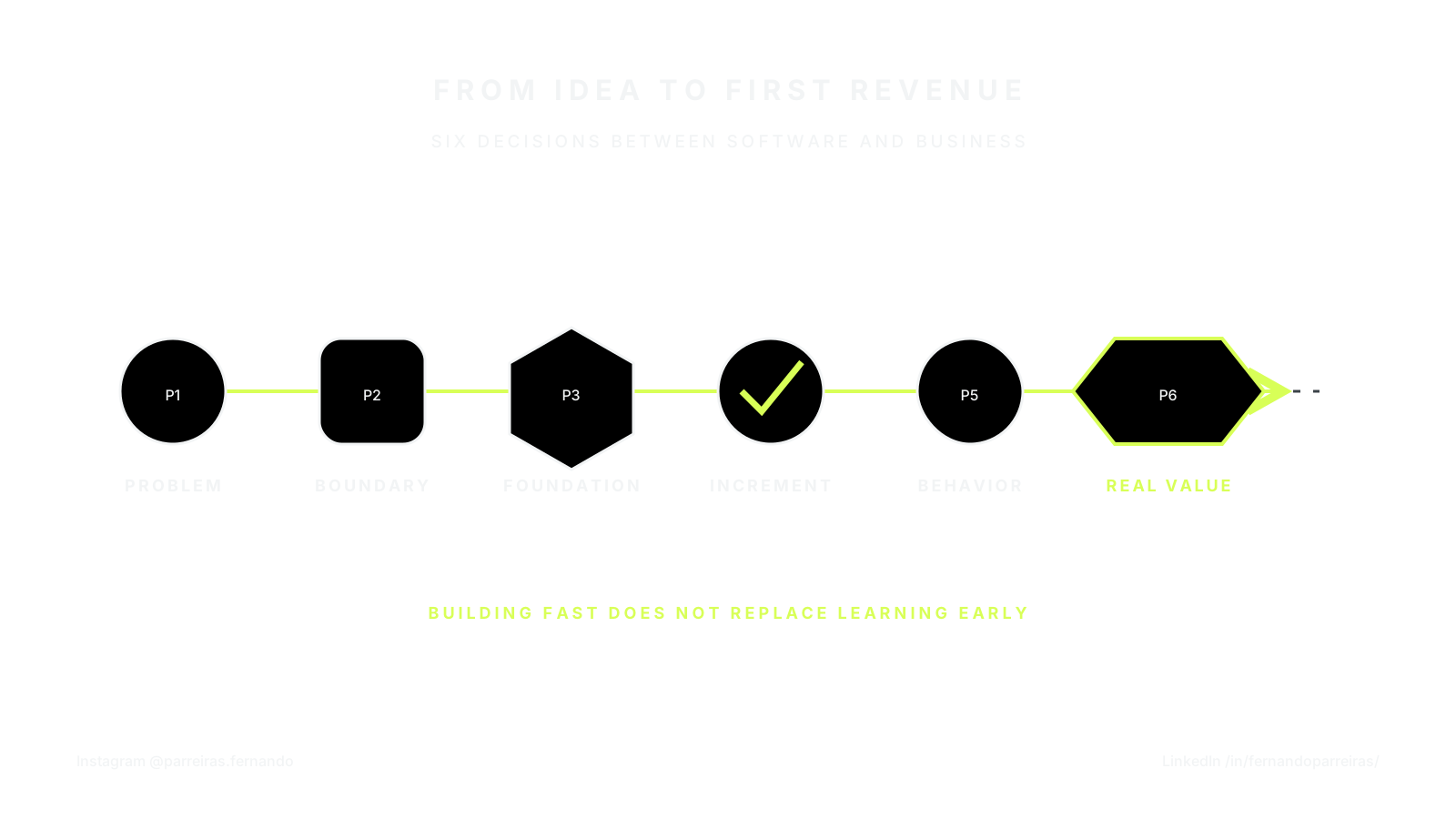
AI has compressed the path between idea and software. P1–P6 protects the path between software and business by transforming discovery, architecture, bootstrapping, development, validation and release into evidence-based decisions.
AI made it cheaper to produce a demo, a landing page, a prototype and even a first working version. This cost reduction is real and valuable. It also created a trap: confusing construction speed with business progress.
A founder can finish software before understanding who the product exists for, what decision it improves, who pays, what risk is assumed and what needs to happen for the operation to survive its first customer. P1–P6 organizes this crossing without transforming entrepreneurship into bureaucracy.
Executive summary
P1–P6 is not a treadmill on which every idea deserves to reach code. It is a decision system:
| Phase | Question that needs to be answered | Output evidence |
|---|---|---|
| P1 — Discovery | Is there a real problem, person and context? | hypotheses, interviews, alternatives and exit criteria |
| P2 — Architecture | Can the product be built and operated with clear boundaries? | contracts, risks, decisions and proof plan |
| P3 — Bootstrap | Is the minimum foundation reproducible? | repository, pipeline, environments and basic controls |
| P4 — Development | Are we reducing the greatest uncertainty in increments? | usable slices, testing, evidence and learning |
| P5 — Validation | Real people can and want to get the result? | observed behavior, failures, acceptance and decision |
| P6 — Launch | Can we deliver, support, measure and correct? | readiness, operation, distribution and feedback |
First revenue does not materialize just because every box turned green. It appears when someone recognizes enough value to exchange money, time, reputation, or commitment for the outcome. The role of the phases is to prevent the team from reaching that conversation while carrying risks it could have removed earlier.
P1: Start with uncertainty, not the interface
The first deliverable is not a backlog. It is a falsifiable thesis:
- who faces the situation;
- which progress tries to accomplish;
- how solve it today;
- why would change;
- what behavior would weaken or support the hypothesis.
AI helps to map the market, compare alternatives, prepare interviews and simulate objections. None of these activities replace contact with the real problem. A synthetic answer can improve the question; cannot be counted as the voice of the customer.
P1 ends with a decision, not enthusiasm: stop, reformulate, seek additional evidence, or authorize the next phase.
P2: architecture is design responsibility
Before the code, explain:
- what result the system produces;
- what data comes in and on what basis;
- where AI can suggest, execute or decide;
- who accepts irreversible effects;
- how faults will be detected and corrected;
- what belongs to the first cut and what remains outside.
Architecture here does not mean anticipating every detail. It means recording choices that would be expensive to discover late. AI teams continue to need orchestration roles and durable decisions; No model alone resolves consequences, supersession and ownership. [R1-C3]
P3: Build a repeatable foundation
Bootstrap turns decisions into an executable path. It must produce the minimum necessary for any subsequent increment to be born with:
- repository and environment identity;
- version and review control;
- configuration contract and secrets outside the code;
- tests and checks that fail visibly;
- deployment and rollback compatible with real maturity;
- record of decisions and work status.
Bootstrap does not prove product. It reduces the cost of testing product without rebuilding the workshop for each experiment.
P4: develop the next test
An AI-first squad can produce a lot. The risk is turning capacity into inventory. Instead of asking “how many features can fit in the sprint?”, ask:
Which increment reduces the greatest uncertainty of value, risk, or operation now?
Each slice needs to connect intent, acceptance criteria, execution, verification and evidence. Agents can implement, test and document. The human team preserves priority, quality standards and risk acceptance.
P5: Validate with behavior that may upset you
Validation is different from demonstration. In a demo, the team controls the narrative. In validation, the user may not understand, not trust, not return or not pay.
Choose evidence proportional to the hypothesis:
| Hypothesis | Evidence stronger than opinion |
|---|---|
| the problem is frequent | recent episodes and observable cost |
| the proposal is understood | person explains value without a script |
| the flow works | task completed in real context |
| there is trust | given, permission or decision actually delegated |
| there is willingness to pay | verifiable economic commitment |
A design partner can deepen learning, but does not represent the entire market. Record what was observed, the sample limit, and the next uncertainty.
P6: launching is making an operational promise
Publishing a URL is simple. Launching means assuming that acquisition, onboarding, support, security, measurement, billing and correction form a minimally coherent system.
Before earning the first revenue, check:
- who responds when the system fails;
- which commercial promise corresponds to the technical state;
- how consent, privacy and retention are handled;
- which metric represents accepted value;
- how the customer leaves, exports or cancels;
- which learning comes back to the product.
Revenue without delivery capacity can buy you a bigger problem. Readiness without business talk can hide perfectionism. P6 balances both things.
What this article proves — and what it doesn't prove
P1–P6 is a FORGE operating model for making decisions and gates explicit. Public sources on experimentation reinforce the value of falsifiable hypotheses, but do not demonstrate that a single sequence fits every business. Sector, regulation, capital, risk and maturity change depth and pace.
The article does not promise first revenue, product-market fit or deadline. It offers a discipline to figure out early why to move forward, change, or stop.
Conclusion
AI has compressed the path between idea and software. P1–P6 protects the path between software and business.
The AI-first founder is not the one who writes the most prompts or eliminates all the human steps. It is who uses the new capacity to learn earlier, preserve responsibility and transform each phase into a better sustained decision.
Previous reading: Why Trustyu created FORGE. Next suggested reading: AI lowers the cost of experimenting; it does not validate your hypothesis.
Editorial and responsibility note
- Research cutoff
- Last review
- Recorded corrections
- No corrections recorded.
The cutoff above applies to the canonical claims. Additional sources and their access dates are identified in the article body.
This article combines cited sources, analysis, and the author's professional experience. Verifiable data and factual statements are linked to their respective sources. Interpretations, hypotheses, projections, recommendations, and opinions represent the author's professional point of view at the time of publication; they do not constitute proven facts, a promise of results, or legal, financial, or technical advice applicable to a specific case. Consult the original sources and qualified professionals before making decisions.
Claims and sources
R1-C3
Multi-agent teams and evolving architecture require explicit orchestration roles plus durable decision records with status, consequences and supersession.
Limit: The sources do not prescribe one universal team topology or ADR template. This is a research-synthesis design input; it does not prove product adoption, operational maturity, independent attestation or outcome.
- Microsoft — Microsoft, MIT/CC-BY-4.0 repository; analysis-only excerpts
- Amazon Web Services — Amazon Web Services, Public official guidance; analysis-only excerpts
- Microsoft Azure — Microsoft Azure, Public official guidance; analysis-only excerpts