
Executive reading · ~60 seconds
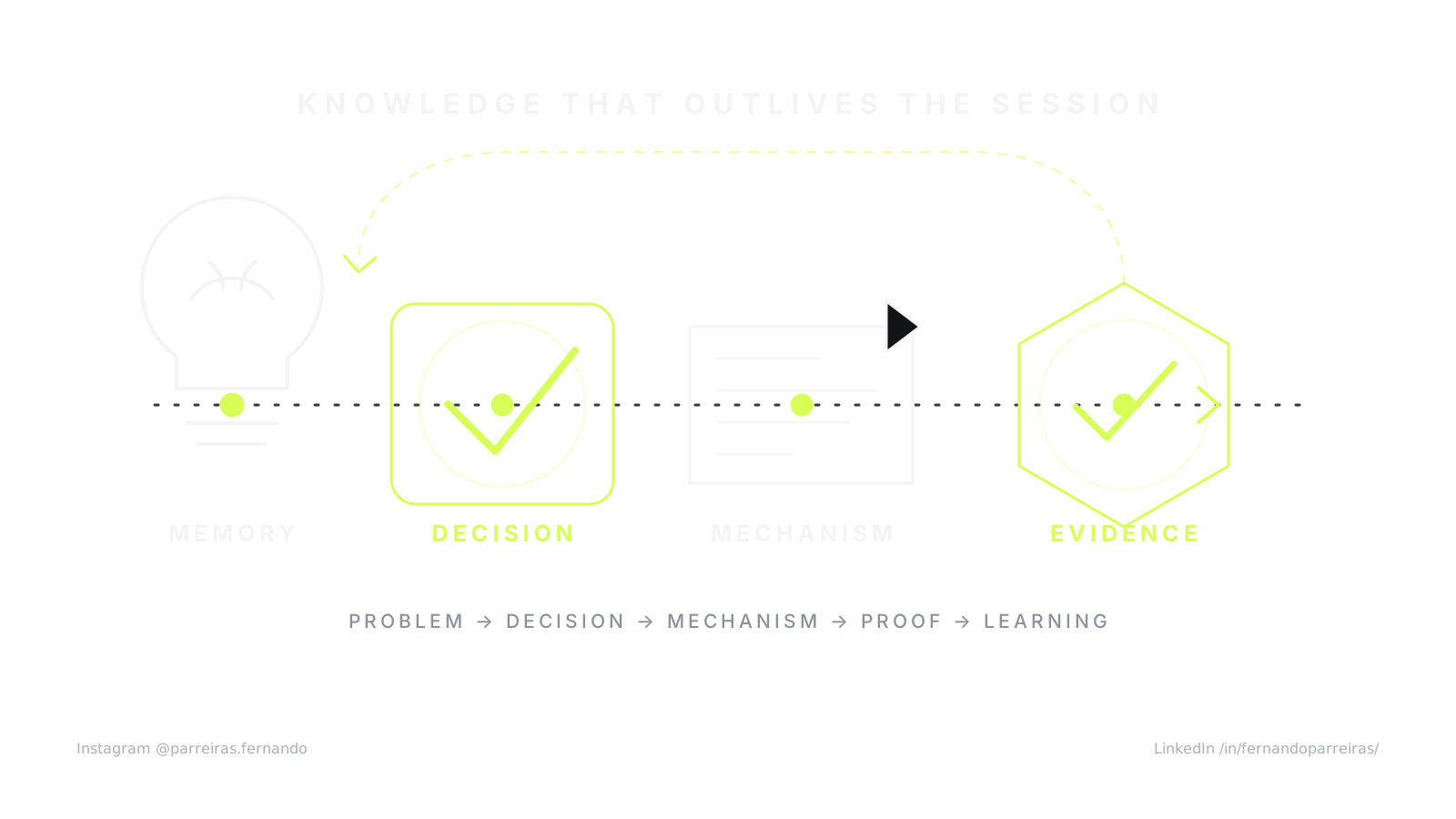
FORGE was born from the need to transform a company's memory and decisions into mechanisms that survive conversations, models and sessions. Its evolution, started as JARVIS, connected versioned context, contracts, bounded capabilities, property checks, asset-linked evidence and learning loops. The objective is not to simulate human autonomy, but to expand execution with AI without losing intention, responsibility and correction capacity.
Companies don't start with a framework. They start with a problem that keeps coming back.
At Trustyu, this problem appeared every time a good decision needed to be reconstructed: why we chose this architecture, what we learned from that incident, what promise had already been tested, what risk remained open, and what “done” really meant. Part of the answers were in documents, part in code and part in the memory of those who participated. The organization made progress, but repeatedly paid to relearn what it already knew.
FORGE was born from this friction. Before it was a public name, it was JARVIS: a way of transforming experience into instructions, decisions and checks that could survive a conversation, an AI model and even the people who were in the original session.
This article is an authorial retrospective. It is not intended to prove that every company should copy FORGE. He explains why Trustyu built it, what shifts in thinking were necessary, and what questions any founder can take advantage of.
Executive summary
FORGE is neither a catalog of prompts nor a fixed selection of models. It is a working system for connecting human intent, AI-assisted execution, thresholds, verification, evidence, and learning.
The evolution took place in six movements:
- memory became versioned context;
- instruction became a contract;
- paper became limited capacity and authority;
- conference became verification by property;
- delivery became evidence linked to the exact asset;
- correction became learning that changes the system.
The most important outcome is not to make AI appear autonomous. It's allowing people to delegate more execution without losing authorship, responsibility or ability to correct the path.
The first problem: memory does not scale
In the beginning, speed usually depends on proximity. The founder knows the product, remembers the conversations, recognizes dangerous shortcuts and mentally completes what the request did not explain. This tacit memory solves a lot of things — until it becomes a bottleneck.
When the team, products and agents increase, the cost appears in familiar ways:
- similar decisions receive different responses;
- a temporary exception becomes a rule;
- the same search is redone without taking advantage of the previous cut;
- “has been validated” circulates without saying which version, environment or criteria;
- an important conversation ends without producing a durable state;
- the founder becomes the only reconciliation mechanism.
Adding AI to this scenario does not remove the problem. Fast AI can reproduce inconsistencies with greater volume. The challenge is no longer just remembering information and becomes preserving decision context: intention, boundary, evidence, validity and consequence.
JARVIS: knowledge needed to become a mechanism
JARVIS began as a practical attempt to make work repeatable. Documents gained hierarchy; architectural decisions now have IDs; standards became verifiable; sessions were separated by scope; handoffs needed to declare state and residual.
The conceptual leap was realizing that useful documentation is not a file that describes the work afterwards. She participates in the work as it happens.
A recorded decision can guide the next implementation. A contract can block an inconsistent projection. A test can prevent a public claim from moving forward without a source. A history can show not only the current state, but how it got there.
This changes the question from “where is the information?” to “what behavior does this knowledge produce?”.
From conversation to versioned state
Conversations are great for exploring. They are bad as the only source of truth. They mix hypotheses, decisions, corrections and transitional context in a sequence that is difficult to compare.
FORGE started to demand that what needs to last leaves the conversation and takes on an addressable form:
- a decision with context and consequences;
- a contract with closed fields and version;
- a plan with acceptance criteria;
- an artifact with hash and origin;
- an evidence linked to the review that has been verified;
- an explicit residual rather than a vague promise of “later.”
Recent research and implementations of managed agents converge on the need to separate session history, orchestration policy, and execution isolation. FORGE's font cutting upholds these boundaries as explicit responsibilities; not as magical properties of a specific model. [HARNESS31-C2]
From prompts to contracts
A prompt can guide behavior. It is not, alone, an operating contract.
Contracts answer what persuasive text usually hides:
- what is the allowed input;
- which output will be accepted;
- what is out of scope;
- who can perform each action;
- which control checks which property;
- where the result is recorded;
- who can publish, pay, delete or send;
- how to correct and remove.
This distinction also protects the work from the volatility of the modeling market. Fable, Sol, Terra, Opus, Sonnet and the names that come after can occupy different positions depending on task, risk, cost and availability. The “Security” role should not mean “always use model X”. It must declare capabilities, tools, limits and responsibility. The roster can change without rewriting the entire architecture.
From decorative papers to bounded authority
Giving agents job names creates a familiar interface, but can hide serious ambiguity. “Architect”, “Backend” and “Security” describe perspectives; they do not automatically grant access or authority.
In FORGE, a useful role needs to answer:
- what kind of decision he prepares;
- what tools you can use;
- what data you can access;
- what can change;
- what evidence it should produce;
- where you need to stop and ask for human decision.
Therefore, the architecture is orchestrated by capabilities. Models are selectable dependencies, not the permanent definition of the role. This was also the response to the concern of maintaining an interface that would age every time a vendor released a new family of models.
From “passed” to evidence linked to the asset
An organization learns little when the result of a check is just a green color.
Useful check informs:
- which review was examined;
- which property the control observes;
- what tool and policy were used;
- which report was produced;
- who approved;
- until when the conclusion remains valid;
- what the control does not prove.
This is how FORGE separates specified, observed, applied and qualified. A documented intention does not become a proximity operation. A test on a commit does not certify another. A good result in one task does not authorize generalization to all tasks.
The six movement system
What began as organized memory has consolidated into six connected responsibilities:
Intention
Transforms desire into outcome, scope, restrictions and definition of ready.
Policy
It defines data, tools, actions, limits and gates that cannot depend solely on the good will of the executor.
Execution
Provide the environment, identity, tools, and continuity to get work done.
Verification
Uses controls appropriate to the properties that need to be proven, without turning the executor into their own universal auditor.
Evidence
Links decision, code, source, test, version and approver to the same result.
Feedback
Makes a correction produce durable change: test, decision, standard, limit, or versioned learning.
These plans don't require a huge platform. They require boundaries that remain visible when the experiment grows.
Why FORGE
The name FORGE marked a change in altitude. JARVIS remains as historical origin and internal codename; FORGE came to represent the framework: the place where human knowledge and AI capabilities are worked on until they become a verifiable result.
The metaphor matters because forging is not about pushing a button. There is raw material, intention, tools, temperature, repetition, inspection and judgment. More uncontrolled energy does not create a better piece.
Likewise, AI capability does not replace driving. It expands what a system can already transform into work.
What FORGE still does not authorize to say
An honest retrospective needs to separate direction from proof.
FORGE organizes controls, contracts and evidence. This does not mean that every mechanism is applied to every product, that every execution is autonomous or that an internal seal replaces an independent evaluation. Public states need to continue saying what was specified, what was observed, and what residual remains.
There is also no “official forever model”. A model may be best for a task today and not be better tomorrow. What must last is the contract that allows it to be evaluated and replaced.
A roadmap for founders
Before building your own platform, it's worth answering:
- What decisions are you reconstructing every week?
- What knowledge exists only in a person's head?
- What word — “ready,” “secure,” “validated” — is being used without common criteria?
- What external action should an AI never perform without an explicit gate?
- What evidence would allow reproducing or correcting the result?
- What recent failure permanently altered the system?
- What needs to remain true when the model changes?
Start with the flow that is most difficult to relearn. Record the decision. Turn a criterion into a contract. Bind a check to the exact asset. Close a loop. The framework must be born from real work, not from an imaginary organization chart of agents.
Conclusion
Trustyu created FORGE because memory, talent and speed were not enough to sustain an organization that wanted to learn from AI without outsourcing responsibility.
His thesis can be summarized as follows:
Human knowledge defines intention and judgment. AI amplifies execution. The system preserves limits, evidence and learning.
The value is not in making a machine look human. It's about making joint work clearer, repeatable and correctable than it would be with either party alone.
Next reading: The model is not the system, which details why model capability still needs an engineering harness.
Editorial and responsibility note
- Research cutoff
- Last review
- Recorded corrections
- No corrections recorded.
The cutoff above applies to the canonical claims. Additional sources and their access dates are identified in the article body.
This article combines cited sources, analysis, and the author's professional experience. Verifiable data and factual statements are linked to their respective sources. Interpretations, hypotheses, projections, recommendations, and opinions represent the author's professional point of view at the time of publication; they do not constitute proven facts, a promise of results, or legal, financial, or technical advice applicable to a specific case. Consult the original sources and qualified professionals before making decisions.
Claims and sources
HARNESS31-C2
A durable harness should maintain session history, orchestration policy and execution isolation as explicit boundaries, while adapters and plugins prevent model or channel choice from becoming the security boundary.
Limit: The sources show two implementations, not a neutral interoperability standard. Actual permissions must be independently enforced and tested outside model choices. This is a source-bound design input; it does not prove product adoption, operational maturity, independent attestation, search ranking, AI citation or outcome.
- Anthropic — Anthropic, proprietary-site-terms
- YC Software —YC Software, MIT
- YC Software —YC Software, MIT