
Executive reading · ~60 seconds
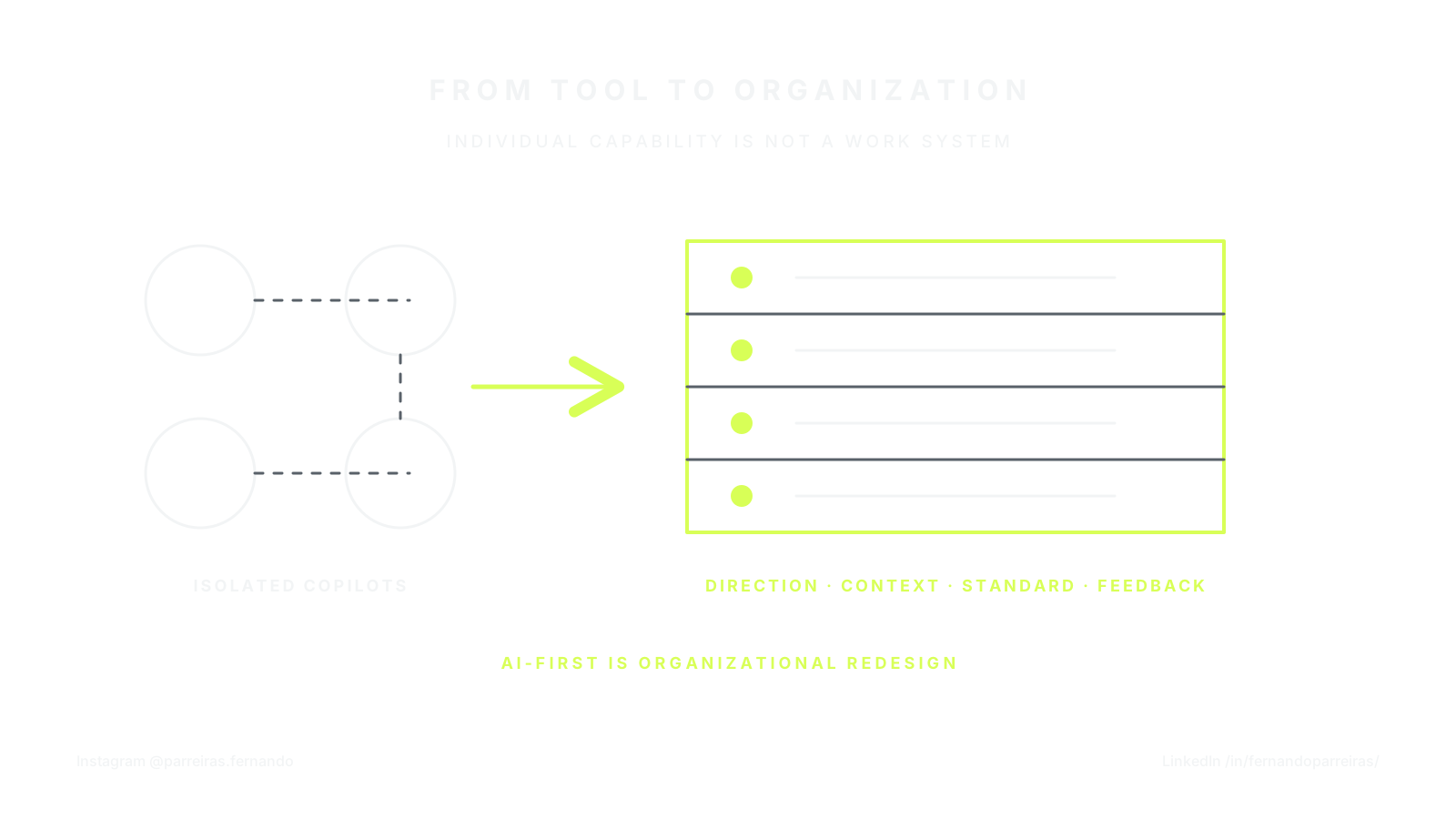
Licenses expand individual capabilities. An AI-first organization connects outcomes, work redesign, context, thin platform, governance, literacy and learning.
Copilot licenses spread quickly. People write, program, analyze and present faster. Still, decisions remain slow, queues grow, risks remain diffuse and the financial result is difficult to demonstrate.
The organization purchased individual capacity. It did not redesign its work system.
Executive summary
Being AI-first does not mean putting AI into every task. It means treating AI as part of an organizational system with:
- priority results;
- redesigned work and decisions;
- trustworthy context;
- common standards and platforms;
- authority proportional to the risk;
- verification and evidence;
- learning that changes the system.
DORA 2025 describes AI as amplifying existing strengths and weaknesses and linking the greatest returns to the organizational system, not just the tool. The conclusion comes from software development and should not be turned into universal law; works as a drawing alert. [CAREER-A18-C5]
Three Stages of Adoption
1. Individual tool
Each person chooses how to use AI. The gain may be immediate, but context, safety, quality and learning remain local. The company measures licenses and usage, not outcomes.
2. Assisted workflow
Teams integrate AI into repeatable tasks, create templates, review and metrics. Work improves, but each area may rebuild the same infrastructure and produce incompatible standards.
3. Organizational capacity
The company defines platform, context, policies, evals, authorities and reusable learning loops. Use cases remain local; critical borders are no longer reinvented.
Not every organization needs to get to the third stage at all. The point is to know where you stand and what the current state does not yet prove.
Start with the results portfolio
Avoid the “where can we use AI?” backlog. He produces dozens of ideas without priority. Build a portfolio of outcomes:
| Question | Sample answer |
|---|---|
| Which flow matters? | commercial request screening |
| Which result changes? | time until referral accepted |
| Who receives value? | customer and service team |
| What risk increases? | wrong classification and sensitive data |
| What decision will be made? | expand, limit or terminate |
Prioritize by impact, frequency, data readiness, reversibility, and verifiability. A flashy, unmeasureable case may teach less than a smaller flow with real feedback.
Redesign the work, not just the step
Automating an isolated step can shift cost to review, correction or downstream. Map:
entrada -> decisão -> execução -> verificação -> aceite -> aprendizadoAsk where there is waiting, ambiguity and rework. Then decide:
- what AI prepares;
- what AI performs;
- what needs deterministic verification;
- where human judgment adds context;
- who accepts the effect;
- as exceptions return to the drawing.
AI-first does not remove people from the flow on principle. It removes the dependency on people to do mechanical work so they can drive and decide better.
Build a thin platform
Excessive centralization creates queues; Full decentralization creates duplicated risk and cost. A thin platform offers common components:
- identity and access;
- gateway models and costs;
- context and sources catalogue;
- sandbox and capabilities;
- logging, tracing and privacy;
- evals and policy gates;
- integration templates;
- evidence and incident learning.
Dominant teams continue to own the problem, the outcome and the specific rules. The platform removes the need to repeatedly resolve cross-cutting concerns.
Literacy is part of architecture
Training cannot be limited to prompting. People need to recognize:
- when an answer requires a source;
- difference between generation, prediction and decision;
- data, rights and confidentiality risks;
- evals and automation limits;
- how to contest and escalate;
- who remains accountable.
Without literacy, controls are bypassed or used as theater. Without controls, literacy depends on memory and individual adherence.
A 90-day plan
Days 1–30: select and measure
- choose two or three flows with owner;
- establish a baseline of quality, time, cost and risk;
- classify data and authorities;
- define stop condition.
Days 31–60: Redraw and shadow run
- map the complete flow;
- connect context and authoritative tools;
- run with human comparison and review;
- capture failures and total cost.
Days 61–90: Decide and Reuse
- promote only what satisfies the contract;
- transform learnings into common components;
- remove worthless experiments;
- publish limits and next gate.
The plan does not promise transformation in three months. It produces a better decision cut than a licensing campaign without a baseline.
Metrics that avoid theater
Measure by flow:
- outcome accepted;
- quality without material rework;
- end-to-end time;
- total cost per unit;
- incidents and near incidents;
- human intervention by class;
- embedded learning.
Usage, prompts and tokens help you operate. They do not prove value in themselves.
What this article proves — and what it doesn't prove
Research and engineering experience support that AI results depend on organization, workflow and system quality. This does not prove that every company should centralize AI, create a large platform, or adopt the same topology.
AI-first is a design direction. Structure, speed and investment need to accompany real risk, strategy and maturity.
Conclusion
Copilots increase people capacity. An AI-first organization transforms this capability into a system that chooses, verifies, learns, and responds to effects.
The advantage will not come from having the same model that everyone can buy. It will come from context, standards, flows and judgment that the company can accumulate without losing speed.
Previous reading: AI amplifies the business you already have. Next suggested reading: The invisible cost of AI.
Editorial and responsibility note
- Research cutoff
- Last review
- Recorded corrections
- No corrections recorded.
The cutoff above applies to the canonical claims. Additional sources and their access dates are identified in the article body.
This article combines cited sources, analysis, and the author's professional experience. Verifiable data and factual statements are linked to their respective sources. Interpretations, hypotheses, projections, recommendations, and opinions represent the author's professional point of view at the time of publication; they do not constitute proven facts, a promise of results, or legal, financial, or technical advice applicable to a specific case. Consult the original sources and qualified professionals before making decisions.
Claims and sources
CAREER-A18-C5
DORA 2025 describes AI primarily as amplifying existing strengths and weaknesses and associates the greatest returns with the organizational system, not just the tools.
Limit: The research focuses on software development; the article uses this formulation as a design principle, not as a universal labor law. This is a source-bound design input; it does not prove product adoption, operational maturity, independent attestation, search ranking, AI citation or outcome.
- Google Cloud DORA — Google Cloud DORA, CC-BY-4.0