
Executive reading · ~60 seconds
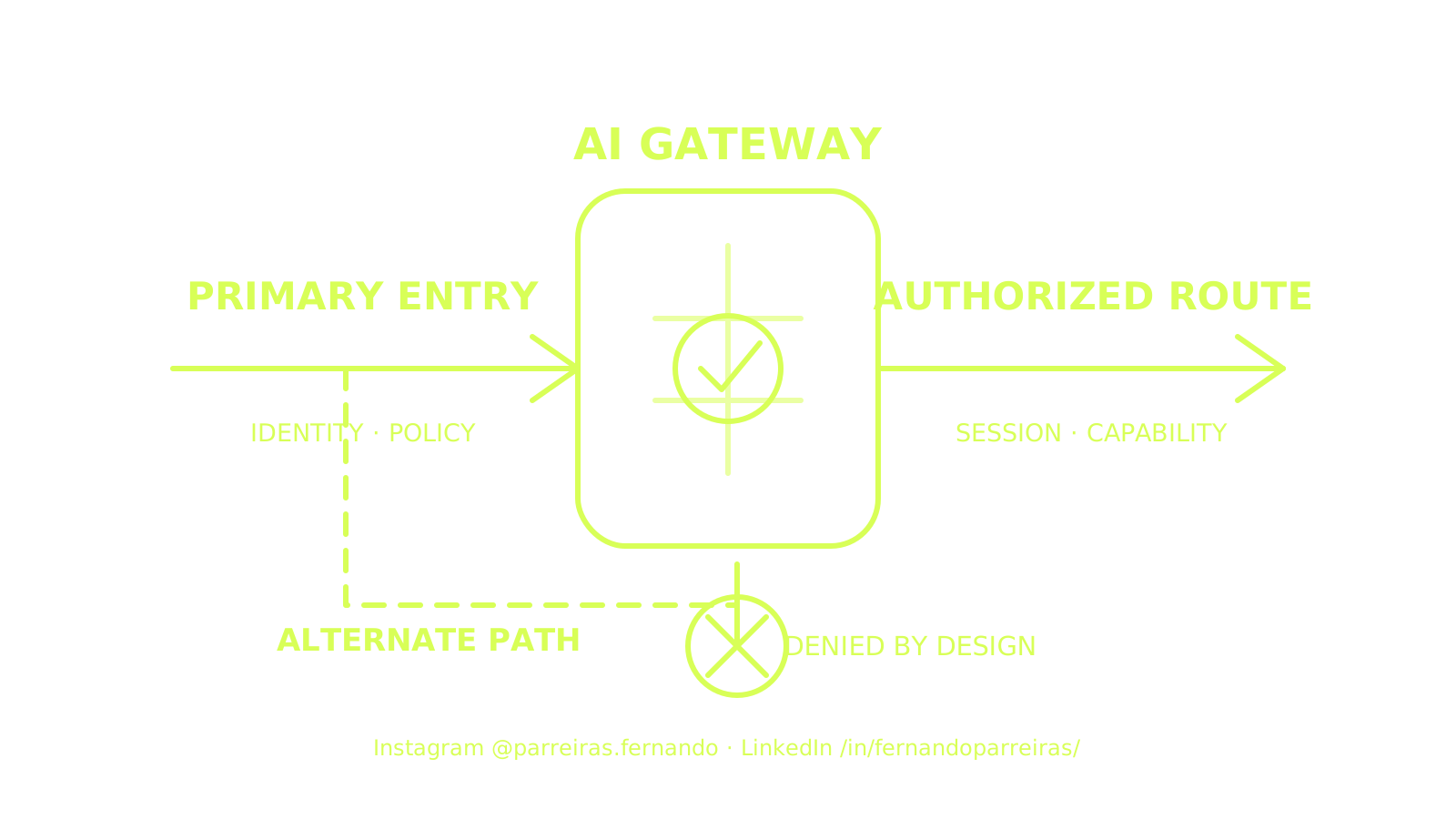
Six advisories fixed in Agent Router 1.2.1 show that validating the primary entry does not protect alternate listeners, cross-route sessions, observable secrets, or the shared control plane.
A gateway can authenticate the correct request and still allow a side path to reach the same component without passing through the expected policy. A set of six advisories published for Agent Router shows why the trust boundary must be verified end to end — at the listener, route, session, secret, and control plane.
Status: Evidence Brief approved for publication. Editorial series: Papers we read for you. The text does not reproduce payloads, credentials, targets, or exploitation instructions.
What was published — and what is the denominator
On November 6, 2026, the project published six advisories associated with the 1.2.1 fix: one rated High, four Moderate, and one Low. This denominator describes six records from the same project, not six products, six production environments, or a representative sample of the AI gateway market.
| Observed boundary | Record | Condition summary | Declared fix |
|---|---|---|---|
| MCP proxy listener | GHSA-mgwh-j6v5-5mf8 | a network path could directly reach a component that trusted headers from the front proxy | bind to loopback |
| session and route | GHSA-72hp-5vm2-frr7 | a session created on one MCPRoute could be presented again on another route under specific conditions | session bound to its origin route |
| prompt selection | GHSA-ph8c-hp5f-jr6w | a prompt hidden from listing could still be requested by a known or guessed name | selector also applied to retrieval and completion |
| session material | GHSA-3qgx-4x8m-wwhg | the encryption seed reached the sidecar as an observable argument in the Pod specification | delivery through protected configuration |
| OAuth metadata | GHSA-29m3-89jf-3q5v | the controller buffered an external response without a limit before processing it | response capped at 1 MiB |
| upstream responses | GHSA-99m8-cq7v-gw4g | 2xx responses with missing or null fields could terminate the external processor | defensive handling of absence and null |
A release 1.2.1 brings together the security and stability fixes. Affected ranges vary across the advisories; reducing them to one universal rule would be incorrect. Operators must check the specific record, the running version, and the effective configuration.
The most measurable experiment
The OAuth metadata advisory reports a test in an isolated Kubernetes environment. A synthetic 40 MiB response was delivered to a controller with a 160 MiB memory limit. According to the record, the process experienced three out-of-memory restarts, and reconciliation of a route in another namespace was delayed for 43 seconds. Both routes recovered after the response was reduced to 1 MiB.
This result has a narrow population and conditions: an isolated k3s deployment, a shared controller, an identity allowed to create MCPRoute in one namespace, and a controlled metadata endpoint. It demonstrates the behavior observed in that test; it does not measure prevalence, estimate risk for every deployment, or prove production exploitation.
Authenticating one hop does not protect the entire path
The common pattern across the six records is the gap between intended architecture and every path the bytes can actually travel. If the internal component trusts headers because it expects only the front proxy to reach it, network restriction is part of authentication. If policy belongs to the route, the session cannot lose its binding to that route. If listing filters a resource, the retrieval operation must apply the same decision.
In the Forge canon, minimal identity, explicit capability, isolation, and provenance are complementary controls. This is engineering guidance; it does not prove deployment, effectiveness, or certification in a specific product. [R2-C3]
Defensive contract for an MCP gateway
| Control | Minimal evidence | Rejection test |
|---|---|---|
| listener reachability | interface, port, and network policy observed at runtime | a direct connection through an unauthorized path must fail |
| session binding | route, identity, and policy preserved in the identifier or server state | a session created on route A must be rejected on route B |
| consistent selection | the same decision applied to list, get, complete, and execute | an excluded resource cannot be retrieved through a direct call |
| secret custody | value absent from arguments, specifications, logs, and public diagnostics | reading the specification does not reveal session material |
| bounded external inputs | timeout, maximum size, concurrency, and retry policy | a response above the limit must fail without taking down the controller |
| defensive parsing | schemas and explicit handling of absence, null and permitted variations | an incomplete response must not terminate the processor |
| control-plane isolation | quotas and failures confined by tenant or namespace when applicable | input from one domain does not interrupt reconciliation in another |
Upgrading the package is necessary for the cited project, but operational evidence requires more than a version number. The receipt should bind the executed image or binary, configuration, listeners, network policies, routes, negative tests, and rollout result. A completed deployment status alone does not demonstrate that all old Pods were replaced or that the alternate path was closed.
Method, counterpoints, and limitations
The advisories combine code inspection, localized tests, and, for the availability issue, reproduction in k3s with synthetic services. The malformed-response record reports 19 cases that failed before the fix. The cross-route session and prompt-selection cases were described in isolated handler tests, without a full Envoy, Kubernetes, and OAuth reproduction in the same test.
We found no independent reproduction of the six records and no confirmation of production exploitation by the editorial cutoff. Several reports were published by the same researcher and disclose AI assistance; this does not invalidate the findings, but it increases the importance of separating a report, maintainer confirmation, independent reproduction, and customer-observed impact. The project's own release is the official response and declares the fixes; it is not independent corroboration.
There is also a proportionality counterpoint: not every deployment exposes the same network, allows namespace users to create MCPRoute resources, shares a controller, or enables the same features. An advisory does not prove compromise. Conversely, the absence of a known incident does not replace testing alternate paths.
Engineering rule
Policy applied at one point is not policy applied across the whole system. For each trust decision, identify the component that produces it, the components that begin to trust it, and every path that can bypass that chain. Then turn each alternate path into an observable negative test.
Direct sources
- Agent Router v1.2.1, the project's official response and fixes.
- MCP proxy reachable outside the front path, GitHub Security Advisory.
- Session reuse across MCPRoutes, GitHub Security Advisory.
- Incomplete enforcement of `promptSelector`, GitHub Security Advisory.
- Session seed in a sidecar argument, GitHub Security Advisory.
- Unbounded OAuth metadata consumption, GitHub Security Advisory.
- Malformed 2xx responses and processor termination, GitHub Security Advisory.
Editorial and responsibility note
This text combines facts attributed to sources with the author's analysis and technical proposal. Personal and professional views are not proven facts; versions, conditions, and limits are stated when available. The content is informational and does not replace technical, legal, regulatory, or security assessment. Agent Router, Envoy, MCP, GitHub, and other marks belong to their respective owners; there is no sponsorship or endorsement. No offensive procedure is reproduced. Tech Human and Trustyu operate commercially in digital-product development and governance. Research, structure, and writing received AI assistance; Fernando Parreiras authorized the topic, factual self-review, and publication on November 7, 2026, without additional independent human review.
Research cutoff: November 7, 2026. Editorial status: special Evidence Brief authorized for November 8, 2026 at 09:00 BRT.
Editorial and responsibility note
- Research cutoff
- Last review
- Recorded corrections
- No corrections recorded.
The cutoff above applies to the canonical claims. Additional sources and their access dates are identified in the article body.
This article combines cited sources, analysis, and the author's professional experience. Verifiable data and factual statements are linked to their respective sources. Interpretations, hypotheses, projections, recommendations, and opinions represent the author's professional point of view at the time of publication; they do not constitute proven facts, a promise of results, or legal, financial, or technical advice applicable to a specific case. Consult the original sources and qualified professionals before making decisions.
Claims and sources
R2-C3
Least privilege, isolated execution and supply-chain provenance are complementary controls; no substitutes for the others in an agentic system.
Limit: The exact control profile remains environment-specific and must be threat-modeled per product. This is a research-synthesis design input; it does not prove product adoption, operational maturity, independent attestation or outcome.
- OpenAI — OpenAI, Apache-2.0 repository; analysis-only excerpts
- OWASP Foundation — OWASP Foundation, CC-BY-SA-4.0 standard; analysis-only excerpts
- OpenSSF SLSA — OpenSSF SLSA, CC-BY-4.0 specification; analysis-only excerpts