
Executive reading · ~60 seconds
How to turn architectural intent into checks, preserve approval authority, and require evidence for the version to be released.
An approval only has value when it is possible to explain what was evaluated, against which criterion and on which version. Adding a reviewer agent does not, by itself, answer these three questions.
This brief proposes a supervision design for changes produced with AI assistance. The goal is to distribute checks without diluting responsibility or allowing the generation workflow alone to decide what “approved” means.
Status: technical proposal for discussion and validation. No control below was implemented or tested by this task. This is not an announcement of Forge capabilities.
Research is the starting point, not the specification
Stolze and Strässle describe layered supervision based on five interviews. The sample is limited, the analysis has a single coder and one participant is a coauthor. These accounts do not demonstrate the universal effectiveness of an architecture. The supplementary material makes it possible to examine the traceability of the interpretations. Paper.
Our proposal below must be assessed on its own merits. Adopting a study's vocabulary is not enough to acquire evidence of outcomes.
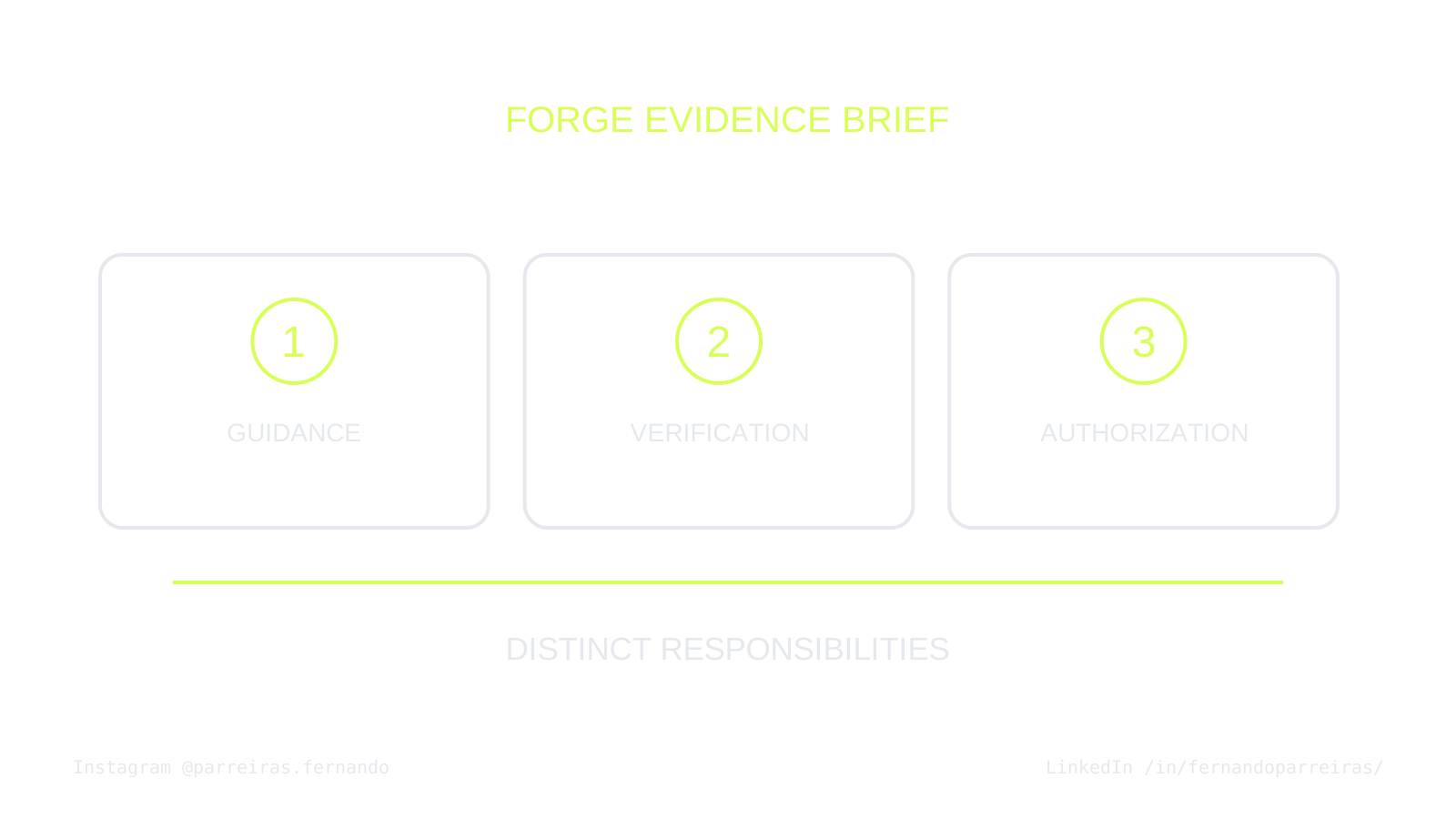
Guidance, verification and authorization are different things
An instruction file can explain a rule to an agent. A test can verify a property of the result. An access policy can prevent an unauthorized action. These mechanisms complement one another but must not be presented as equivalent.
Writing “do not change this contract” does not demonstrate that changes are blocked. Running a suite does not demonstrate that all relevant behavior is covered. Recording approval does not prove the approver received enough information.
NIST SSDF 1.1 provides practices for integrating security into development. Mentioning it here does not constitute certification or demonstrate compliance by any specific implementation. NIST SP 800-218.
A proposed design for change
Before execution, record the requested outcome, change boundaries, properties to preserve, and situations requiring human intervention. The record needs a version and an owner. Conflicting instructions should trigger a decision, not a silent choice by the agent.
During execution, keep the change bounded and make deviations visible. Google's guidance on small changes is useful here: scope should facilitate review and understanding, not merely satisfy an arbitrary line count. Small CLs.
During verification, each important rule needs an appropriate mechanism and an observable failure condition. The table is a prescriptive example, not a list of existing product capabilities.
| Intended property | Proposed mechanism | Evidence to require |
|---|---|---|
| Preserve an integration contract | Contract tests and breaking-change analysis | Result linked to the evaluated contract and version |
| Prevent prohibited dependencies between modules | Executable architecture rule | A valid case passes; a known violation is rejected |
| Do not approve a run without actual tests | Validation of test collection, completion and results | Explicit counts, execution errors, and skipped tests |
| Preserve approval criteria | Protection of verification definitions and separate review of changes to them | Record of who changed the criterion and who authorized it |
| Release only the examined version | Verifiable link between review, artifact, and deployment | Identifiers and evidence of correspondence |
| Handle exceptions without making them permanent | Accountable person, rationale, scope and expiration | Traceable, reassessable exception |
Test the verifier instead of merely trusting it
I recommend including known negative cases. If a contract test should block an incompatible change, demonstrate that it actually rejects one in a controlled environment. If a check depends on an unavailable service, the result should be execution failure or inconclusive, not success.
This also applies to seemingly neutral results: no files analyzed, no tasks collected, or a report from another version. The process must distinguish “found no problem” from “did not examine what it should have.”
Signatures and hashes help identify artifacts, but do not turn poor judgment into sound judgment. Identity, integrity, and test adequacy are separate questions.
Preserve the authority to say no
I propose giving the person responsible for release a concise, verifiable view: what changed, which properties were tested, what was not tested and which consequences remain uncertain.
Changes to data, authorization, billing, or recovery may need deeper review than presentation changes. Risk classification must follow the system's context, not just the number of files.
The change author should not be able to silently modify criteria and then use the result to approve their own work. If one person holds multiple roles in a solo business, record that limitation and define when external challenge is required. A second call to the same model must not be described as an independent audit.
Do not confuse supervision with replacing learning
This design may free attention for difficult decisions, but must also preserve learning for newcomers. A useful review explains the relationship between a change, its risk, and the test that evaluates it.
I propose allowing bounded changes to be led by professionals in training, with supervision proportionate to risk. The person should explain why the test matters and what they would do if it failed. Copying automatic approval does not demonstrate learning.
The Echoes of AI experiment provides a counterpoint to inevitable deterioration: it found no systematic maintainability advantage or disadvantage in the tasks examined. It uses a different design and data predating the current generation of agents. Study.
How to evaluate this design
Before expanding adoption, choose an authorized workflow and record a baseline: waiting, rework, failures reaching operation, interventions, and recovery time. Compare tasks with similar risk and document team and tool changes.
Do not attribute an improvement to layered supervision just because it followed the change. The assessment must consider alternative explanations. It may even find that a control costs more than it delivers in that context.
Forge's editorial proposal is to keep this conversation tied to evidence. The goal is not a more sophisticated approval ceremony. It is to know what confidence has actually been built — and what remains a hypothesis.
Additional engineering guidance
Small, reviewable changes help limit assessment scope; workspace isolation is not a security boundary. This earlier guidance is independent of the new study and does not validate its results. [R1-C2]
Sources and editorial context
- Stolze and Strässle — When Review Alone No Longer Scales. ESEM/SEIP 2026, arXiv v1. Accessed: August 28, 2026. No independent replication located. Supplement.
- NIST — SP 800-218, SSDF 1.1. Technical publication, February 2022. Accessed: August 28, 2026. Security reference, not certification.
- Google — Small CLs. Engineering guide. Accessed: August 28, 2026.
- Borg et al. — Echoes of AI. Empirical Software Engineering, June 9, 2026. Accessed: August 28, 2026. Declared commercial ties to CodeScene and Equal Experts; not a replication of the supervision study.
Editorial and responsibility note
This text combines findings attributed to sources with the author's analysis and recommendations. Personal and professional views are not proven facts; verifiable data require sources and context. The content is informational, does not replace case-specific technical, legal, or financial assessment, and promises no results. Tech Human and Trustyu have commercial activities in related fields. Research and writing were AI-assisted; Fernando Parreiras reviewed and approved the Portuguese original on August 28, 2026, without independent human review. This translation was AI-assisted.
Research cutoff: August 28, 2026. Human editorial review: Fernando Parreiras, August 28, 2026. Correction history: initial version, no material corrections recorded.
Editorial and responsibility note
- Research cutoff
- Last review
- Recorded corrections
- No corrections recorded.
The cutoff above applies to the canonical claims. Additional sources and their access dates are identified in the article body.
This article combines cited sources, analysis, and the author's professional experience. Verifiable data and factual statements are linked to their respective sources. Interpretations, hypotheses, projections, recommendations, and opinions represent the author's professional point of view at the time of publication; they do not constitute proven facts, a promise of results, or legal, financial, or technical advice applicable to a specific case. Consult the original sources and qualified professionals before making decisions.
Claims and sources
R1-C2
Autonomy should be bound by isolation and small reviewable changes; a worktree allone is not a security bondary and a large change weakens review quality.
Limit: Change-size guidance is human-review guidance; it does not by itself define an agent sandbox policy. This is a research-synthesis design input; it does not prove product adoption, operational maturity, independent attestation or outcome.