
Executive reading · ~60 seconds
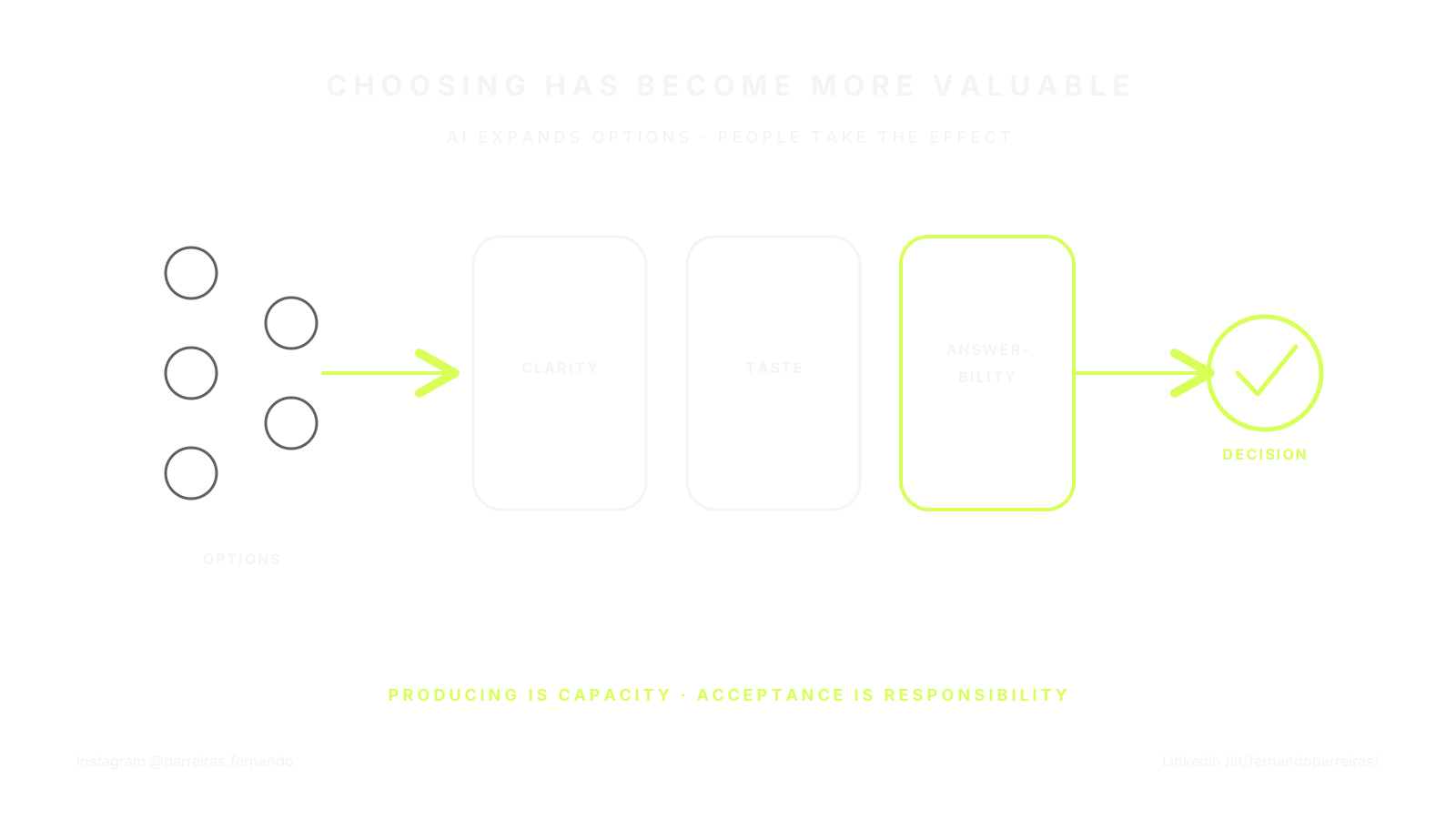
AI expands options; People still need to frame, choose, verify, assume consequences and learn from the result.
When producing became cheaper, many people concluded that knowing how to produce lost value. The conclusion is hasty. What lost exclusivity was part of the mechanical execution. The standard for choosing, guiding, evaluating and assuming the result has become higher.
We call this combination taste, responsibility and clarity. It's not aesthetic elitism. It is the practical ability to recognize what serves the problem, explain why, and account for the effect.
Executive summary
AI expands options. People continue to need to transform options into decisions.
| Skill | Central question | Evidence at work |
|---|---|---|
| clarity | What needs to change and for whom? | intention, context and criteria ready |
| taste | Which solution is adequate, coherent and simple? | compared choices and trade-offs |
| critical thinking | What could be wrong or missing? | counterpoint, test and limit |
| responsibility | Who accepts risk and consequences? | explicit owner and decision |
| learning | What changes after the result? | feedback built into the system |
These skills do not replace technical or business knowledge. They depend on him.
Taste is not “liked”
Taste is trained judgment. A designer notices hierarchy and friction; an engineer perceives coupling and risk; a business person notices whether the proposal improves an actual decision.
This judgment arises from repertoire, practice, comparison and feedback. It allows you to say:
- this solution answers the wrong problem;
- this complexity does not buy enough value;
- this text seems convincing, but does not support claim;
- this automation removes a necessary learning step;
- this result is locally correct and inappropriate for the system.
A model can offer variations and criticisms. A person needs to recognize the difference between novelty, quality and suitability.
Clarity became a production interface
Previously, ambiguity could be resolved over weeks of execution. With agents, a vague instruction can produce dozens of files and effects before someone realizes the goal was poorly defined.
Clarity needs to include:
- problem and recipient;
- observable result;
- sufficient context, not encyclopedic;
- limits and not objectives;
- available authority;
- verification criteria;
- stop condition.
This is not “learning to write magical prompts”. It's learning how to specify work.
Critical thinking is not denying everything
Critical thinking separates possibility from evidence. He asks:
- Does the source support the entire sentence?
- Does the sample represent this context?
- Does the benchmark measure the task that matters?
- did the system check outcome or just output?
- What would happen in the negative case?
- what incentive might distort the conclusion?
Work reports point to task transformation as a more plausible scenario than uniform replacement, but exposure is neither an individual's destiny nor a prediction of employment. [CAREER-A18-C3] This difference is an exercise in critical thinking: do not transform an exposition index into a sentence.
Responsibility cannot be delegated to the text
When an AI recommends, someone still decides to use, change, reject or escalate. When it executes, someone still defines the authority that made the effect possible.
Human responsibility means:
- declare who is accountable;
- calibrate risk review;
- do not attribute to the model a decision that the system has authorized;
- correct damage and preserve learning;
- communicate limits without hiding behind “it was the AI”.
This goes for a junior, an expert, a founder and a board. The range changes; the principle does not.
Human labor changes position
The ILO global index notes that many occupations combine exposed tasks and tasks that still depend on human participation; therefore, transformation is a more plausible aggregate result than full automation. This does not exclude replacement in specific tasks, companies or groups. [CAREER-A18-C4]
In practice, people can spend less time starting an artifact and more time on:
- formulate the right question;
- bring context that is not documented;
- select between alternatives;
- check consequence;
- talk to whoever receives the result;
- learn from the difference between intention and effect.
The risk is to remove mechanical tasks without redesigning how someone acquires repertoire. An organization that automates inbound work needs to create new, deliberate cycles of practice and feedback.
A weekly taste exercise
Choose an important artifact and make five passes:
1. Intention
Write in one sentence the result it should produce.
2. Alternatives
Ask for or create three substantially different solutions, not just three tone variations.
3. Criteria
Define five criteria before choosing: clarity, suitability, simplicity, risk and evidence, for example.
4. Criticism
Look for the best argument against the preferred option and a case where it would fail.
5. Real feedback
Observe a person using or deciding with the artifact. Record what surprised you.
Taste grows when preference meets consequence.
How to demonstrate these skills
Don’t just write “critical thinking” on your profile. Show:
- a well-framed problem;
- discarded alternatives and reason;
- quality criteria;
- test that found a failure;
- decision to simplify;
- feedback that changed the work;
- limit you refused to hide.
Your portfolio should make judgment visible without revealing confidential information.
An organization also has taste
DORA describes AI as an amplifier of the organizational system in software development. FORGE uses this formulation as a design principle, not as a universal law for every industry. [CAREER-A18-C5]
An organization expresses taste through:
- standards that distinguish quality from mere conformity;
- positive and negative examples;
- review with experts;
- metrics linked to outcome;
- space to say “we don’t know yet”;
- memory of decisions and corrections.
If the pattern only lives in the heads of a few people, AI accelerates divergence. If it becomes a mechanism, example and feedback, the capacity is distributed.
What this article proves — and what it doesn't prove
Research on occupational exposure and AI-assisted development shows heterogeneity by task, context, and organization. They do not prove that everyone will need the same combination of skills, nor that human capacity automatically grows with the use of AI.
Taste is an authorial synthesis for trained judgment. Its development requires mastery, practice, feedback and real responsibility.
Conclusion
The cheaper it is to generate a response, the more important it is to formulate the question, select the appropriate response, test what it promises and respond to what happens next.
AI expands options. Clarity reduces noise. Taste chooses. Evidence corrects. Responsibility closes the human circuit.
Previous reading: Junior in the age of AI. Next suggested reading: The first product is not just a product.
Editorial and responsibility note
- Research cutoff
- Last review
- Recorded corrections
- No corrections recorded.
The cutoff above applies to the canonical claims. Additional sources and their access dates are identified in the article body.
This article combines cited sources, analysis, and the author's professional experience. Verifiable data and factual statements are linked to their respective sources. Interpretations, hypotheses, projections, recommendations, and opinions represent the author's professional point of view at the time of publication; they do not constitute proven facts, a promise of results, or legal, financial, or technical advice applicable to a specific case. Consult the original sources and qualified professionals before making decisions.
Claims and sources
CAREER-A18-C3
The ILO global index estimates that one in four employed people is in an occupation with some degree of exposure to generative AI and that 3.3% of global employment is in the highest exposure category.
Limit: Potential task exposure is not realized automation, job loss, speed of adoption, or deterministic forecasting. This is a source-bound design input; it does not prove product adoption, operational maturity, independent attestation, search ranking, AI citation or outcome.
- International Labor Organization — International Labor Organization, CC-BY-4.0
CAREER-A18-C4
As most occupations combine automatable tasks and tasks that require human input, the ILO considers job transformation more likely than full replacement.
Limit: The conclusion is a global estimate and does not exclude substitution in specific tasks, companies or occupations. This is a source-bound design input; it does not prove product adoption, operational maturity, independent attestation, search ranking, AI citation or outcome.
- International Labor Organization — International Labor Organization, CC-BY-4.0
CAREER-A18-C5
DORA 2025 describes AI primarily as amplifying existing strengths and weaknesses and associates the greatest returns with the organizational system, not just the tools.
Limit: The research focuses on software development; the article uses this formulation as a design principle, not as a universal labor law. This is a source-bound design input; it does not prove product adoption, operational maturity, independent attestation, search ranking, AI citation or outcome.
- Google Cloud DORA — Google Cloud DORA, CC-BY-4.0